
Pulp Fiction, 1917 · page 64 of 196
Adventure Magazine, Mid-September 1917 — page 64: what you’re looking at
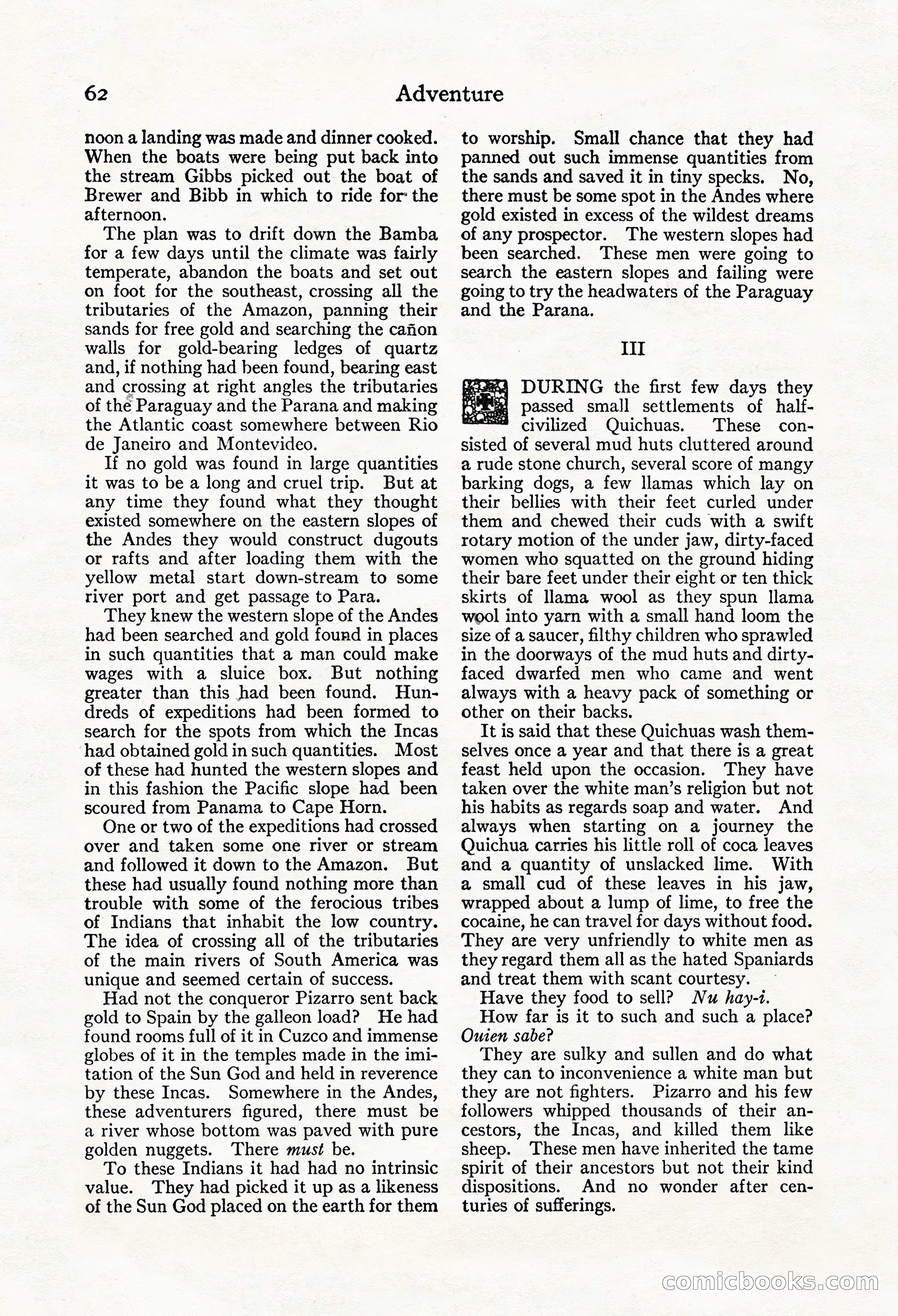
A restored page from Pulp Fiction, 1917. Page through the whole issue in the reader above.
📄 Transcribed text from this page (OCR, searchable)
Machine-transcribed from the original scan — historical spelling and the odd misread are preserved.
62 noon a landing was made and dinner cooked. When the boats were being put back into the stream Gibbs picked out the boat of Brewer and Bibb in which to ride for the afternoon. The plan was to drift down the Bamba for a few days until the climate was fairly temperate, abandon the boats and set out on foot for the southeast, crossing all the tributaries of the Amazon, panning their sands for free gold and searching the cafion walls for gold-bearing ledges of quartz and, if nothing had been found, bearing east and crossing at right angles the tributaries of the Paraguay and the Parana and making the Atlantic coast somewhere between Rio de Janeiro and Montevideo. If no gold was found in large quantities it was to be a long and cruel trip. But at any time they found what they thought existed somewhere on the eastern slopes of the Andes they would construct dugouts or rafts and after loading them with the yellow metal start down-stream to some river port and get passage to Para. They knew the western slope of the Andes had been searched and gold found in places in such quantities that a man could make wages with a sluice box. But nothing greater than this had been found. Hun- dreds of expeditions had been formed to search for the spots from which the Incas ‘had obtained gold in such quantities. Most of these had hunted the western slopes and in this fashion the Pacific slope had been scoured from Panama to Cape Horn. One or two of the expeditions had crossed over and taken some one river or stream and followed it down to the Amazon. But these had usually found nothing more than trouble with some of the ferocious tribes of Indians that inhabit the low country. The idea of crossing all of the tributaries of the main rivers of South America was unique and seemed certain of success. Had not the conqueror Pizarro sent back gold to Spain by the galleon load? He had found rooms full of it in Cuzco and immense globes of it in the temples made in the imi- tation of the Sun God and held in reverence by these Incas. Somewhere in the Andes, these adventurers figured, there must be a river whose bottom was paved with pure golden nuggets. There must be. To these Indians it had had no intrinsic value. They had picked it up as a likeness of the Sun God placed on the earth for them Adventure to worship. Small chance that they had panned out such immense quantities from the sands and saved it in tiny specks. No, there must be some spot in the Andes where gold existed in excess of the wildest dreams of any prospector. The western slopes had been searched. These men were going to search the eastern slopes and failing were going to try the headwaters of the Paraguay and the Parana. III a Re) passed small settlements of half- me! civilized Quichuas. These con- sisted of several mud huts cluttered around a rude stone church, several score of mangy barking dogs, a few llamas which lay on their bellies with their feet curled under them and chewed their cuds with a swift rotary motion of the under jaw, dirty-faced women who squatted on the ground hiding their bare feet under their eight or ten thick skirts of llama wool as they spun llama wool into yarn with a small hand loom the size of a saucer, filthy children who sprawled in the doorways of the mud huts and dirty- faced dwarfed men who came and went always with a heavy pack of something or other on their backs. It is said that these Quichuas wash them- selves once a year and that there is a great feast held upon the occasion. They have taken over the white man’s religion but not his habits as regards soap and water. And always when starting on a journey the Quichua carries his little roll of coca leaves and a quantity of unslacked lime. With a small cud of these leaves in his jaw, wrapped about a lump of lime, to free the cocaine, he can travel for days without food. They are very unfriendly to white men as they regard them all as the hated Spaniards and treat them with scant courtesy. Have they food to sell? Nu hay-t. How far is it to such and such a place? Ouien sabe? They are sulky and sullen and do what they can to inconvenience a white man but they are not fighters. Pizarro and his few followers whipped thousands of their an- cestors, the Incas, and killed them like sheep. ‘These men have inherited the tame spirit of their ancestors but not their kind dispositions. And no wonder after cen- turies of sufferings. COMmiclsoo C©