
Pulp Fiction, 1917 · page 186 of 196
Adventure Magazine, Mid-September 1917 — page 186: what you’re looking at
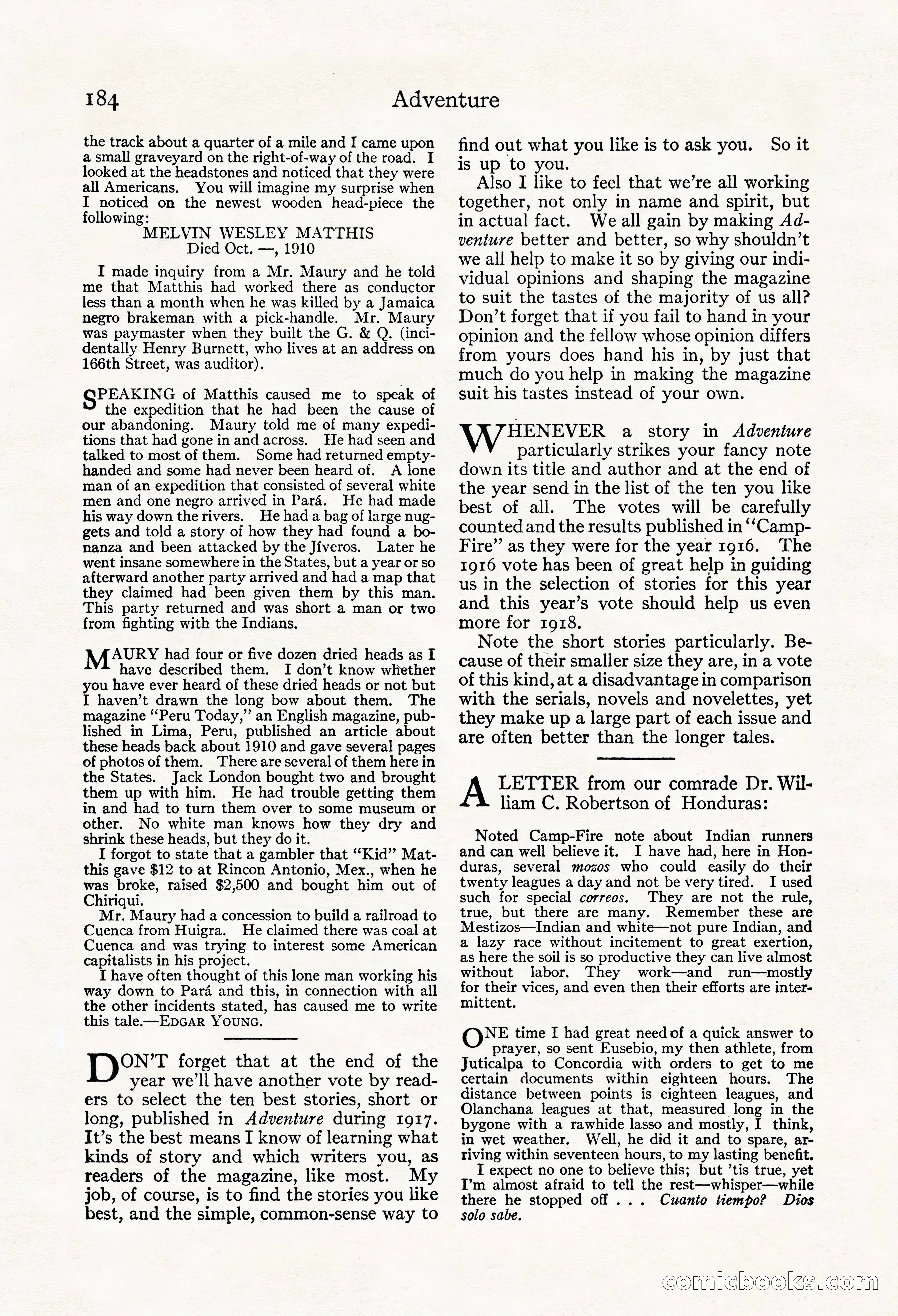
A restored page from Pulp Fiction, 1917. Page through the whole issue in the reader above.
📄 Transcribed text from this page (OCR, searchable)
Machine-transcribed from the original scan — historical spelling and the odd misread are preserved.
184 the track about a quarter of a mile and I came upon a small graveyard on the right-of-way of the road. I looked at the headstones and noticed that they were all Americans. You will imagine my surprise when I noticed on the newest wooden head-piece the following: MELVIN WESLEY MATTHIS Died Oct. —, 1910 I made inquiry from a Mr. Maury and he told me that Matthis had worked there as conductor less than a month when he was killed by a Jamaica negro brakeman with a pick-handle. Mr. Maury was paymaster when they built the G. & Q. (inci- dentally Henry Burnett, who lives at an address on 166th Street, was auditor). GPEAKING of Matthis caused me to speak of the expedition that he had been the cause of our abandoning. Maury told me of many expedi- tions that had gone in and across. He had seen and talked to most of them. Some had returned empty- handed and some had never been heard of. A lone man of an expedition that consisted of several white men and one negro arrived in Para. He had made his way down therivers. He had a bag of large nug- gets and told a story of how they had found a bo- nanza and been attacked by the Jiveros. Later he went insane somewhere in the States, but a year or so afterward another party arrived and had a map that they claimed had been given them by this man. This party returned and was short a man or two from fighting with the Indians. MAavRY had four or five dozen dried heads as I have described them. I don’t know whether you have ever heard of these dried heads or not but I haven’t drawn the long bow about them. The magazine ‘“‘Peru Today,” an English magazine, pub- lished in Lima, Peru, published an article about these heads back about 1910 and gave several pages of photos of them. There are several of them here in the States. Jack London bought two and brought them up with him. He had trouble getting them in and had to turn them over to some museum or other. No white man knows how they dry and shrink these heads, but they do it. I forgot to state that a gambler that “Kid” Mat- this gave $12 to at Rincon Antonio, Mex., when he was broke, raised $2,500 and bought him out of Chiriqui. Mr. Maury had a concession to build a railroad to Cuenca from Huigra. He claimed there was coal at Cuenca and was trying to interest some American capitalists in his project. I have often thought of this lone man working his way down to Para and this, in connection with all the other incidents stated, has caused me to write this tale-—EDGAR YOUNG. ON’T forget that at the end of the year we'll have another vote by read- ers to select the ten best stories, short or long, published in Adventure during 1917. It’s the best means I know of learning what kinds of story and which writers you, as readers of the magazine, like most. My job, of course, is to find the stories you like best, and the simple, common-sense way to Adventure find out what you like is to ask you. So it is up to you. Also I like to feel that we’re all working together, not only in name and spirit, but in actual fact. Weall gain by making Ad- venture better and better, so why shouldn’t we all help to make it so by giving our indi- vidual opinions and shaping the magazine to suit the tastes of the majority of us all? Don’t forget that if you fail to hand in your opinion and the fellow whose opinion differs from yours does hand his in, by just that much do you help in making the magazine suit his tastes instead of your own. VV BENEVER a story in Adventure particularly strikes your fancy note down its title and author and at the end of the year send in the list of the ten you like best of all. The votes will be carefully counted and the results published in ‘‘Camp- Fire” as they were for the year 1916. ‘The 1916 vote has been of great help in guiding us in the selection of stories for this year and this year’s vote should help us even more for 1918. Note the short stories particularly. Be- cause of their smaller size they are, in a vote of this kind, at a disadvantage in comparison with the serials, novels and novelettes, yet they make up a large part of each issue and are often better than the longer tales. LETTER from our comrade Dr. Wil- liam C. Robertson of Honduras: Noted Camp-Fire note about Indian runners and can well believe it. I have had, here in Hon- duras, several mozos who could easily do their twenty leagues a day and not be very tired. I used such for special correos. They are not the rule, true, but there are many. Remember these are Mestizos—Indian and white—not pure Indian, and a lazy race without incitement to great exertion, as here the soil is so productive they can live almost without labor. They work—and run—mostly for their vices, and even then their efforts are inter- mittent. ONE time I had great need of a quick answer to prayer, so sent Eusebio, my then athlete, from Juticalpa to Concordia with orders to get to me certain documents within eighteen hours. The distance between points is eighteen leagues, and Olanchana leagues at that, measured long in the bygone with a rawhide lasso and mostly, I think, in wet weather. Well, he did it and to spare, ar- riving within seventeen hours, to my lasting benefit. I expect no one to believe this; but ’tis true, yet I’m almost afraid to tell the rest—whisper—while there he stopped off ... Cuanto tiempo? Dios solo sabe. COmilcbookxs.conn