
Pulp Fiction, 1917 · page 185 of 196
Adventure Magazine, Mid-September 1917 — page 185: what you’re looking at
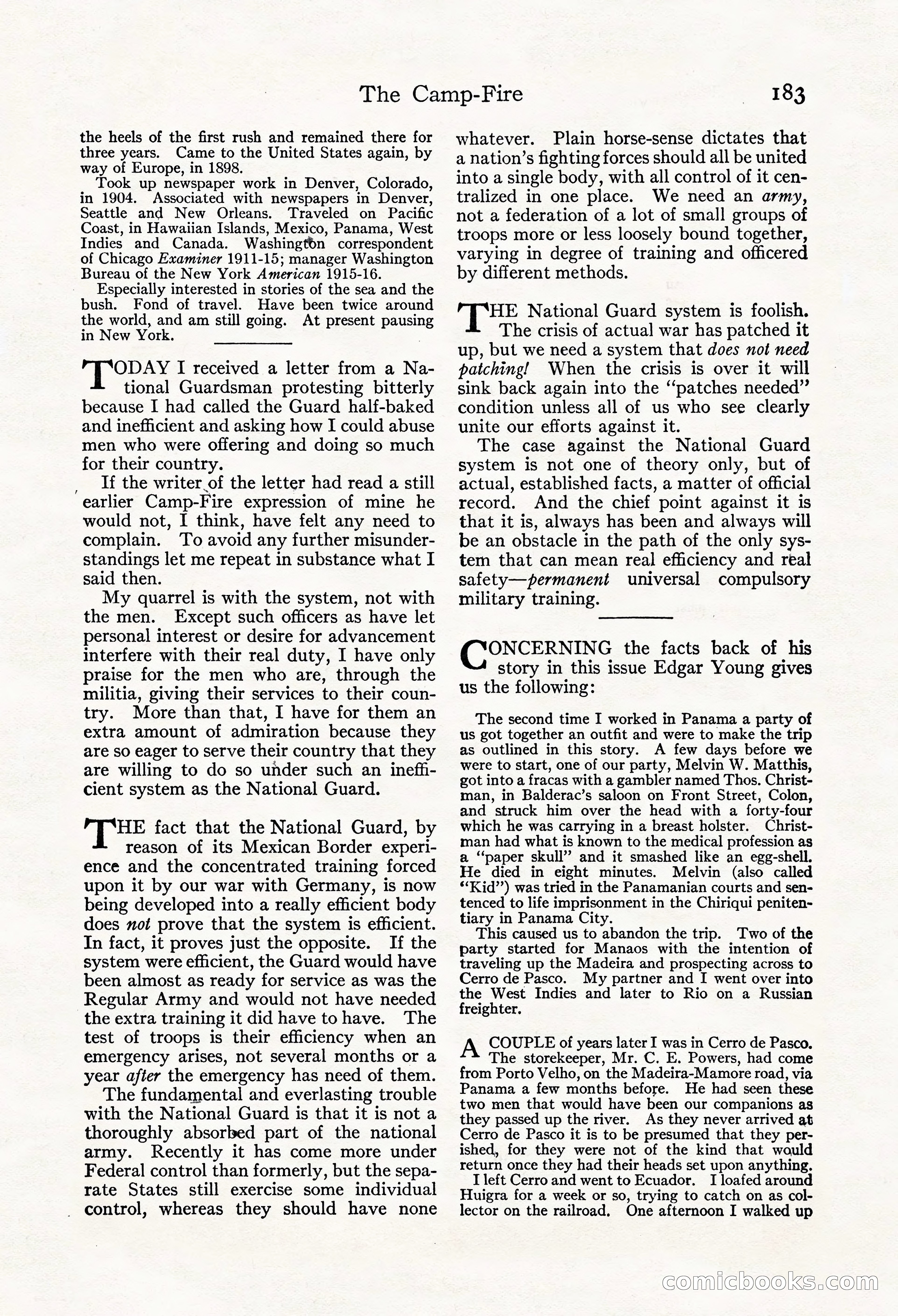
A restored page from Pulp Fiction, 1917. Page through the whole issue in the reader above.
📄 Transcribed text from this page (OCR, searchable)
Machine-transcribed from the original scan — historical spelling and the odd misread are preserved.
The Camp-Fire the heels of the first rush and remained there for three years. Came to the United States again, by way of Europe, in 1898. Took up newspaper work in Denver, Colorado, in 1904. Associated with newspapers in Denver, Seattle and New Orleans. Traveled on Pacific Coast, in Hawaiian Islands, Mexico, Panama, West Indies and Canada. Washington correspondent of Chicago Examiner 1911-15; manager Washington Bureau of the New York American 1915-16. Especially interested in stories of the sea and the bush. Fond of travel. Have been twice around the world, and am still going. At present pausing in New York. ODAY I received a letter from a Na- tional Guardsman protesting bitterly because I had called the Guard half-baked and inefficient and asking how I could abuse men who were offering and doing so much for their country. _ If the writer of the letter had read a still earlier Camp-Fire expression of mine he would not, I think, have felt any need to complain. ‘To avoid any further misunder- standings let me repeat in substance what I said then. My quarrel is with the system, not with the men. Except such officers as have let personal interest or desire for advancement interfere with their real duty, I have only praise for the men who are, through the militia, giving their services to their coun- try. More than that, I have for them an extra amount of admiration because they are so eager to serve their country that they are willing to do so under such an inefh- cient system as the National Guard. ‘THE fact that the National Guard, by reason of its Mexican Border experi- ence and the concentrated training forced upon it by our war with Germany, is now being developed into a really efficient body does not prove that the system is efficient. In fact, it proves just the opposite. If the system were efficient, the Guard would have been almost as ready for service as was the Regular Army and would not have needed the extra training it did have tohave. The test of troops is their efficiency when an emergency arises, not several months or a year after the emergency has need of them. The fundamental and everlasting trouble with the National Guard is that it is not a thoroughly absorbed part of the national army. Recently it has come more under Federal control than formerly, but the sepa- rate States still exercise some individual control, whereas they should have none 183 whatever. Plain horse-sense dictates that a nation’s fighting forces should all be united into a single body, with all control of it cen- tralized in one place. We need an army, not a federation of a lot of small groups of troops more or less loosely bound together, varying in degree of training and officered by different methods. jou National Guard system is foolish. The crisis of actual war has patched it up, but we need a system that does not need patching! When the crisis is over it will sink back again into the ‘‘patches needed”’ condition unless all of us who see clearly unite our efforts against it. The case against the National Guard system is not one of theory only, but of actual, established facts, a matter of official record. And the chief point against it is that it is, always has been and always will be an obstacle in the path of the only sys- tern that can mean real efficiency and real safety—permanent universal compulsory military training. ONCERNING the facts back of his story in this issue Edgar Young gives us the following: The second time I worked in Panama a party of us got together an outfit and were to make the trip as outlined in this story. A few days before we were to start, one of our party, Melvin W. Matthis, got into a fracas with a gambler named Thos. Christ- man, in Balderac’s saloon on Front Street, Colon, and struck him over the head with a forty-four which he was carrying in a breast holster. Christ- man had what is known to the medical profession as a “paper skull” and it smashed like an egg-shell. He died in eight minutes. Melvin (also called *‘Kid’’) was tried in the Panamanian courts and sen- tenced to life imprisonment in the Chiriqu! peniten- tiary in Panama City. This caused us to abandon the trip. Two of the party started for Manaos with the intention of traveling up the Madeira and prospecting across to Cerro de Pasco. My partner and I went over into the West Indies and later to Rio on a Russian freighter. A COUPLE of years later I was in Cerro de Pasco. The storekeeper, Mr. C. E. Powers, had come from Porto Velho, on the Madeira-Mamore road, via Panama a few months before. He had seen these two men that would have been our companions as they passed up the river. As they never arrived at Cerro de Pasco it is to be presumed that they per- ished, for they were not of the kind that would return once they had their heads set upon anything. I left Cerro and went to Ecuador. I loafed around Huigra for a week or so, trying to catch on as col- lector on the railroad. One afternoon I walked up Clo@@