
Pulp Fiction, 1917 · page 132 of 196
Adventure Magazine, Mid-September 1917 — page 132: what you’re looking at
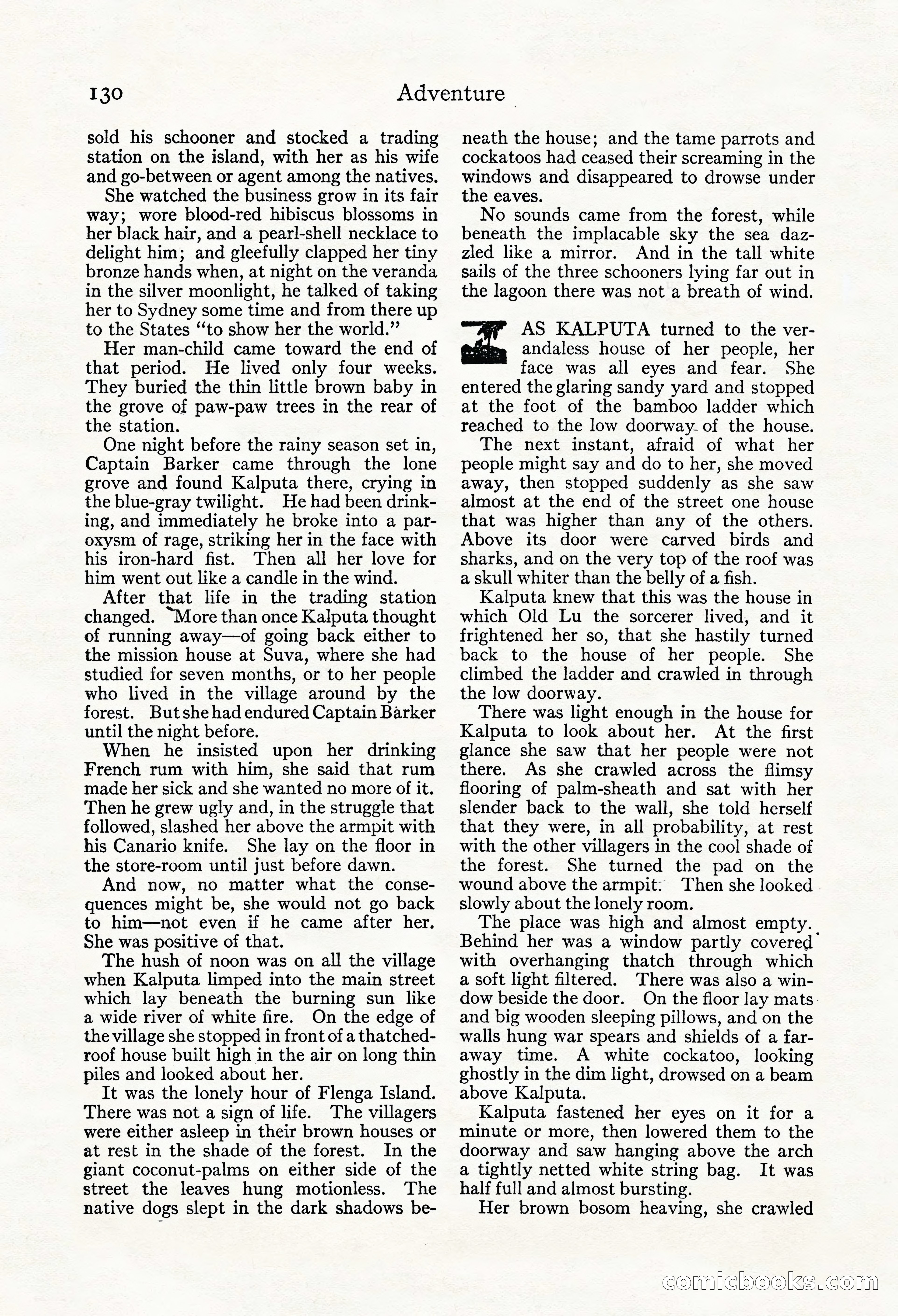
A restored page from Pulp Fiction, 1917. Page through the whole issue in the reader above.
📄 Transcribed text from this page (OCR, searchable)
Machine-transcribed from the original scan — historical spelling and the odd misread are preserved.
130 sold his schooner and stocked a trading station on the island, with her as his wife and go-between or agent among the natives. She watched the business grow in its fair way; wore blood-red hibiscus blossoms in her black hair, and a pearl-shell necklace to delight him; and gleefully clapped her tiny bronze hands when, at night on the veranda in the silver moonlight, he talked of taking her to Sydney some time and from there up to the States ‘‘to show her the world.” Her man-child came toward the end of that period. He lived only four weeks. They buried the thin little brown baby in the grove of paw-paw trees in the rear of the station. One night before the rainy season set in, Captain Barker came through the lone grove and found Kalputa there, crying in the blue-gray twilight. He had been drink- ing, and immediately he broke into a par- oxysm of rage, striking her in the face with his iron-hard fist. Then all her love for him went out like a candle in the wind. After that life in the trading station changed. ~More than once Kalputa thought of running away—of going back either to the mission house at Suva, where she had studied for seven months, or to her people who lived in the village around by the forest. Butshehad endured Captain Barker until the night before. When he insisted upon her drinking French rum with him, she said that rum made her sick and she wanted no more of it. Then he grew ugly and, in the struggle that followed, slashed her above the armpit with his Canario knife. She lay on the floor in the store-room until just before dawn. And now, no matter what the conse- quences might be, she would not go back to him—not even if he came after her. She was positive of that. The hush of noon was on all the village when Kalputa limped into the main street which lay beneath the burning sun like a wide river of white fire. On the edge of the village she stopped in front of a thatched- roof house built high in the air on long thin piles and looked about her. It was the lonely hour of Flenga Island. There was not a sign of life. The villagers were either asleep in their brown houses or at rest in the shade of the forest. In the giant coconut-palms on either side of the street the leaves hung motionless. The native dogs slept in the dark shadows be- Adventure - neath the house; and the tame parrots and cockatoos had ceased their screaming in the windows and disappeared to drowse under the eaves. No sounds came from the forest, while beneath the implacable sky the sea daz- zled like a mirror. sails of the three schooners lying far out in the lagoon there was not a breath of wind. AS KALPUTA turned to the ver- andaless house of her people, her face was all eyes and fear. She entered the glaring sandy yard and stopped at the foot of the bamboo ladder which reached to the low doorway- of the house. The next instant, afraid of what her people might say and do to her, she moved away, then stopped suddenly as she saw almost at the end of the street one house that was higher than any of the others. Above its door were carved birds and sharks, and on the very top of the roof was a skull whiter than the belly of a fish. Kalputa knew that this was the house in which Old Lu the sorcerer lived, and it frightened her so, that she hastily turned back to the house of her people. She climbed the ladder and crawled in through the low doorway. There was light enough in the house for Kalputa to look about her. At the first glance she saw that her people were not there. As she crawled across the flimsy flooring of palm-sheath and sat with her slender back to the wall, she told herself that they were, in all probability, at rest with the other villagers in the cool shade of the forest. She turned the pad on the wound above the armpit: Then she looked slowly about the lonely room. The place was high and almost empty. Behind her was a window partly covered’ with overhanging thatch through which a soft light filtered. There was also a win- dow beside the door. and big wooden sleeping pillows, and on the walls hung war spears and shields of a far- away time. A white cockatoo, looking ghostly in the dim light, drowsed on a beam above Kalputa. Kalputa fastened her eyes on it for a minute or more, then lowered them to the doorway and saw hanging above the arch a tightly netted white string bag. It was half full and almost bursting. Her brown bosom heaving, she crawled CoOMmiclsoo On the floor lay mats: And in the tall white | ©