
Pulp Fiction, 1917 · page 131 of 196
Adventure Magazine, Mid-September 1917 — page 131: what you’re looking at
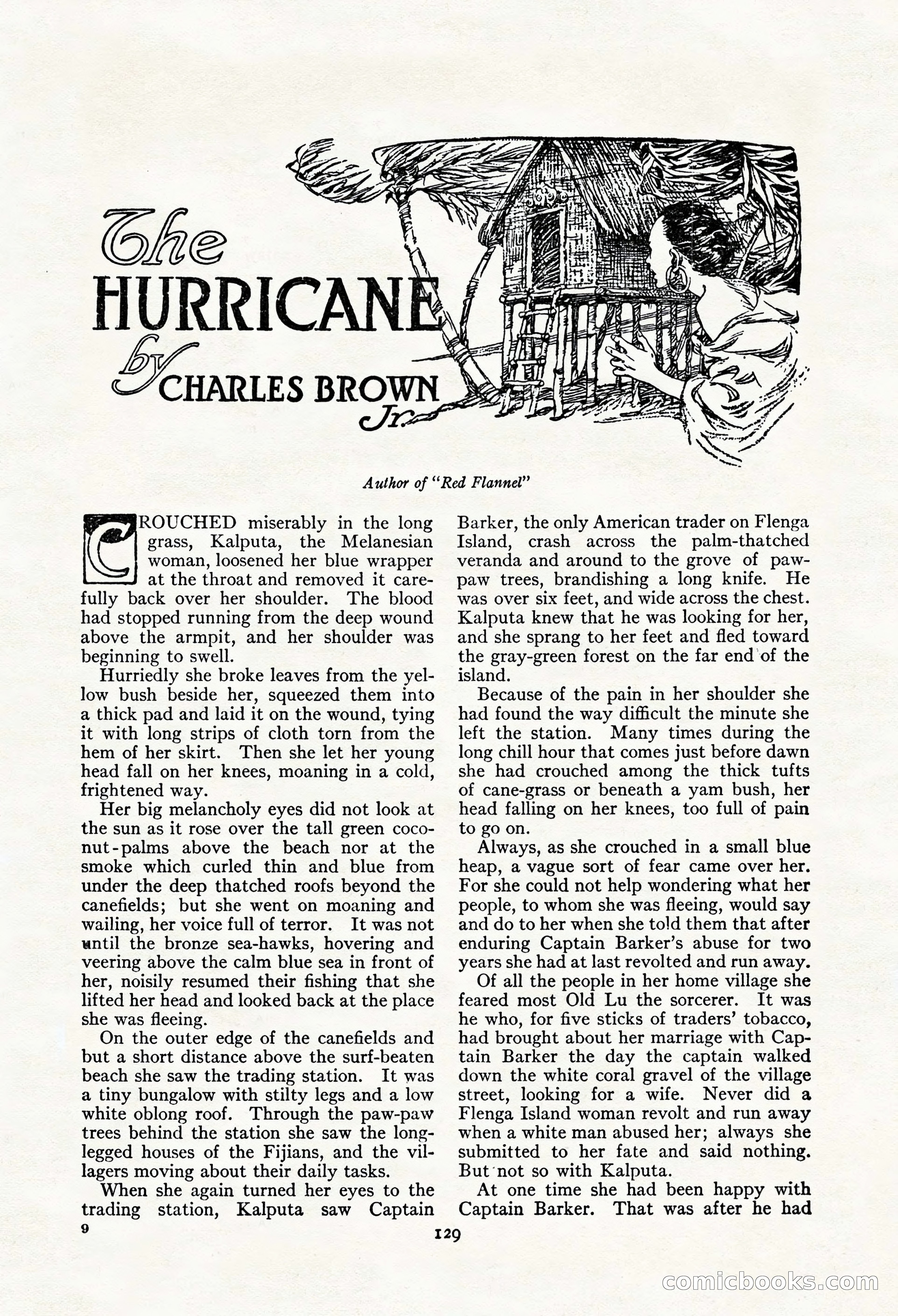
A restored page from Pulp Fiction, 1917. Page through the whole issue in the reader above.
📄 Transcribed text from this page (OCR, searchable)
Machine-transcribed from the original scan — historical spelling and the odd misread are preserved.
ohe i URRICANI Y IG, CHARLES BROWN. Tat” “Os AM i NN Al © CRRA OLY G Ly > AZ ae _{\ “4 ata x ~ 4 \ “ae » § I | 3502S woth Sn ho SS aN ; sf A i f J 3 [3 v \ \) v eZ iI Author of ‘‘Red Flannel” ROUCHED miserably in the long grass, Kalputa, the Melanesian woman, loosened her blue wrapper at the throat and removed it care- fully back over her shoulder. The blood had stopped running from the deep wound above the armpit, and her shoulder was beginning to swell. Hurriedly she broke leaves from the yel- low bush beside her, squeezed them into a thick pad and laid it on the wound, tying it with long strips of cloth torn from the hem of her skirt. Then she let her young head fall on her knees, moaning in a cold, frightened way. Her big melancholy eyes did not look at the sun as it rose over the tall green coco- nut-palms above the beach nor at the smoke which curled thin and blue from under the deep thatched roofs beyond the canefields; but she went on moaning and wailing, her voice full of terror. It was not until the bronze sea-hawks, hovering and veering above the calm blue sea in front of her, noisily resumed their fishing that she lifted her head and looked back at the place she was fleeing. On the outer edge of the canefields and but a short distance above the surf-beaten beach she saw the trading station. It was a tiny bungalow with stilty legs and a low white oblong roof. Through the paw-paw trees behind the station she saw the long- legged houses of the Fijians, and the vil- lagers moving about their daily tasks. When she again turned her eyes to the trading station, Kalputa saw Captain 9 Barker, the only American trader on Flenga Island, crash across the palm-thatched veranda and around to the grove of paw- paw trees, brandishing a long knife. He was over six feet, and wide across the chest. Kalputa knew that he was looking for her, and she sprang to her feet and fled toward the gray-green forest on the far end’of the island. Because of the pain in her shoulder she had found the way difficult the minute she left the station. Many times during the long chill hour that comes just before dawn she had crouched among the thick tufts of cane-grass or beneath a yam bush, her head falling on her knees, too full of pain to go on. Always, as she crouched in a small blue heap, a vague sort of fear came over her. For she could not help wondering what her people, to whom she was fleeing, would say and do to her when she told them that after enduring Captain Barker’s abuse for two years she had at last revolted and run away. Of all the people in her home village she feared most Old Lu the sorcerer. It was he who, for five sticks of traders’ tobacco, had brought about her marriage with Cap- tain Barker the day the captain walked down the white coral gravel of the village street, looking for a wife. Never did a Flenga Island woman revolt and run away when a white man abused her; always she submitted to her fate and said nothing. But not so with Kalputa. At one time she had been happy with Captain Barker. That was after he had 129 COmicloo (©