
Pulp Fiction, 1917 · page 127 of 196
Adventure Magazine, Mid-September 1917 — page 127: what you’re looking at
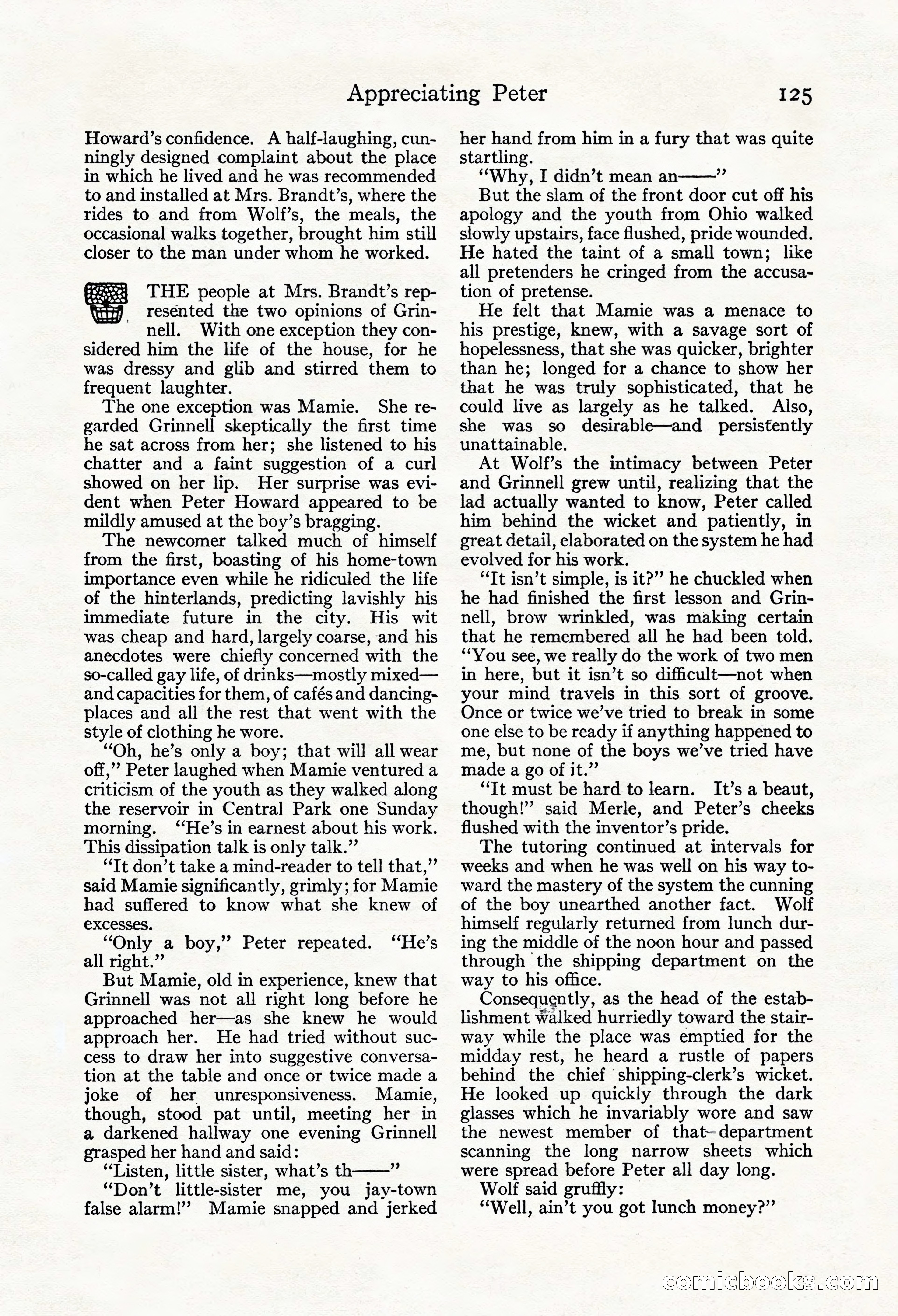
A restored page from Pulp Fiction, 1917. Page through the whole issue in the reader above.
📄 Transcribed text from this page (OCR, searchable)
Machine-transcribed from the original scan — historical spelling and the odd misread are preserved.
Appreciating Peter Howard’s confidence. A half-laughing, cun- ningly designed complaint about the place in which he lived and he was recommended to and installed at Mrs. Brandt’s, where the rides to and from Wolf’s, the meals, the occasional walks together, brought him still closer to the man under whom he worked. THE people at Mrs. Brandt’s rep- resented the two opinions of Grin- nell. With one exception they con- sidered him the life of the house, for he was dressy and glib and stirred them to frequent laughter. The one exception was Mamie. She re- garded Grinnell skeptically the first time he sat across from her; she listened to his chatter and a faint suggestion of a curl showed on her lip. Her surprise was evi- dent when Peter Howard appeared to be mildly amused at the boy’s bragging. The newcomer talked much of himself from the first, boasting of his home-town importance even while he ridiculed the life of the hinterlands, predicting lavishly his immediate future in the city. His wit was cheap and hard, largely coarse, and his anecdotes were chiefly concerned with the so-called gay life, of drinks—mostly mixed— and capacities for them, of cafés and dancing- places and all the rest that went with the style of clothing he wore. “Oh, he’s only a boy; that will all wear off,” Peter laughed when Mamie ventured a criticism of the youth as they walked along the reservoir in Central Park one Sunday morning. “He’s in earnest about his work. This dissipation talk is only talk.”’ “It don’t take a mind-reader to tell that,” said Mamie significantly, grimly; for Mamie had suffered to know what she knew of excesses. “Only a boy,” Peter repeated. all right.” But Mamie, old in experience, knew that Grinnell was not all right long before he approached her—as she knew he would approach her. He had tried without suc- cess to draw her into suggestive conversa- tion at the table and once or twice made a joke of her unresponsiveness. Mamie, though, stood pat until, meeting her in a darkened hallway one evening Grinnell grasped her hand and said: ‘Listen, little sister, what’s th $3 “Don’t little-sister me, you jay-town false alarm!’’ Mamie snapped and jerked ““He’s 125 her hand from him in a fury that was quite startling. “Why, I didn’t mean an——”’ But the slam of the front door cut off his apology and the youth from Ohio walked slowly upstairs, face flushed, pride wounded. He hated the taint of a small town; like all pretenders he cringed from the accusa- tion of pretense. He felt that Mamie was a menace to his prestige, knew, with a savage sort of hopelessness, that she was quicker, brighter than he; longed for a chance to show her that he was truly sophisticated, that he could live as largely as he talked. Also, she was so desirable—and persistently unattainable. | At Wolf’s the intimacy between Peter and Grinnell grew until, realizing that the lad actually wanted to know, Peter called him behind the wicket and patiently, in great detail, elaborated on the system he had evolved for his work. “Tt isn’t simple, is it?’’ he chuckled when he had finished the first lesson and Grin- nell, brow wrinkled, was making certain that he remembered all he had been told. ‘“You see, we really do the work of two men in here, but it isn’t so diffcult—not when your mind travels in this sort of groove. Once or twice we’ve tried to break in some one else to be ready if anything happened to me, but none of the boys we’ve tried have made a go of it.” “Tt must be hard to learn. It’s a beaut, though!”’ said Merle, and Peter’s cheeks flushed with the inventor’s pride. The tutoring continued at intervals for weeks and when he was well on his way to- ward the mastery of the system the cunning of the boy unearthed another fact. Wolf himself regularly returned from lunch dur- ing the middle of the noon hour and passed through the shipping department on the way to his office. Consequently, as the head of the estab- lishment walked hurriedly toward the stair- way while the place was emptied for the midday rest, he heard a rustle of papers behind the chief shipping-clerk’s wicket. He looked up quickly through the dark glasses which he invariably wore and saw the newest member of that- department scanning the long narrow sheets which were spread before Peter all day long. Wolf said gruffly: — “Well, ain’t you got lunch money?” COmicloo ©