
Pulp Fiction, 1917 · page 126 of 196
Adventure Magazine, Mid-September 1917 — page 126: what you’re looking at
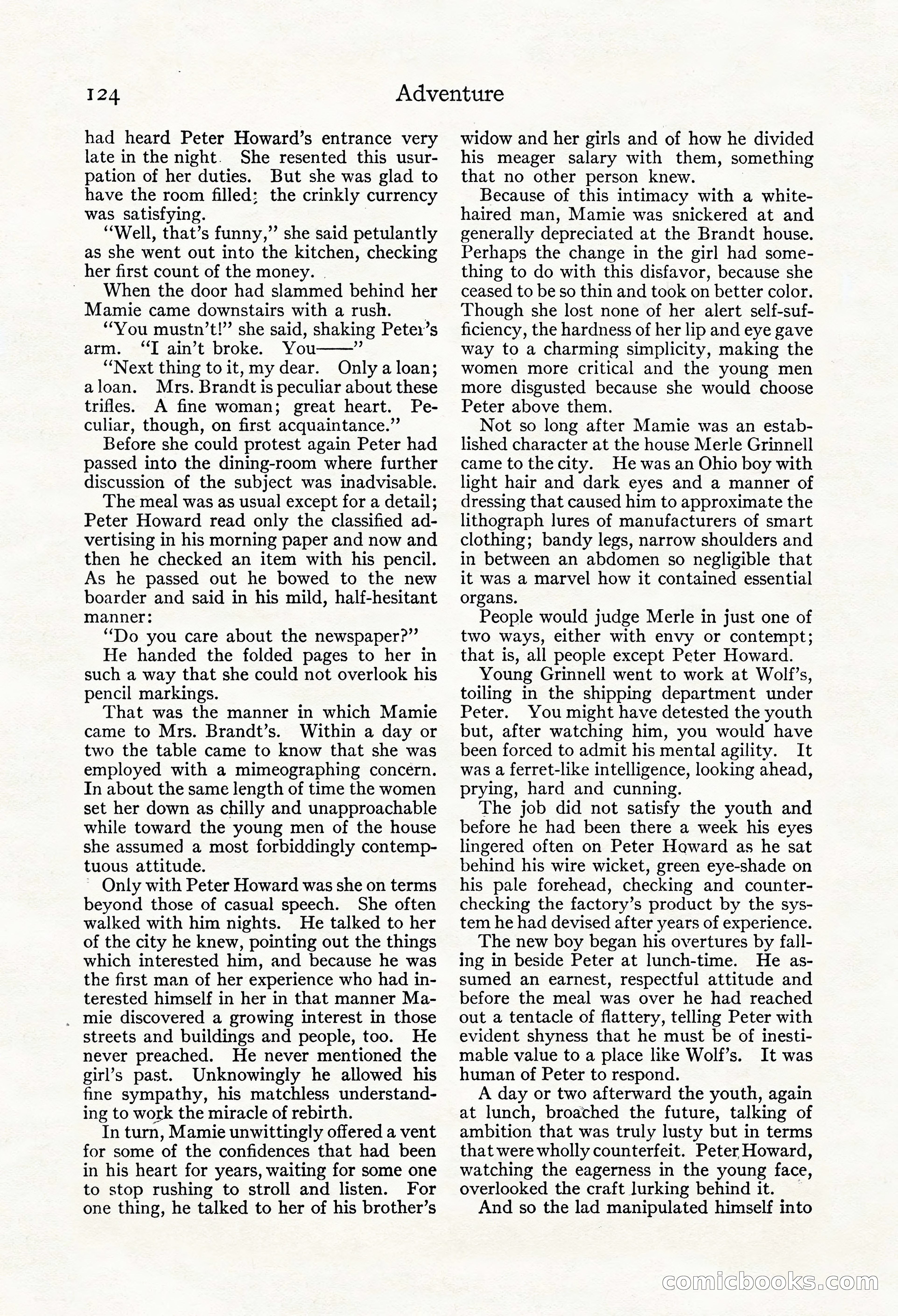
A restored page from Pulp Fiction, 1917. Page through the whole issue in the reader above.
📄 Transcribed text from this page (OCR, searchable)
Machine-transcribed from the original scan — historical spelling and the odd misread are preserved.
124 had heard Peter Howard’s entrance very late in the night. She resented this usur- pation of her duties. But she was glad to have the room filled; the crinkly currency was Satisfying. ‘Well, that’s funny,” she said petulantly as she went out into the kitchen, checking her first count of the money. | When the door had slammed behind her Mamie came downstairs with arush. ‘You mustn’t!” she said, shaking Peter’s arm. “TI ain’t broke. You——” “Next thing toit, my dear. Only a loan; aloan. Mrs. Brandt is peculiar about these trifles. A fine woman; great heart. Pe- culiar, though, on first acquaintance.”’ Before she could protest again Peter had passed into the dining-room where further discussion of the subject was inadvisable. The meal was as usual except for a detail; Peter Howard read only the classified ad- vertising in his morning paper and now and then he checked an item with his pencil. As he passed out he bowed to the new boarder and said in his mild, half-hesitant manner: “Do you care about the newspaper?” He handed the folded pages to her in such a way that she could not overlook his pencil markings. That was the manner in which Mamie came to Mrs. Brandt’s. Within a day or two the table came to know that she was employed with a mimeographing concern. In about the same length of time the women set her down as chilly and unapproachable while toward the young men of the house she assumed a most forbiddingly contemp- tuous attitude. ~ Only with Peter Howard was she on terms beyond those of casual speech. She often walked with him nights. He talked to her of the city he knew, pointing out the things which interested him, and because he was the first man of her experience who had in- terested himself in her in that manner Ma- _ Iie discovered a growing interest in those streets and buildings and people, too. He never preached. He never mentioned the girl’s past. Unknowingly he allowed his fine sympathy, his matchless understand- ing to work the miracle of rebirth. In turn, Mamie unwittingly offered a vent for some of the confidences that had been in his heart for years, waiting for some one to stop rushing to stroll and listen. For one thing, he talked to her of his brother’s Adventure widow and her girls and of how he divided his meager salary with them, something that no other person knew. Because of this intimacy with a white- haired man, Mamie was snickered at and generally depreciated at the Brandt house. Perhaps the change in the girl had some- thing to do with this disfavor, because she ceased to be so thin and took on better color. Though she lost none of her alert self-suf- ficiency, the hardness of her lip and eye gave way to a charming simplicity, making the women more critical and the young men more disgusted because she would choose Peter above them. Not so long after Mamie was an estab- lished character at the house Merle Grinnell came to the city. He was an Ohio boy with light hair and dark eyes and a manner of dressing that caused him to approximate the lithograph lures of manufacturers of smart clothing; bandy legs, narrow shoulders and in between an abdomen so negligible that it was a marvel how it contained essential organs. People would judge Merle in just one of two ways, either with envy or contempt; that is, all people except Peter Howard. Young Grinnell went to work at Wolf’s, toiling in the shipping department under Peter. You might have detested the youth but, after watching him, you would have been forced to admit his mental agility. It was a ferret-like intelligence, looking ahead, prying, hard and cunning. The job did not satisfy the youth and before he had been there a week his eyes lingered often on Peter Howard as he sat behind his wire wicket, green eye-shade on his pale forehead, checking and counter- checking the factory’s product by the sys- tem he had devised after years of experience. The new boy began his overtures by fall- ing in beside Peter at lunch-time. He as- sumed an earnest, respectful attitude and before the meal was over he had reached out a tentacle of flattery, telling Peter with evident shyness that he must be of inesti- mable value to a place like Wolf’s. It was human of Peter to respond. A day or two afterward the youth, again at lunch, broached the future, talking of ambition that was truly lusty but in terms that were wholly counterfeit. Peter Howard, watching the eagerness in the young face, overlooked the craft lurking behind it. And so the lad manipulated himself into CoOMmiclsoo (©