
Pulp Fiction, 1917 · page 124 of 196
Adventure Magazine, Mid-September 1917 — page 124: what you’re looking at
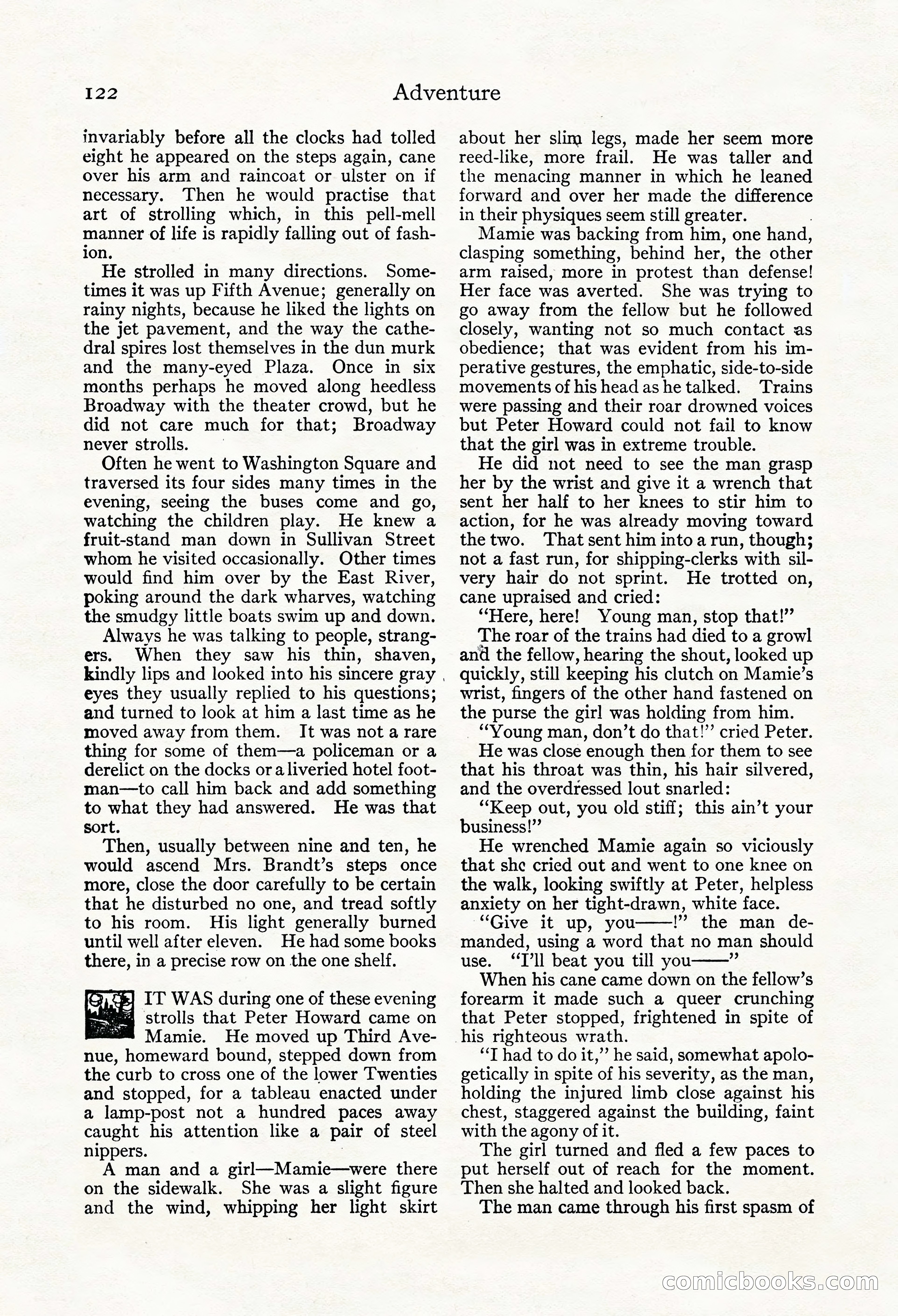
A restored page from Pulp Fiction, 1917. Page through the whole issue in the reader above.
📄 Transcribed text from this page (OCR, searchable)
Machine-transcribed from the original scan — historical spelling and the odd misread are preserved.
I22 invariably before all the clocks had tolled eight he appeared on the steps again, cane over his arm and raincoat or ulster on if necessary. Then he would practise that art of strolling which, in this pell-mell manner of life is rapidly falling out of fash- ion. He strolled in many directions. Some- times it was up Fifth Avenue; generally on rainy nights, because he liked the lights on the jet pavement, and the way the cathe- dral spires lost themselves in the dun murk and the many-eyed Plaza. Once in six months perhaps he moved along heedless Broadway with the theater crowd, but he did not care much for that; Broadway never strolls. Often he went to Washington Square and traversed its four sides many times in the evening, seeing the buses come and go, watching the children play. He knew a fruit-stand man down in Sullivan Street whom he visited occasionally. Other times would find him over by the East River, poking around the dark wharves, watching the smudgy little boats swim up and down. Always he was talking to people, strang- ers. When they saw his thin, shaven, kindly lips and looked into his sincere gray , eyes they usually replied to his questions; and turned to look at him a last time as he moved away from them. It was not a rare thing for some of them—a policeman or a derelict on the docks oraliveried hotel foot- man—to call him back and add something to what they had answered. He was that sort. Then, usually between nine and ten, he would ascend Mrs. Brandt’s steps once more, Close the door carefully to be certain that he disturbed no one, and tread softly to his room. His light generally burned until well after eleven. He had some books there, in a precise row on the one shelf. aie? IT WAS during one of these evening “em strolls that Peter Howard came on “e886 Mamie. He moved up Third Ave- nue, homeward bound, stepped down from the curb to cross one of the lower Twenties and stopped, for a tableau enacted under a lamp-post not a hundred paces away caught his attention like a pair of steel nippers. A man and a girl—Mamie—were there on the sidewalk. She was a slight figure and the wind, whipping her light skirt Adventure about her slim legs, made her seem more reed-like, more frail. He was taller and the menacing manner in which he leaned forward and over her made the difference in their physiques seem still greater. | Mamie was backing from him, one hand, clasping something, behind her, the other arm raised, more in protest than defense! Her face was averted. She was trying to go away from the fellow but he followed closely, wanting not so much contact as obedience; that was evident from his im- perative gestures, the emphatic, side-to-side movements of his head as he talked. Trains were passing and their roar drowned voices but Peter Howard could not fail to know that the girl was in extreme trouble. He did not need to see the man grasp her by the wrist and give it a wrench that sent her half to her knees to stir him to action, for he was already moving toward the two. That sent him into a run, though; not a fast run, for shipping-clerks with sil- very hair do not sprint. He trotted on, cane upraised and cried: “Here, here! Young man, stop that!” The roar of the trains had died to a growl and the fellow, hearing the shout, looked up quickly, still keeping his clutch on Mamie’s wrist, fingers of the other hand fastened on the purse the girl was holding from him. _ “Young man, don’t do that!” cried Peter. He was close enough then for them to see that his throat was thin, his hair silvered, and the overdressed lout snarled: *“‘Keep out, you old stiff; this ain’t your business!”’ He wrenched Mamie again so viciously that she cried out and went to one knee on the walk, looking swiftly at Peter, helpless anxiety on her tight-drawn, white face. “Give it up, you !’ the man de- manded, using a word that no man should use. “T’ll beat you till you When his cane came down on the fellow’s forearm it made such a queer crunching that Peter stopped, frightened in spite of his righteous wrath. “T had to do it,” he said, somewhat apolo- getically in spite of his severity, as the man, holding the injured limb close against his chest, staggered against the building, faint with the agony of it. The girl turned and fled a few paces to put herself out of reach for the moment. Then she halted and looked back. The man came through his first spasm of CoOMmiclsoo (©