
Pulp Fiction, 1917 · page 49 of 196
Adventure, August 1917 — page 49: what you’re looking at
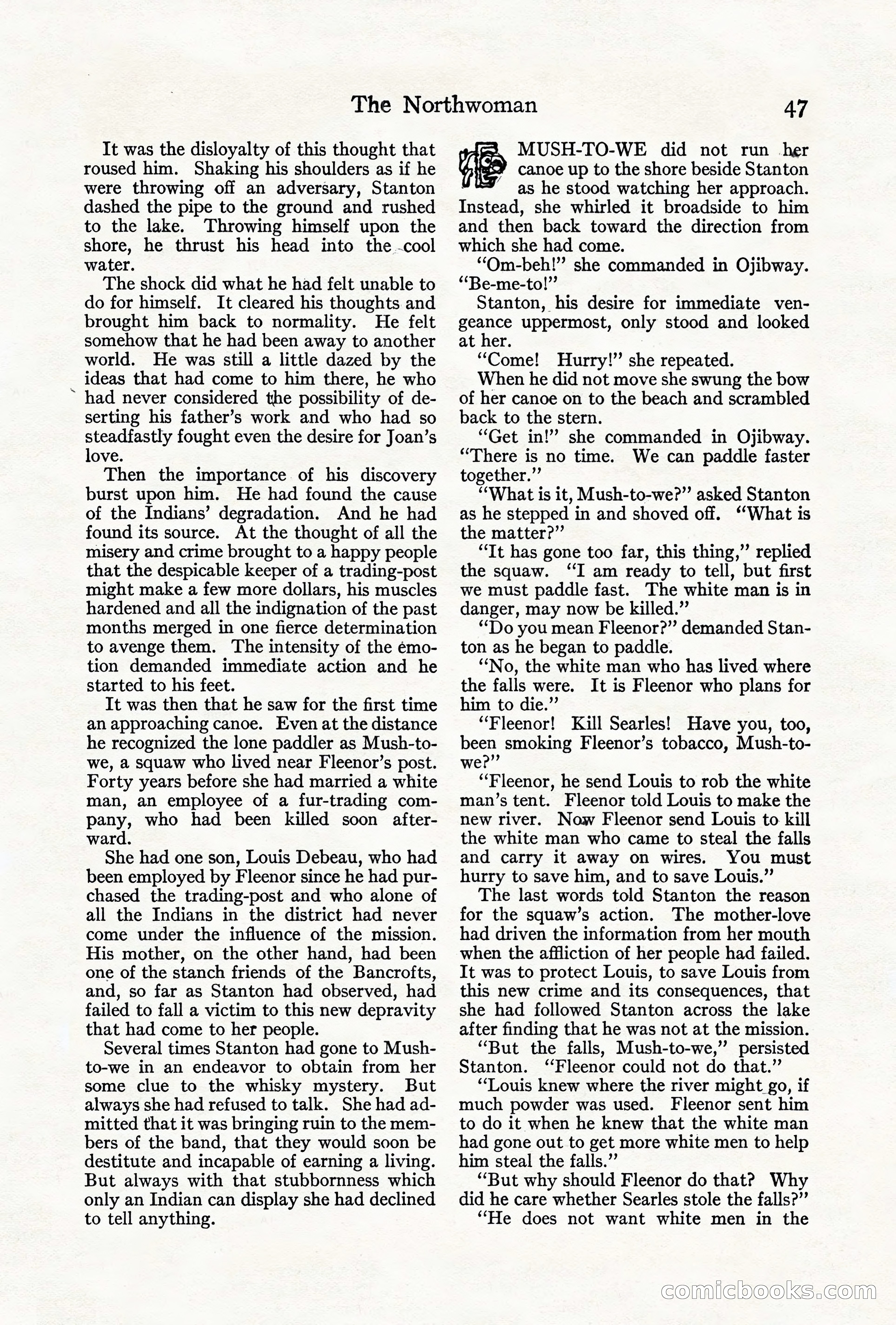
A restored page from Pulp Fiction, 1917. Page through the whole issue in the reader above.
📄 Transcribed text from this page (OCR, searchable)
Machine-transcribed from the original scan — historical spelling and the odd misread are preserved.
f The Northwoman It was the disloyalty of this thought that roused him. Shaking his shoulders as if he were throwing off an adversary, Stanton dashed the pipe to the ground and rushed to the lake. Throwing himself upon the shore, he thrust his head into the -cool water. The shock did what he had felt unable to do for himself. It cleared his thoughts and brought him back to normality. He felt somehow that he had been away to another world. He was still a little dazed by the ideas that had come to him there, he who had never considered the possibility of de- serting his father’s work and who had so steadfastly fought even the desire for Joan’s love. Then the importance of his discovery burst upon him. He had found the cause of the Indians’ degradation. And he had found its source. At the thought of all the misery and crime brought to a happy people that the despicable keeper of a trading-post might make a few more dollars, his muscles hardened and all the indignation of the past months merged in one fierce determination to avenge them. The intensity of the émo- tion demanded immediate action and he started to his feet. It was then that he saw for the first time an approaching canoe. Even at the distance he recognized the lone paddler as Mush-to- we, a squaw who lived near Fleenor’s post. Forty years before she had married a white man, an employee of a fur-trading com- pany, who had been killed soon after- ward. She had one son, Louis Debeau, who had been employed by Fleenor since he had pur- chased the trading-post and who alone of all the Indians in the district had never come under the influence of the mission. His mother, on the other hand, had been one of the stanch friends of the Bancrofts, and, so far as Stanton had observed, had failed to fall a victim to this new depravity that had come to her people. Several times Stanton had gone to Mush- to-we in an endeavor to obtain from her some clue to the whisky mystery. But always she had refused to talk. She had ad- mitted that it was bringing ruin to the mem- bers of the band, that they would soon be destitute and incapable of earning a living. But always with that stubbornness which only an Indian can display she had declined to tell anything. 47 MUSH-TO-WE did not run _ her ¥ canoe up to the shore beside Stanton as he stood watching her approach. Instead, she whirled it broadside to him and then back toward the direction from which she had come. ‘““(Om-beh!” she commanded in Ojibway. ‘‘Be-me-to!”’ Stanton, his desire for immediate ven- geance uppermost, only stood and looked at her. | “Come! Hurry!” she repeated. When he did not move she swung the bow of her canoe on to the beach and scrambled back to the stern. “Get in!” she commanded in Ojibway. “‘There is no time. We can paddle faster together.” ‘“‘What is it, Mush-to-we?” asked Stanton as he stepped in and shoved off. ‘What is the matter?”’ “It has gone too far, this thing,” replied the squaw. “I am ready to tell, but first we must paddle fast. The white man is in danger, may now be killed.” “Do you mean Fleenor?” demanded Stan- ton as he began to paddle. ‘“‘No, the white man who has lived. where the falls were. It is Fleenor who plans for him to die.”’ “Fleenor! Kull Searles! Have you, too, been smoking Fleenor’s tobacco, Mush-to- we?” “Fleenor, he send Louis to rob the white man’s tent. Fleenor told Louis to make the new river. Now Fleenor send Louis to kill the white man who came to steal the falls and carry it away on wires. You must hurry to save him, and to save Louis.” The last words told Stanton the reason for the squaw’s action. The mother-love had driven the information from her mouth when the affliction of her people had failed. It was to protect Louis, to save Louis from this new crime and its consequences, that she had followed Stanton across the lake after finding that he was not at the mission. “But the falls, Mush-to-we,” persisted Stanton. ‘“Fleenor could not do that.” ‘“‘Louis knew where the river might go, if much powder was used. Fleenor sent him to do it when he knew that the white man had gone out to get more white men to help him steal the falls.” “But why should Fleenor do that? Why did he care whether Searles stole the falls?” ‘‘He does not want white men in the cCoOmiclsoo CO 5}