
Pulp Fiction, 1917 · page 48 of 196
Adventure, August 1917 — page 48: what you’re looking at
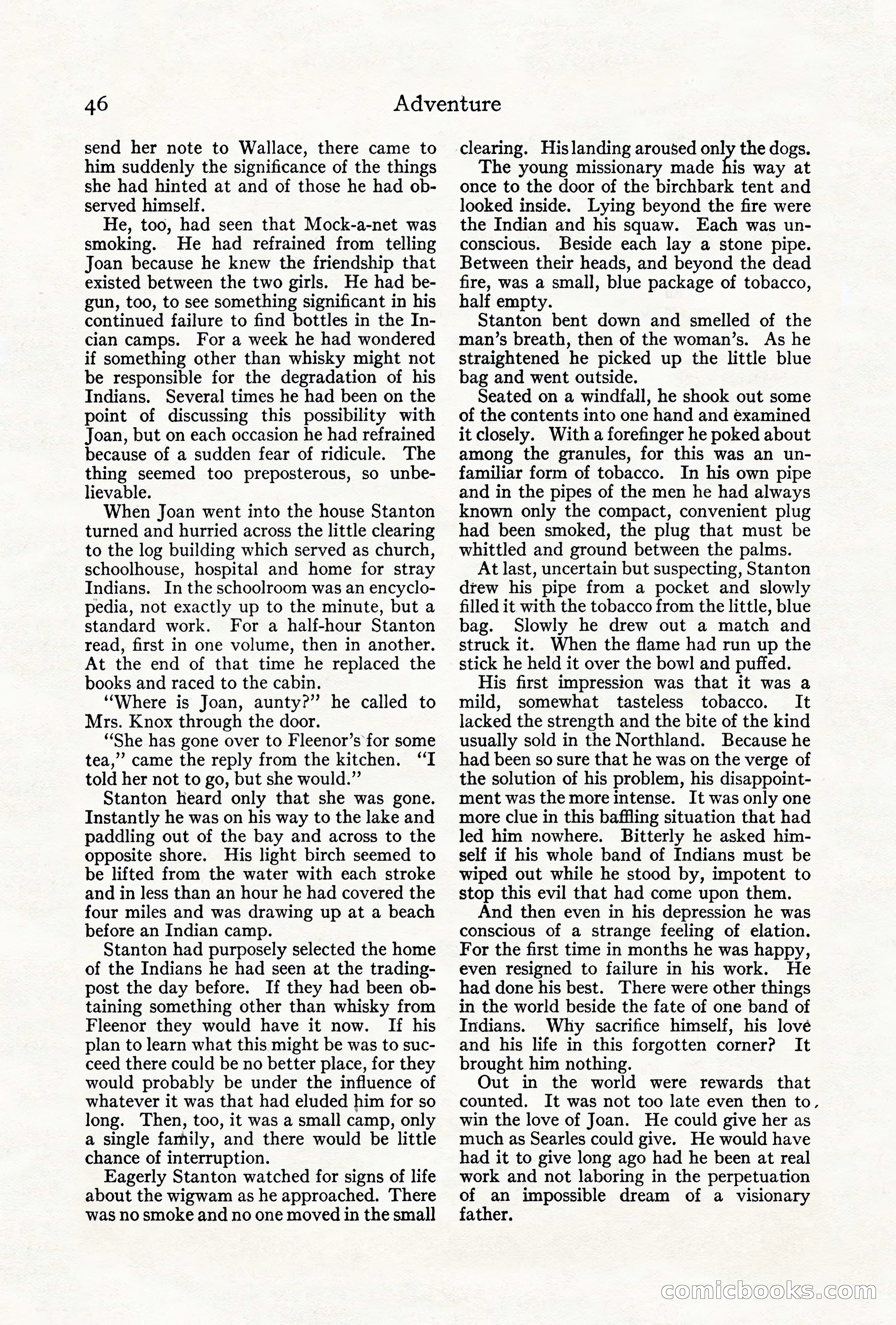
A restored page from Pulp Fiction, 1917. Page through the whole issue in the reader above.
📄 Transcribed text from this page (OCR, searchable)
Machine-transcribed from the original scan — historical spelling and the odd misread are preserved.
46 send her note to Wallace, there came to him suddenly the significance of the things she had hinted at and of those he had ob- served himself. He, too, had seen that Mock-a-net was smoking. He had refrained from telling Joan because he knew the friendship that existed between the two girls. He had be- gun, too, to see something significant in his continued failure to find bottles in the In- cian camps. For a week he had wondered if something other than whisky might not be responsible for the degradation of his Indians. Several times he had been on the point of discussing this possibility with Joan, but on each occasion he had refrained because of a sudden fear of ridicule. The thing seemed too preposterous, so unbe- lievable. When Joan went into the house Stanton turned and hurried across the little clearing to the log building which served as church, schoolhouse, hospital and home for stray Indians. In the schoolroom was an encyclo- pedia, not exactly up to the minute, but a standard work. For a half-hour Stanton read, first in one volume, then in another. At the end of that time he replaced the books and raced to the cabin. ‘“‘Where is Joan, aunty?” he called to Mrs. Knox through the door. ‘She has gone over to Fleenor’s for some tea,” came the reply from the kitchen. “T told her not to go, but she would.” Stanton heard only that she was gone. Instantly he was on his way to the lake and paddling out of the bay and across to the opposite shore. His light birch seemed to be lifted from the water with each stroke and in less than an hour he had covered the four miles and was drawing up at a beach before an Indian camp. Stanton had purposely selected the home of the Indians he had seen at the trading- post the day before. If they had been ob- taining something other than whisky from Fleenor they would have it now. If his plan to learn what this might be was to suc- ceed there could be no better place, for they would probably be under the influence of whatever it was that had eluded him for so long. Then, too, it was a small camp, only a single family, and there would be little chance of interruption. Eagerly Stanton watched for signs of life about the wigwam as he approached. There was no smoke and no one moved in the small Adventure clearing. His landing aroused only the dogs. The young missionary made his way at once to the door of the birchbark tent and looked inside. Lying beyond the fire were the Indian and his squaw. Each was un- conscious. Beside each lay a stone pipe. Between their heads, and beyond the dead fire, was a small, blue package of tobacco, half empty. Stanton bent down and smelled of the man’s breath, then of the woman’s. As he straightened he picked up the little blue bag and went outside. Seated on a windfall, he shook out some of the contents into one hand and examined it closely. With a forefinger he poked about among the granules, for this was an un- familiar form of tobacco. In his own pipe and in the pipes of the men he had always known only the compact, convenient plug had been smoked, the plug that must be whittled and ground between the palms. At last, uncertain but suspecting, Stanton drew his pipe from a pocket and slowly filled it with the tobacco from the little, blue bag. Slowly he drew out a match and struck it. When the flame had run up the stick he held it over the bow! and puffed. His first impression was that it was a mild, somewhat tasteless tobacco. It lacked the strength and the bite of the kind usually sold in the Northland. Because he had been so sure that he was on the verge of the solution of his problem, his disappoint- ment was the more intense. It was only one more clue in this baffling situation that had led him nowhere. Bitterly he asked him- self if his whole band of Indians must be wiped out while he stood by, impotent to stop this evil that had come upon them. And then even in his depression he was conscious of a strange feeling of elation. For the first time in months he was happy, even resigned to failure in his work. He had done his best. There were other things in the world beside the fate of one band of Indians. Why sacrifice himself, his lové and his life in this forgotten corner? It brought him nothing. Out in the world were rewards that counted. It was not too late even then to, win the love of Joan. He could give her as much as Searles could give. He would have had it to give long ago had he been at real work and not laboring in the perpetuation of an impossible dream of a visionary father. cComiclaook (© 5}