
Pulp Fiction, 1917 · page 50 of 196
Adventure, August 1917 — page 50: what you’re looking at
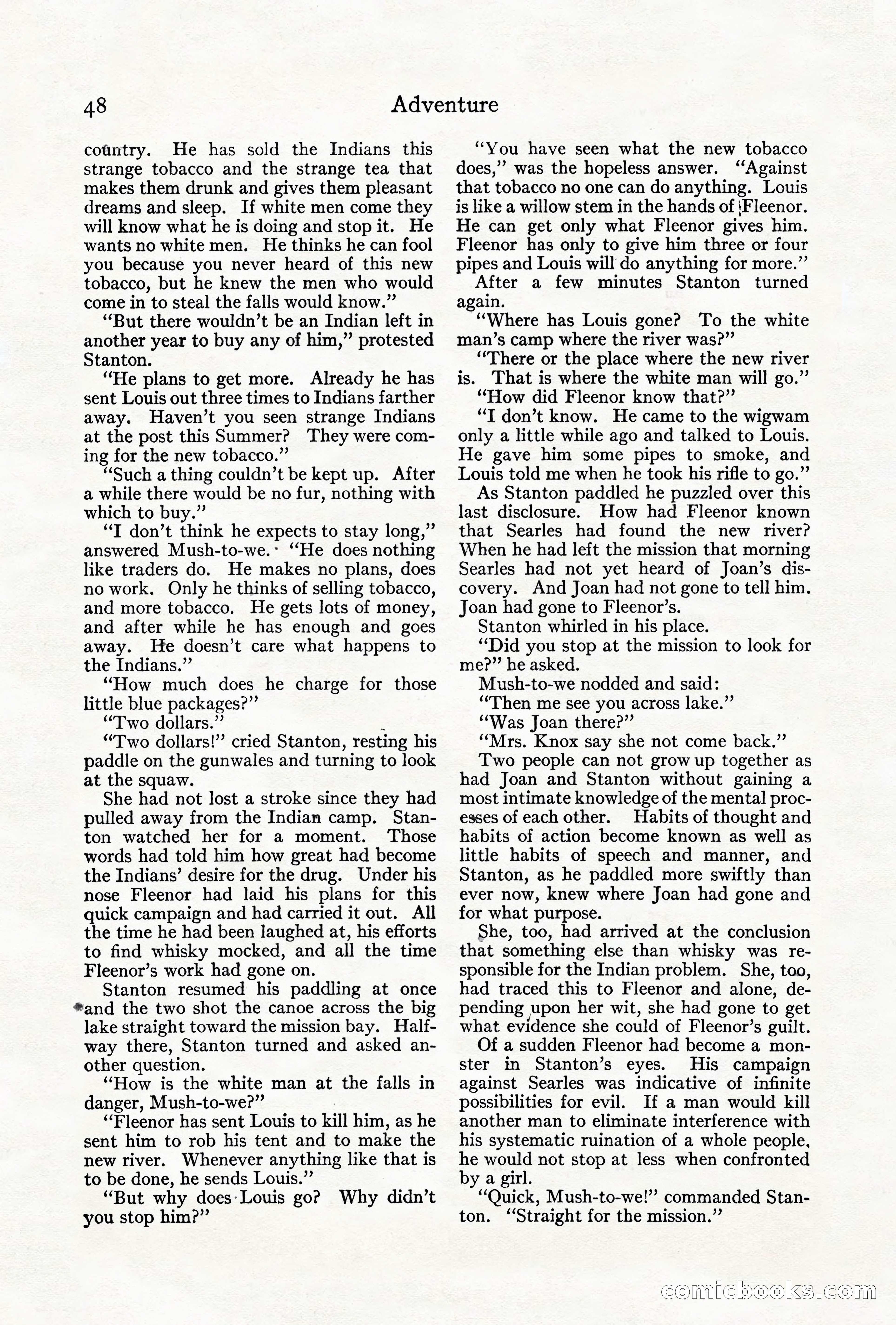
A restored page from Pulp Fiction, 1917. Page through the whole issue in the reader above.
📄 Transcribed text from this page (OCR, searchable)
Machine-transcribed from the original scan — historical spelling and the odd misread are preserved.
48 country. He has sold the Indians this strange tobacco and the strange tea that makes them drunk and gives them pleasant dreams and sleep. If white men come they will know what he is doing and stop it. He wants no white men. He thinks he can fool you because you never heard of this new tobacco, but he knew the men who would come in to steal the falls would know.” “But there wouldn’t be an Indian left in another year to buy any of him,” protested Stanton. “He plans to get more. Already he has sent Louis out three times to Indians farther away. Haven’t you seen strange Indians at the post this Summer? They were com- ing for the new tobacco.” “Such a thing couldn’t be kept up. After a while there would be no fur, nothing with which to buy.” “T don’t think he expects to stay long,” answered Mush-to-we.- ‘He does nothing like traders do. He makes no plans, does no work. Only he thinks of selling tobacco, and more tobacco. He gets lots of money, and after while he has enough and goes away. He doesn’t care what happens to the Indians.” “How much does he charge for those little blue packages?” “Two dollars.” “Two dollars!” cried Stanton, resting his paddle on the gunwales and turning to look at the squaw. She had not lost a stroke since they had pulled away from the Indian camp. Stan- ton watched her for a moment. Those words had told him how great had become the Indians’ desire for the drug. Under his nose Fleenor had laid his plans for this quick campaign and had carried it out. All the time he had been laughed at, his efforts to find whisky mocked, and all the time Fleenor’s work had gone on. Stanton resumed his paddling at once *and the two shot the canoe across the big lake straight toward the mission bay. Half- way there, Stanton turned and asked an- other question. “How is the white man at the falls in danger, Mush-to-we?” “Fleenor has sent Louis to kill him, as he sent him to rob his tent and to make the new river. Whenever anything like that is to be done, he sends Louis.” “But why does:Louis go? Why didn’t you stop him?” Adventure “You have seen what the new tobacco does,’ was the hopeless answer. “Against that tobacco no one can do anything. Louis is like a willow stem in the hands of ‘Fleenor. He can get only what Fleenor gives him. Fleenor has only to give him three or four pipes and Louis will do anything for more.” After a few minutes Stanton turned again. “Where has Louis gone? To the white man’s camp where the river was?” “‘There or the place where the new river That is where the white man will go.” “How did Fleenor know that?” “T don’t know. He came to the wigwam only a little while ago and talked to Louis. He gave him some pipes to smoke, and Louis told me when he took his rifle to go.” As Stanton paddled he puzzled over this last disclosure. How had Fleenor known that Searles had found the new river? When he had left the mission that morning Searles had not yet heard of Joan’s dis- covery. And Joan had not gone to tell him. Joan had gone to Fleenor’s. Stanton whirled in his place. “Did you stop at the mission to look for me?” he asked. Mush-to-we nodded and said: “‘Then me see you across lake.” ‘“‘Was Joan there?” ‘“‘Mrs. Knox say she not come back.” Two people can not grow up together as had Joan and Stanton without gaining a most intimate knowledge of the mental proc- esses of eachother. Habits of thought and habits of action become known as well as little habits of speech and manner, and Stanton, as he paddled more swiftly than ever now, knew where Joan had gone and for what purpose. She, too, had arrived at the conclusion that something else than whisky was re- sponsible for the Indian problem. She, too, had traced this to Fleenor and alone, de- pending upon her wit, she had gone to get what evidence she could of Fleenor’s guilt. Of a sudden Fleenor had become a mon- ster in Stanton’s eyes. His campaign against Searles was indicative of infinite possibilities for evil. If a man would kill another man to eliminate interference with his systematic ruination of a whole people, he would not stop at less when confronted by a girl. “Quick, Mush-to-we!”? commanded Stan- ton. “Straight for the mission.” is. CoOmiclsoo C© 5}