
Pulp Fiction, 1917 · page 45 of 196
Adventure, August 1917 — page 45: what you’re looking at
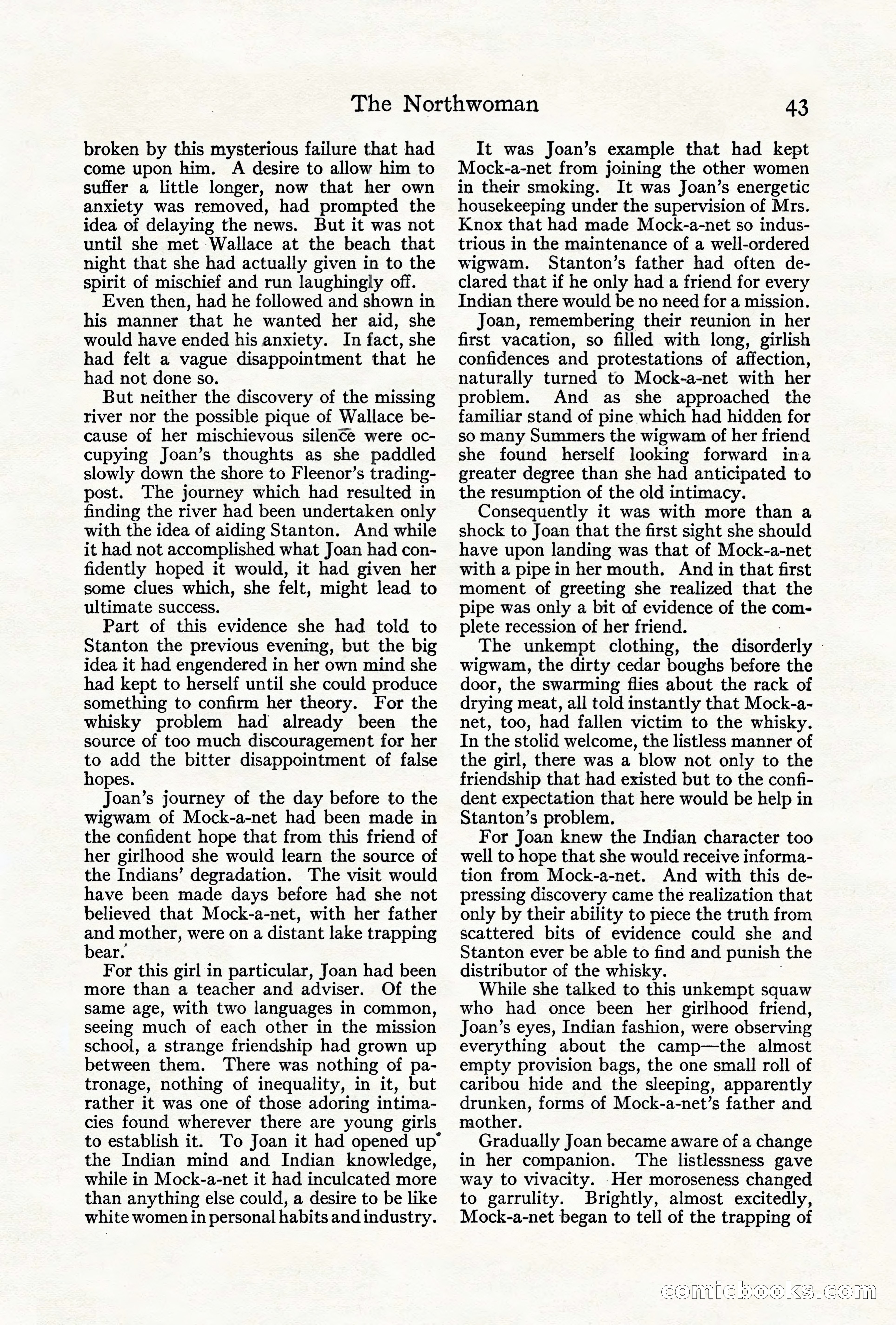
A restored page from Pulp Fiction, 1917. Page through the whole issue in the reader above.
📄 Transcribed text from this page (OCR, searchable)
Machine-transcribed from the original scan — historical spelling and the odd misread are preserved.
The Northwoman broken by this mysterious failure that had come upon him. A desire to allow him to suffer a little longer, now that her own anxiety was removed, had prompted the idea of delaying the news. But it was not until she met Wallace at the beach that night that she had actually given in to the spirit of mischief and run laughingly off. Even then, had he followed and shown in his manner that he wanted her aid, she would have ended his anxiety. In fact, she had felt a vague disappointment that he had not done so. But neither the discovery of the missing river nor the possible pique of Wallace be- cause of her mischievous silence were oc- cupying Joan’s thoughts as she paddled slowly down the shore to Fleenor’s trading- post. The journey which had resulted in finding the river had been undertaken only with the idea of aiding Stanton. And while it had not accomplished what Joan had con- fidently hoped it would, it had given her some clues which, she felt, might lead to ultimate success. Part of this evidence she had told to Stanton the previous evening, but the big idea it had engendered in her own mind she had kept to herself until she could produce something to confirm her theory. For the whisky problem had already been the source of too much discouragement for her to add the bitter disappointment of false hopes. Joan’s journey of the day before to the wigwam of Mock-a-net had been made in the confident hope that from this friend of her girlhood she would learn the source of the Indians’ degradation. The visit would have been made days before had she not believed that Mock-a-net, with her father and mother, were on a distant lake trapping bear. For this girl in particular, Joan had been more than a teacher and adviser. Of the same age, with two languages in common, seeing much of each other in the mission school, a strange friendship had grown up between them. There was nothing of pa- tronage, nothing of inequality, in it, but rather it was one of those adoring intima- cies found wherever there are young girls to establish it. To Joan it had opened up’ the Indian mind and Indian knowledge, while in Mock-a-net it had inculcated more than anything else could, a desire to be like white women in personal habits and industry. 43 It was Joan’s example that had kept Mock-a-net from joining the other women in their smoking. It was Joan’s energetic housekeeping under the supervision of Mrs. Knox that had made Mock-a-net so indus- trious in the maintenance of a well-ordered wigwam. Stanton’s father had often de- clared that if he only had a friend for every Indian there would be no need for a mission. Joan, remembering their reunion in her first vacation, so filled with long, girlish confidences and protestations of affection, naturally turned to Mock-a-net with her problem. And as she approached the familiar stand of pine which had hidden for so many Summers the wigwam of her friend she found herself looking forward ina greater degree than she had anticipated to the resumption of the old intimacy. Consequently it was with more than a shock to Joan that the first sight she should have upon landing was that of Mock-a-net with a pipe in her mouth. And in that first moment of preeting she realized that the pipe was only a bit of evidence of the com- plete recession of her friend. The unkempt clothing, the disorderly . wigwam, the dirty cedar boughs before the door, the swarming flies about the rack of drying meat, all told instantly that Mock-a- net, too, had fallen victim to the whisky. In the stolid welcome, the listless manner of the girl, there was a blow not only to the friendship that had existed but to the confi- dent expectation that here would be help in Stanton’s problem. For Joan knew the Indian character too well to hope that she would receive informa- tion from Mock-a-net. And with this de- pressing discovery came the realization that only by their ability to piece the truth from scattered bits of evidence could she and Stanton ever be able to find and punish the distributor of the whisky. While she talked to this unkempt squaw who had once been her girlhood friend, Joan’s eyes, Indian fashion, were observing everything about the camp—the almost empty provision bags, the one small roll of caribou hide and the sleeping, apparently drunken, forms of Mock-a-net’s father and mother. Gradually Joan became aware of a change in her companion. The listlessness gave way to vivacity. Her moroseness changed to garrulity. Brightly, almost excitedly, Mock-a-net began to tell of the trapping of cCoOMmiclsoo CO 5}