
Pulp Fiction, 1917 · page 46 of 196
Adventure, August 1917 — page 46: what you’re looking at
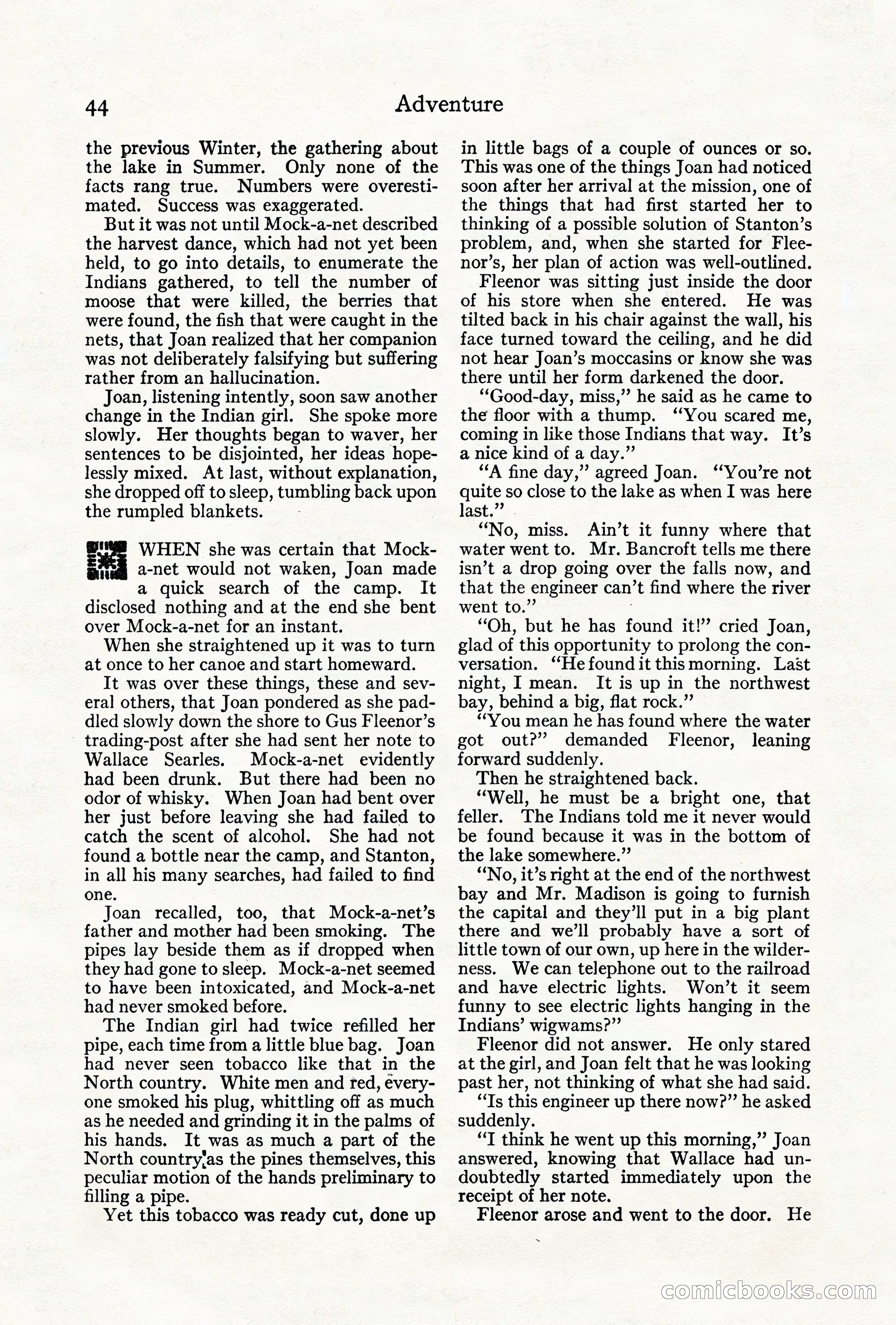
A restored page from Pulp Fiction, 1917. Page through the whole issue in the reader above.
📄 Transcribed text from this page (OCR, searchable)
Machine-transcribed from the original scan — historical spelling and the odd misread are preserved.
44 the previous Winter, the gathering about the lake in Summer. Only none of the facts rang true. Numbers were overesti- mated. Success was exaggerated. But it was not until Mock-a-net described the harvest dance, which had not yet been held, to go into details, to enumerate the Indians gathered, to tell the number of moose that were killed, the berries that were found, the fish that were caught in the nets, that Joan realized that her companion was not deliberately falsifying but suffering rather from an hallucination. Joan, listening intently, soon saw another change in the Indian girl. She spoke more slowly. Her thoughts began to waver, her sentences to be disjointed, her ideas hope- lessly mixed. At last, without explanation, she dropped off to sleep, tumbling back upon the rumpled blankets. —_—- @'' WHEN she was certain that Mock- Sia a-net would not waken, Joan made a quick search of the camp. It disclosed nothing and at the end she bent over Mock-a-net for an instant. When she straightened up it was to turn at once to her canoe and start homeward. It was over these things, these and sev- eral others, that Joan pondered as she pad- dled slowly down the shore to Gus Fleenor’s trading-post after she had sent her note to Wallace Searles. Mock-a-net evidently had been drunk. But there had been no odor of whisky. When Joan had bent over her just before leaving she had failed to catch the scent of alcohol. She had not found a bottle near the camp, and Stanton, in all his many searches, had failed to find one. Joan recalled, too, that Mock-a-net’s father and mother had been smoking. The pipes lay beside them as if dropped when they had gone to sleep. Mock-a-net seemed to have been intoxicated, and Mock-a-net had never smoked before. The Indian girl had twice refilled her pipe, each time from a little blue bag. Joan had never seen tobacco like that in the North country. White men and ted, every- one smoked his plug, whittling off as much as he needed and grinding it in the palms of his hands. It was as much a part of the North countryias the pines themselves, this peculiar motion of the hands preliminary to filling a pipe. Yet this tobacco was ready cut, done up Adventure in little bags of a couple of ounces or so. This was one of the things Joan had noticed soon after her arrival at the mission, one of the things that had first started her to thinking of a possible solution of Stanton’s problem, and, when she started for Flee- nor’s, her plan of action was well-outlined. Fleenor was sitting Just inside the door of his store when she entered. He was tilted back in his chair against the wall, his face turned toward the ceiling, and he did not hear Joan’s moccasins or know she was there until her form darkened the door. ‘“‘Good-day, miss,”’ he said as he came to the floor with a thump. ‘‘You scared me, coming in like those Indians that way. It’s a nice kind of a day.” “A fine day,” agreed Joan. ‘“‘You’re not quite so close to the lake as when I was here last.” . “No, miss. Ain’t it funny where that water went to. Mr. Bancroft tells me there isn’t a drop going over the falls now, and that the engineer can’t find where the river went to.” “Oh, but he has found it!” cried Joan, glad of this opportunity to prolong the con- versation. “Hefoundit thismorning. Last night, I mean. It is up in the northwest bay, behind a big, flat rock.” ‘““You mean he has found where the water got out?’ demanded Fleenor, leaning forward suddenly. Then he straightened back. “Well, he must be a bright one, that feller. The Indians told me it never would be found because it was in the bottom of the lake somewhere.” : “No, it’s right at the end of the northwest bay and Mr. Madison is going to furnish the capital and they’ll put in a big plant there and we'll probably have a sort of little town of our own, up here in the wilder- ness. Wecan telephone out to the railroad and have electric lights. Won’t it seem funny to see electric lights hanging in the Indians’ wigwams?”’ Fleenor did not answer. He only stared at the girl, and Joan felt that he was looking past her, not thinking of what she had said. “Is this engineer up there now?” he asked suddenly. “T think he went up this morning,” Joan answered, knowing that Wallace had un- doubtedly started immediately upon the receipt of her note. Fleenor arose and went to the door. He ComicldOolkxs.conm