
Pulp Fiction, 1917 · page 44 of 196
Adventure, August 1917 — page 44: what you’re looking at
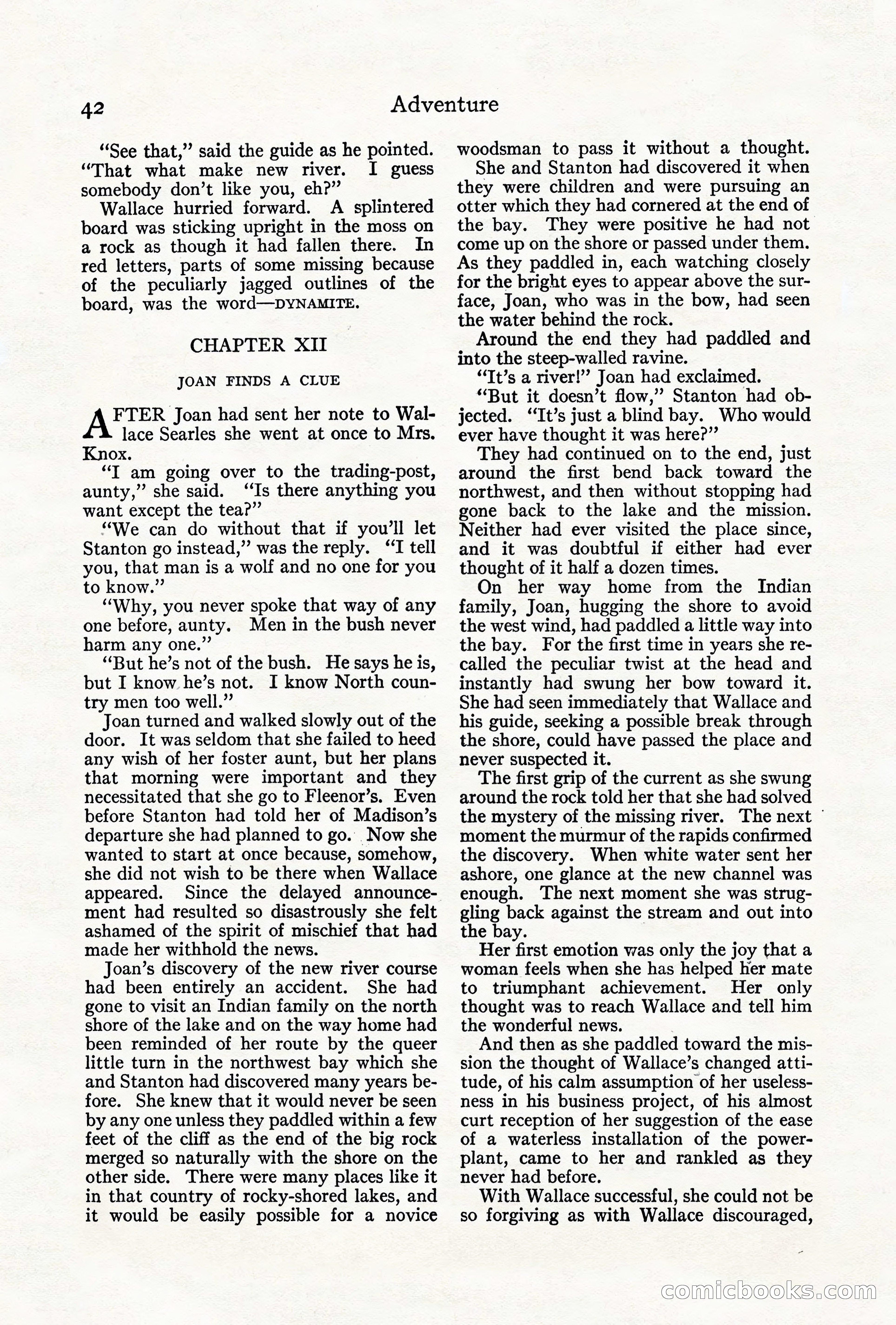
A restored page from Pulp Fiction, 1917. Page through the whole issue in the reader above.
📄 Transcribed text from this page (OCR, searchable)
Machine-transcribed from the original scan — historical spelling and the odd misread are preserved.
42 “See that,” said the guide as he pointed. “That what make new river. I guess somebody don’t like you, eh?” Wallace hurried forward. A splintered board was sticking upright in the moss on a rock as though it had fallen there. In red letters, parts of some missing because of the peculiarly jagged outlines of the board, was the word—DYNAMITE. CHAPTER XII JOAN FINDS A CLUE are Joan had sent her note to Wal- lace Searles she went at once to Mrs. Knox. “TI am going over to the trading-post, aunty,” she said. “Is there anything you want except the tea?”’ “We can do without that if you’ll let Stanton go instead,” was the reply. “T tell you, that man is a wolf and no one for you to know.” “Why, you never spoke that way of any one before, aunty. Men in the bush never harm any one.” “But he’s not of the bush. He says he is, but I know he’s not. I know North coun- try men too well.” Joan turned and walked slowly out of the door. It was seldom that she failed to heed any wish of her foster aunt, but her plans that morning were important and they necessitated that she go to Fleenor’s. Even before Stanton had told her of Madison’s departure she had planned to go. _Now she wanted to start at once because, somehow, she did not wish to be there when Wallace appeared. Since the delayed announce- ment had resulted so disastrously she felt ashamed of the spirit of mischief that had made her withhold the news. Joan’s discovery of the new river course had been entirely an accident. She had gone to visit an Indian family on the north shore of the lake and on the way home had been reminded of her route by the queer little turn in the northwest bay which she and Stanton had discovered many years be- fore. She knew that it would never be seen by any one unless they paddled within a few feet of the cliff as the end of the big rock merged so naturally with the shore on the other side. There were many places like it in that country of rocky-shored lakes, and it would be easily possible for a novice Adventure woodsman to pass it without a thought. She and Stanton had discovered it when they were children and were pursuing an otter which they had cornered at the end of the bay. They were positive he had not come up on the shore or passed under them. As they paddled in, each watching closely for the bright eyes to appear above the sur- face, Joan, who was in the bow, had seen the water behind the rock. Around the end they had paddled and into the steep-walled ravine. “Tt’s a river!’ Joan had exclaimed. “But it doesn’t flow,” Stanton had ob- jected. “It’s just a blind bay. Who would ever have thought it was here?”’ They had continued on to the end, just around the first bend back toward the northwest, and then without stopping had gone back to the lake and the mission. Neither had ever visited the place since, and it was doubtful if either had ever thought of it half a dozen times. On her way home from the Indian family, Joan, hugging the shore to avoid the west wind, had paddled a little way into the bay. For the first time in years she re- called the peculiar twist at the head and instantly had swung her bow toward it. She had seen immediately that Wallace and his guide, seeking a possible break through the shore, could have passed the place and never suspected it. The first grip of the current as she swung around the rock told her that she had solved the mystery of the missing river. The next © moment the murmur of the rapids confirmed the discovery. When white water sent her ashore, one glance at the new channel was enough. The next moment she was strug- gling back against the stream and out into the bay. Her first emotion was only the joy that a woman feels when she has helped her mate to triumphant achievement. Her only thought was to reach Wallace and tell him the wonderful news. And then as she paddled toward the mis- sion the thought of Wallace’s changed atti- tude, of his calm assumption of her useless- ness in his business project, of his almost curt reception of her suggestion of the ease of a waterless installation of the power- plant, came to her and rankled as they never had before. With Wallace successful, she could not be so forgiving as with Wallace discouraged, cComiclaook © 5}