
Pulp Fiction, 1917 · page 36 of 196
Adventure, August 1917 — page 36: what you’re looking at
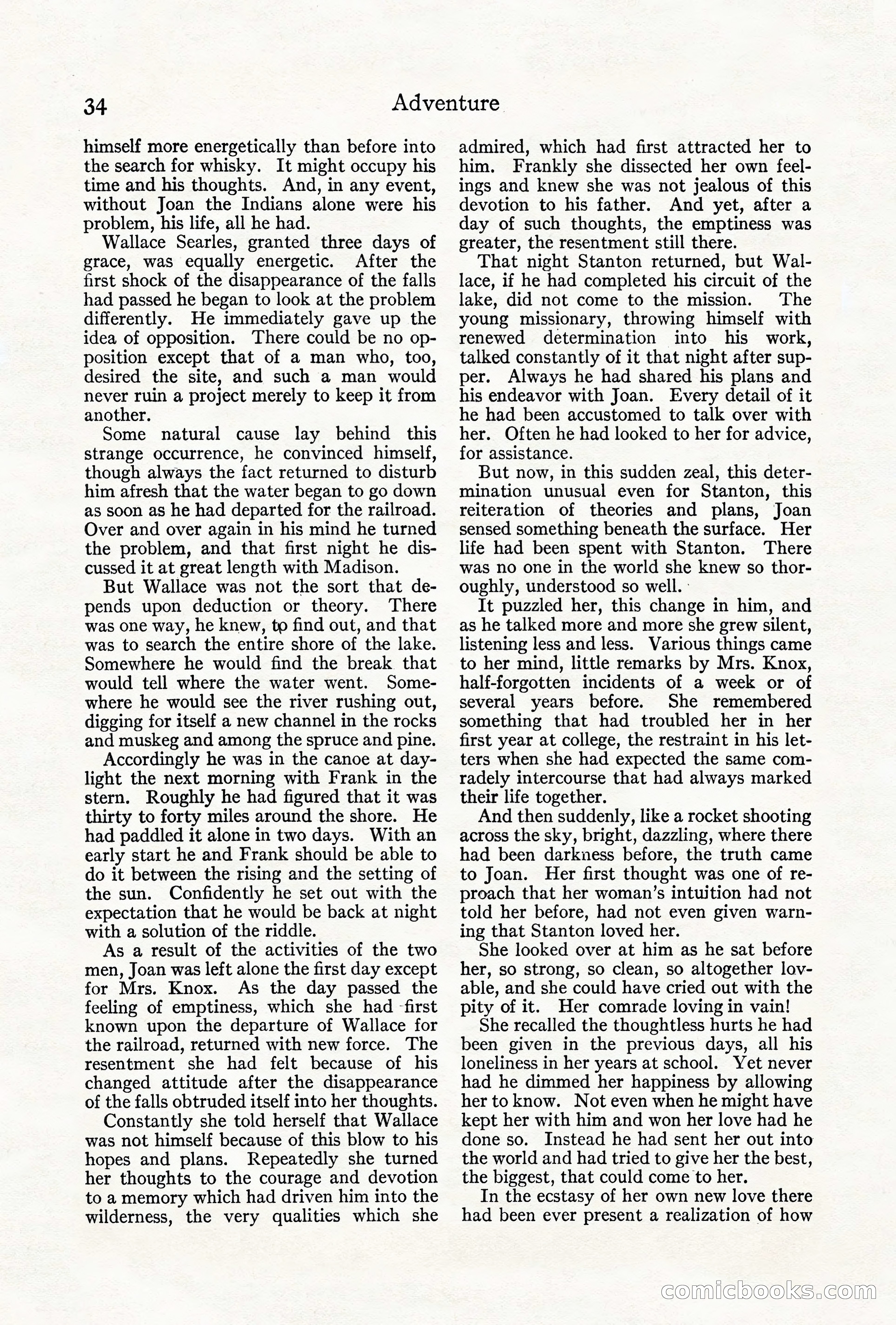
A restored page from Pulp Fiction, 1917. Page through the whole issue in the reader above.
📄 Transcribed text from this page (OCR, searchable)
Machine-transcribed from the original scan — historical spelling and the odd misread are preserved.
34 himself more energetically than before into the search for whisky. It might occupy his time and his thoughts. And, in any event, without Joan the Indians alone were his problem, his life, all he had. Wallace Searles, granted three days of grace, was equally energetic. After the first shock of the disappearance of the falls had passed he began to look at the problem differently. He immediately gave up the idea of opposition. There could be no op- position except that of a man who, too, desired the site, and such a man would never ruin a project merely to keep it from another. Some natural cause lay behind this strange occurrence, he convinced himself, though always the fact returned to disturb him afresh that the water began to go down as soon as he had departed for the railroad. Over and over again in his mind he turned the problem, and that first night he dis- cussed it at great length with Madison. But Wallace was not the sort that de- pends upon deduction or theory. There was one way, he knew, to find out, and that was to search the entire shore of the lake. Somewhere he would find the break that would tell where the water went. Some- where he would see the river rushing out, digging for itself a new channel in the rocks and muskeg and among the spruce and pine. Accordingly he was in the canoe at day- light the next morning with Frank in the stern. Roughly he had figured that it was thirty to forty miles around the shore. He had paddled it alone in two days. With an early start he and Frank should be able to do it between the rising and the setting of the sun. Confidently he set out with the expectation that he would be back at night with a solution of the riddle. As a result of the activities of the two men, Joan was left alone the first day except for Mrs. Knox. As the day passed the feeling of emptiness, which she had -first known upon the departure of Wallace for the railroad, returned with new force. The resentment she had felt because of his changed attitude after the disappearance of the falls obtruded itself into her thoughts. Constantly she told herself that Wallace was not himself because of this blow to his hopes and plans. Repeatedly she turned her thoughts to the courage and devotion to a memory which had driven him into the wilderness, the very qualities which she Adventure admired, which had first attracted her to him. Frankly she dissected her own feel- ings and knew she was not jealous of this devotion to his father. And yet, after a day of such thoughts, the emptiness was greater, the resentment still there. That night Stanton returned, but Wal- lace, if he had completed his circuit of the lake, did not come to the mission. The young missionary, throwing himself with renewed determination into his work, talked constantly of it that night after sup- per. Always he had shared his plans and his endeavor with Joan. Every detail of it he had been accustomed to talk over with her. Often he had looked to her for advice, for assistance. But now, in this sudden zeal, this deter- mination unusual even for Stanton, this reiteration of theories and plans, Joan sensed something beneath the surface. Her life had been spent with Stanton. There was no one in the world she knew so thor- oughly, understood so well. It puzzled her, this change in him, and as he talked more and more she grew silent, listening less and less. Various things came to her mind, little remarks by Mrs. Knox, half-forgotten incidents of a week or of several years before. She remembered something that had troubled her in her first year at college, the restraint in his let- ters when she had expected the same com- radely intercourse that had always marked their life together. And then suddenly, like a rocket shooting across the sky, bright, dazzling, where there had been darkness before, the truth came to Joan. Her first thought was one of re- proach that her woman’s intuition had not told her before, had not even given warn- ing that Stanton loved her. She looked over at him as he sat before her, so strong, so clean, so altogether lov- able, and she could have cried out with the pity of it. Her comrade loving in vain! She recalled the thoughtless hurts he had been given in the previous days, all his loneliness in her years at school. Yet never had he dimmed her happiness by allowing her to know. Not even when he might have kept her with him and won her love had he done so. Instead he had sent her out into the world and had tried to give her the best, the biggest, that could come to her. In the ecstasy of her own new love there had been ever present a realization of how cComiclook CO S|