
Pulp Fiction, 1917 · page 37 of 196
Adventure, August 1917 — page 37: what you’re looking at
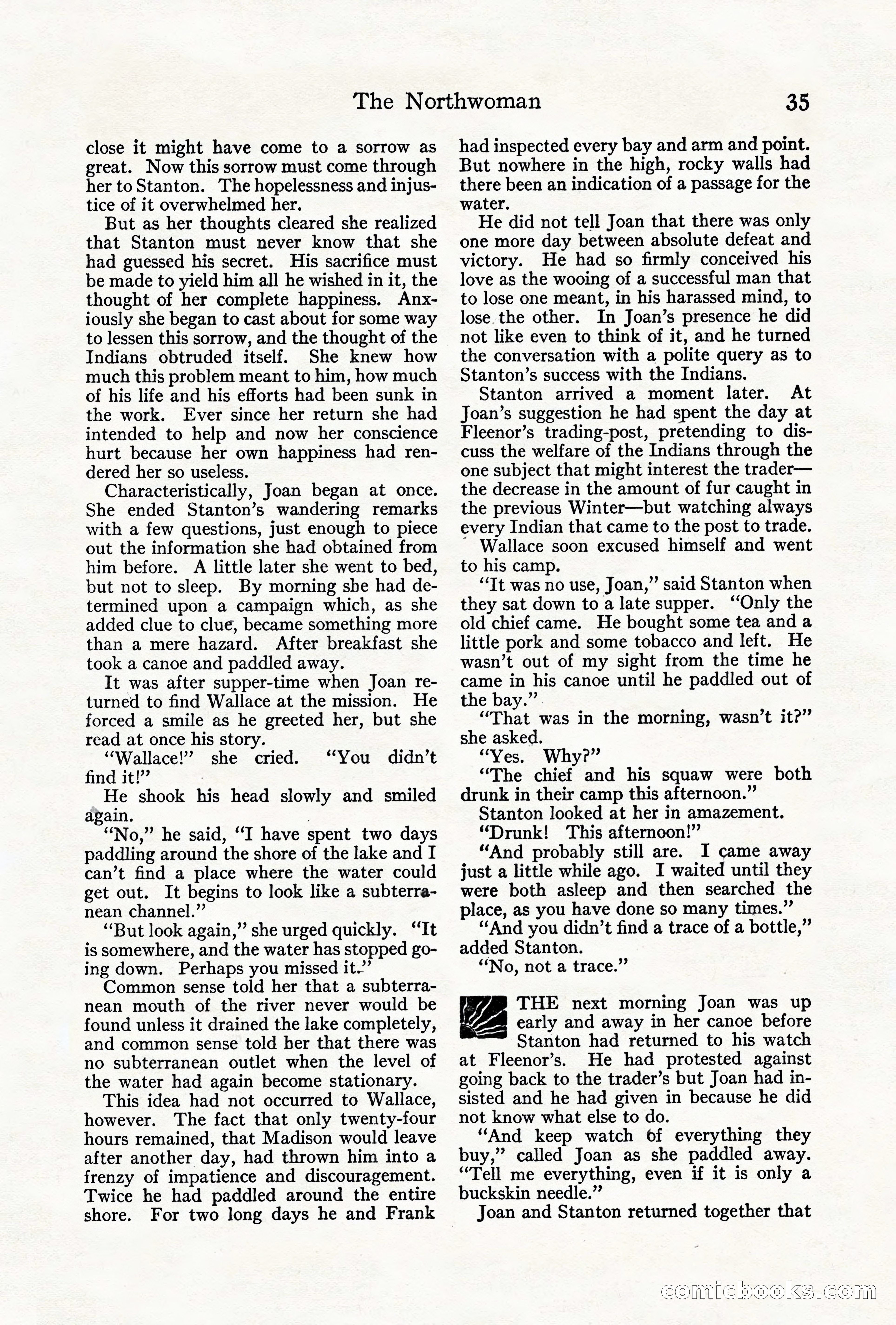
A restored page from Pulp Fiction, 1917. Page through the whole issue in the reader above.
📄 Transcribed text from this page (OCR, searchable)
Machine-transcribed from the original scan — historical spelling and the odd misread are preserved.
The Northwoman close it might have come to a sorrow as great. Now this sorrow must come through her to Stanton. The hopelessness and injus- tice of it overwhelmed her. But as her thoughts cleared she realized that Stanton must never know that she had guessed his secret. His sacrifice must be made to yield him all he wished in it, the thought of her complete happiness. Anx- iously she began to cast about for some way to lessen this sorrow, and the thought of the Indians obtruded itself. She knew how much this problem meant to him, how much of his life and his efforts had been sunk in the work. Ever since her return she had intended to help and now her conscience hurt because her own happiness had ren- dered her so useless. Characteristically, Joan began at once. She ended Stanton’s wandering remarks with a few questions, just enough to piece out the information she had obtained from him before. A little later she went to bed, but not to sleep. By morning she had de- termined upon a campaign which, as she added clue to clue, became something more than a mere hazard. After breakfast she took a canoe and paddled away. It was after supper-time when Joan re- turned to find Wallace at the mission. He forced a smile as he greeted her, but she read at once his story. “Wallace!” she cried. “You didn’t find it!” He shook his head slowly and smiled apain. “No,” he said, “I have spent two days paddling around the shore of the lake and I can’t find a place where the water could get out. It begins to look like a subterra- nean channel.” | “But look again,” she urged quickly. “It is somewhere, and the water has stopped go- ing down. Perhaps you missed it.” Common sense told her that a subterra- nean mouth of the river never would be found unless it drained the lake completely, and common sense told her that there was no subterranean outlet when the level of the water had again become stationary. This idea had not occurred to Wallace, however. The fact that only twenty-four hours remained, that Madison would leave after another day, had thrown him into a frenzy of impatience and discouragement. Twice he had paddled around the entire shore. For two long days he and Frank 35 had inspected every bay and arm and point. But nowhere in the high, rocky walls had there been an indication of a passage for the water. He did not tell Joan that there was only one more day between absolute defeat and victory. He had so firmly conceived his love as the wooing of a successful man that to lose one meant, in his harassed mind, to lose.the other. In Joan’s presence he did not like even to think of it, and he turned the conversation with a polite query as to Stanton’s success with the Indians. Stanton arrived a moment later. At Joan’s suggestion he had spent the day at Fleenor’s trading-post, pretending to dis- cuss the welfare of the Indians through the one subject that might interest the trader— the decrease in the amount of fur caught in the previous Winter—but watching always every Indian that came to the post to trade. ~ Wallace soon excused himself and went to his camp. “Tt was no use, Joan,” said Stanton when they sat down to a late supper. “Only the old chief came. He bought some tea and a little pork and some tobacco and left. He wasn’t out of my sight from the time he came in his canoe until he paddled out of the bay.” “That was in the morning, wasn’t it?’ she asked. “Yes. Why?” “The chief and his squaw were both drunk in their camp this afternoon.” Stanton looked at her in amazement. ‘Drunk! This afternoon!” ‘‘And probably still are. I came away just a little while ago. I waited until they were both asleep and then searched the place, as you have done so many times.”’ “And you didn’t find a trace of a bottle,” added Stanton. “No, not a trace.” Ap THE next morning Joan was up Ge early and away in her canoe before Stanton had returned to his watch at Fleenor’s. He had protested against going back to the trader’s but Joan had in- sisted and he had given in because he did not know what else to do. “And keep watch Of everything they buy,” called Joan as she paddled away. ‘“‘Tell me everything, even if it is only a buckskin needle.” Joan and Stanton returned together that CoOmiclsoo C© S|