
Pulp Fiction, 1917 · page 35 of 196
Adventure, August 1917 — page 35: what you’re looking at
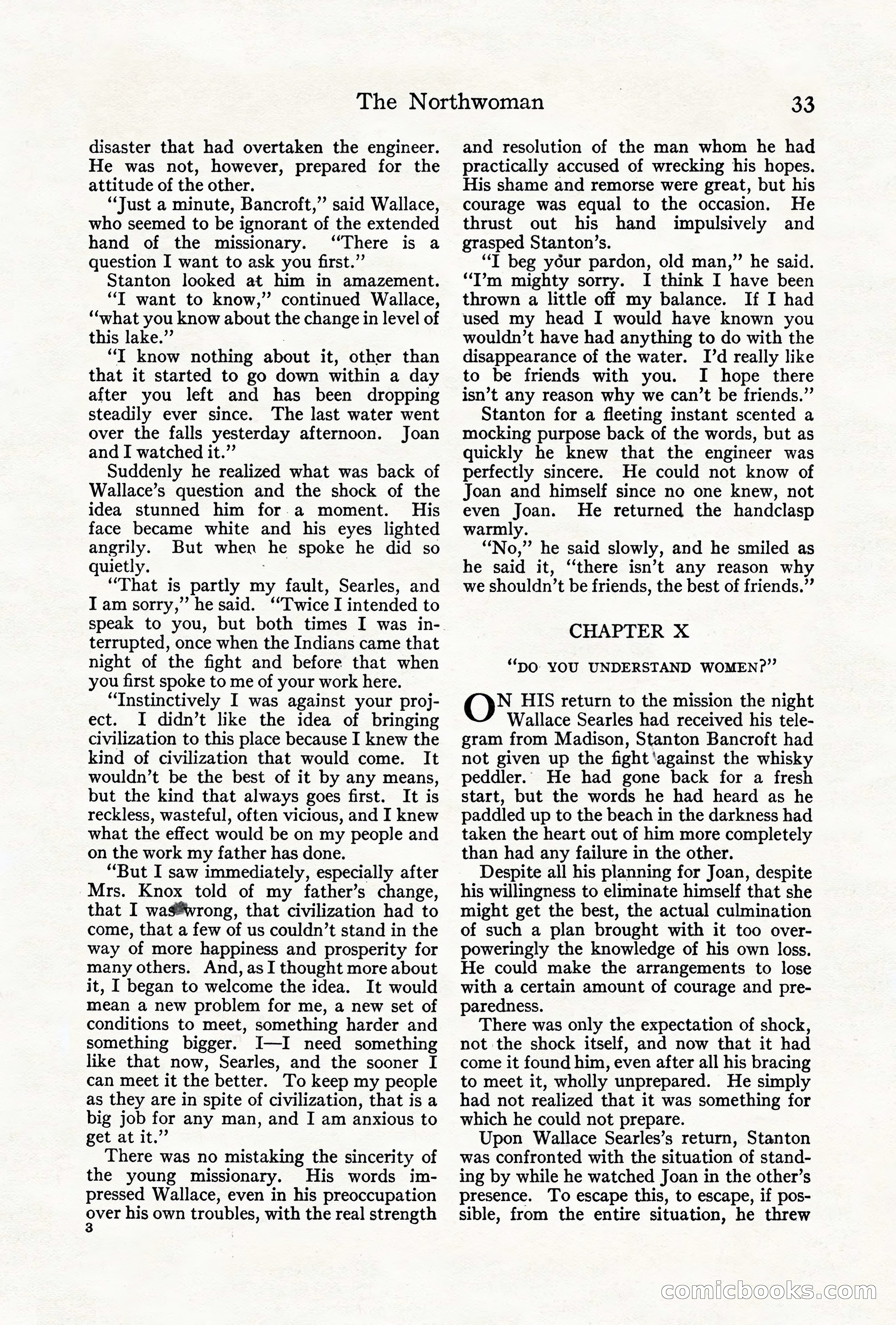
A restored page from Pulp Fiction, 1917. Page through the whole issue in the reader above.
📄 Transcribed text from this page (OCR, searchable)
Machine-transcribed from the original scan — historical spelling and the odd misread are preserved.
The Northwoman disaster that had overtaken the engineer. He was not, however, prepared for the attitude of the other. “Just a minute, Bancroft,” said Wallace, who seemed to be ignorant of the extended hand of the missionary. “There is a question I want to ask you first.” Stanton looked at him in amazement. “IT want to know,” continued Wallace, “what you know about the change in level of this lake.” 7 “I know nothing about it, other than that it started to go down within a day after you left and has been dropping steadily ever since. The last water went over the falls yesterday afternoon. Joan and I watched it.” Suddenly he realized what was back of Wallace’s question and the shock of the idea stunned him for.a moment. His face became white and his eyes lighted angrily. But when he spoke he did so quietly. “That is partly my fault, Searles, and Iam sorry,” he said. ‘Twice I intended to speak to you, but both times I was in- terrupted, once when the Indians came that night of the fight and before that when you first spoke to me of your work here. “Instinctively I was against your proj- ect. I didn’t like the idea of bringing civilization to this place because I knew the kind of civilization that would come. It wouldn’t be the best of it by any means, but the kind that always goes first. It is reckless, wasteful, often vicious, and I knew what the effect would be on my people and on the work my father has done. “But I saw immediately, especially after Mrs. Knox told of my father’s change, that I was#wrong, that civilization had to come, that a few of us couldn’t stand in the way of more happiness and prosperity for many others. And, asI thought more about it, I began to welcome the idea. It would mean a new problem for me, a new set of conditions to meet, something harder and something bigger. I—I need something like that now, Searles, and the sooner I can meet it the better. To keep my people as they are in spite of civilization, that is a big job for any man, and I am anxious to pet at it.” There was no mistaking the sincerity of the young missionary. His words im- pressed Wallace, even in his preoccupation over his own troubles, with the real strength 33 and resolution of the man whom he had practically accused of wrecking his hopes. His shame and remorse were great, but his courage was equal to the occasion. He thrust out his hand impulsively and grasped Stanton’s. “I beg your pardon, old man,” he said. “I’m mighty sorry. I think I have been thrown a little off my balance. If I had used my head I would have known you wouldn’t have had anything to do with the disappearance of the water. I’d really like to be friends with you. I hope there isn’t any reason why we can’t be friends.”’ Stanton for a fleeting instant scented a mocking purpose back of the words, but as quickly he knew that the engineer was perfectly sincere. He could not know of Joan and himself since no one knew, not even Joan. He returned the handclasp warmly. “No,” he said slowly, and he smiled as he said it, “there isn’t any reason why we shouldn’t be friends, the best of friends.” CHAPTER X “DO YOU UNDERSTAND WOMEN?” ON HIS return to the mission the night Wallace Searles had received his tele- gram from Madison, Stanton Bancroft had not given up the fight ‘against the whisky peddler. He had gone back for a fresh start, but the words he had heard as he paddled up to the beach in the darkness had taken the heart out of him more completely than had any failure in the other. Despite all his planning for Joan, despite his willingness to eliminate himself that she might get the best, the actual culmination of such a plan brought with it too over- poweringly the knowledge of his own loss. He could make the arrangements to lose with a certain amount of courage and pre- paredness. There was only the expectation of shock, not the shock itself, and now that it had come it found him, even after all his bracing to meet it, wholly unprepared. He simply had not realized that it was something for which he could not prepare. Upon Wallace Searles’s return, Stanton was confronted with the situation of stand- ing by while he watched Joan in the other’s presence. To escape this, to escape, if pos- sible, from the entire situation, he threw cComiclsoo (© 5}