
Pulp Fiction, 1917 · page 18 of 196
Adventure, August 1917 — page 18: what you’re looking at
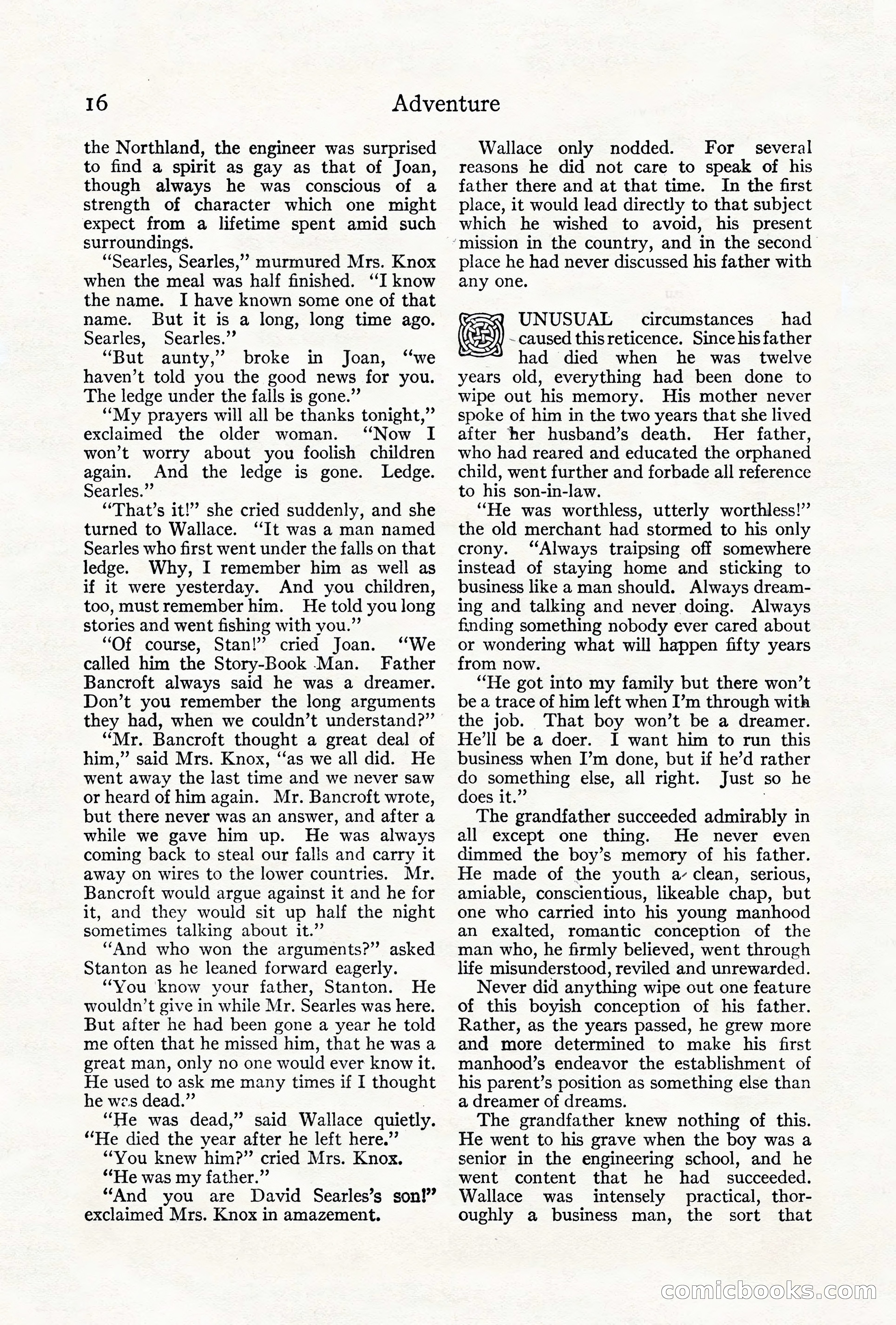
A restored page from Pulp Fiction, 1917. Page through the whole issue in the reader above.
📄 Transcribed text from this page (OCR, searchable)
Machine-transcribed from the original scan — historical spelling and the odd misread are preserved.
16 the Northland, the engineer was surprised to find a spirit as gay as that of Joan, though always he was conscious of a strength of character which one might expect from a lifetime spent amid such surroundings. ‘Searles, Searles,’”” murmured Mrs. Knox when the meal was half finished. ‘I know the name. I have known some one of that name. But it is a long, long time ago. Searles, Searles.”’ “But aunty,’ broke in Joan, “we haven’t told you the good news for you. The ledge under the falls is gone.” “My prayers will all be thanks tonight,” exclaimed the older woman. “Now I won’t worry about you foolish children again. And the ledge is gone. Ledge. Searles.” “That’s it!” she cried suddenly, and she turned to Wallace. “It was a man named Searles who first went under the falls on that ledge. Why, I remember him as well as if it were yesterday. And you children, too, must remember him. He told you long stories and went fishing with you.” “Of course, Stan!’ cried Joan. ‘“‘We called him the Story-Book Man. Father Bancroft always said he was a dreamer. Don’t you remember the long arguments they had, when we couldn’t understand?” “Mr. Bancroft thought a great deal of him,” said Mrs. Knox, ‘‘as we all did. He went away the last time and we never saw or heard of him again. Mr. Bancroft wrote, but there never was an answer, and after a while we gave him up. He was always coming back to steal our falls and carry it away on wires to the lower countries. Mr. Bancroft would argue against it and he for it, and they would sit up half the night sometimes talking about it.” “And who won the arguments?” asked Stanton as he leaned forward eagerly. ‘You know your father, Stanton. He wouldn’t give in while Mr. Searles was here. But after he had been gone a year he told me often that he missed him, that he was a great man, only no one would ever know it. He used to ask me many times if I thought he wes dead.” | “Fe was dead,” said Wallace quietly. “He died the year after he left here.” “You knew him?” cried Mrs. Knox. ‘He was my father.” “And you are David Searles’s son!” exclaimed Mrs. Knox in amazement. Adventure Wallace only nodded. For several reasons he did not care to speak of his father there and at that time. In the first place, it would lead directly to that subject which he wished to avoid, his present ‘mission in the country, and in the second place he had never discussed his father with any one. v= UNUSUAL circumstances had (GS) ~caused this reticence. Since his father had died when he was_ twelve years old, everything had been done to wipe out his memory. His mother never spoke of him in the two years that she lived after her husband’s death. Her father, who had reared and educated the orphaned child, went further and forbade all reference to his son-in-law. ‘“‘He was worthless, utterly worthless!”’ the old merchant had stormed to his only crony. ‘‘Always traipsing off somewhere instead of staying home and sticking to business like a man should. Always dream- ing and talking and never doing. Always finding something nobody ever cared about or wondering what will happen fifty years from now. “He got into my family but there won’t be a trace of him left when I’m through with the job. That boy won’t be a dreamer. He’ll be a doer. I want him to run this business when I’m done, but if he’d rather do something else, all right. Just so he does it.” 3 The grandfather succeeded admirably in all except one thing. He never even dimmed the boy’s memory of his father. He made of the youth a- clean, serious, amiable, conscientious, likeable chap, but one who carried into his young manhood an exalted, romantic conception of the man who, he firmly believed, went through life misunderstood, reviled and unrewarded. Never did anything wipe out one feature of this boyish conception of his father. Rather, as the years passed, he grew more and more determined to make his first manhood’s endeavor the establishment of his parent’s position as something else than a dreamer of dreams. The grandfather knew nothing of this. He went to his grave when the boy was a senior in the engineering school, and he went content that he had_ succeeded. Wallace was intensely practical, thor- oughly a business man, the sort that cComiclaook C© 5}