
Pulp Fiction, 1917 · page 17 of 196
Adventure, August 1917 — page 17: what you’re looking at
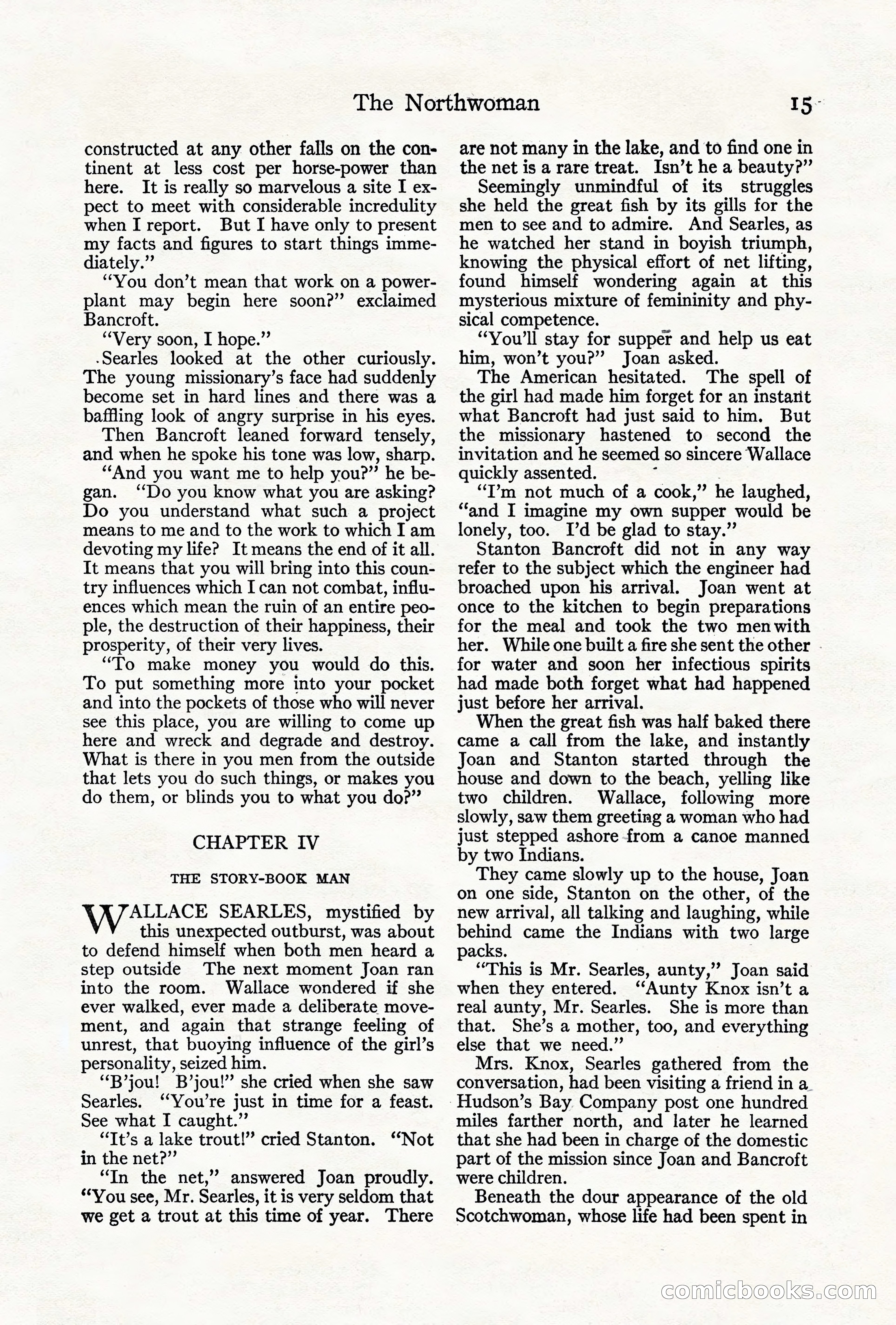
A restored page from Pulp Fiction, 1917. Page through the whole issue in the reader above.
📄 Transcribed text from this page (OCR, searchable)
Machine-transcribed from the original scan — historical spelling and the odd misread are preserved.
The Northwoman constructed at any other falls on the con- tinent at less cost per horse-power than here. It is really so marvelous a site I ex- pect to meet with considerable incredulity when I report. But I have only to present my facts and figures to start things imme- diately.” “You don’t mean that work on a power- plant may begin here soon?” exclaimed Bancroft. “Very soon, I hope.” -Searles looked at the other curiously. The young missionary’s face had suddenly become set in hard lines and there was a baffling look of angry surprise in his eyes. Then Bancroft leaned forward tensely, and when he spoke his tone was low, sharp. ‘‘And you want me to help you?” he be- gan. ‘Do you know what you are asking? Do you understand what such a project means to me and to the work to which I am devoting my life? It means the end of it all. It means that you will bring into this coun- try influences which I can not combat, influ- ences which mean the ruin of an entire peo- ple, the destruction of their happiness, their prosperity, of their very lives. “To make money you would do this. To put something more into your pocket and into the pockets of those who will never see this place, you are willing to come up here and wreck and degrade and destroy. What is there in you men from the outside that lets you do such things, or makes you do them, or blinds you to what you do?” CHAPTER IV THE STORY-BOOK MAN AV VE Ser ana SEARLES, mystified by this unexpected outburst, was about to defend himself when both men heard a step outside The next moment Joan ran into the room. Wallace wondered if she ever walked, ever made a deliberate move- ment, and again that strange feeling of unrest, that buoying influence of the girl’s personality, seized him. “B’jou! B’jou!” she cried when she saw Searles. ‘“‘You’re just in time for a feast. See what I caught.”’ “Tt’s a lake trout!” cried Stanton. “Not in the net?” “In the net,” answered Joan proudly. “You see, Mr. Searles, it is very seldom that we get a trout at this time of year. There are not many in the lake, and to find one in the net is a rare treat. Isn’t he a beauty?” Seemingly unmindful of its struggles she held the great fish by its gills for the men to see and to admire. And Searles, as he watched her stand in boyish triumph, knowing the physical effort of net lifting, found himself wondering again at this mysterious mixture of femininity and phy- sical competence. “You'll stay for supper and help us eat him, won’t your” Joan asked. The American hesitated. The spell of the girl had made him forget for an instarit what Bancroft had just said to him. But the missionary hastened to second the invitation and he seemed so sincere Wallace quickly assented. “I’m not much of a cook,” he laughed, “and I imagine my own supper would be lonely, too. I’d be glad to stay.” Stanton Bancroft did not in any way refer to the subject which the engineer had broached upon his arrival. Joan went at once to the kitchen to begin preparations for the meal and took the two menwith her. While one built a fire she sent the other - for water and soon her infectious spirits had made both forget what had happened just before her arrival. When the great fish was half baked there came a call from the lake, and instantly Joan and Stanton started through the house and down to the beach, yelling like two children. Wallace, following more slowly, saw them greeting a woman who had just stepped ashore from a canoe manned by two Indians. They came slowly up to the house, Joan on one side, Stanton on the other, of the new arrival, all talking and laughing, while behind came the Indians with two large packs. “This is Mr. Searles, aunty,’ Joan said when they entered. “Aunty Knox isn’t a real aunty, Mr. Searles. She is more than that. She’s a mother, too, and everything else that we need.” Mrs. Knox, Searles gathered from the conversation, had been visiting a friend in a -Hudson’s Bay Company post one hundred miles farther north, and later he learned that she had been in charge of the domestic part of the mission since Joan and Bancroft were children. Beneath the dour appearance of the old Scotchwoman, whose life had been spent in CoMmiclsoo 15- © S|