
Pulp Fiction, 1917 · page 19 of 196
Adventure, August 1917 — page 19: what you’re looking at
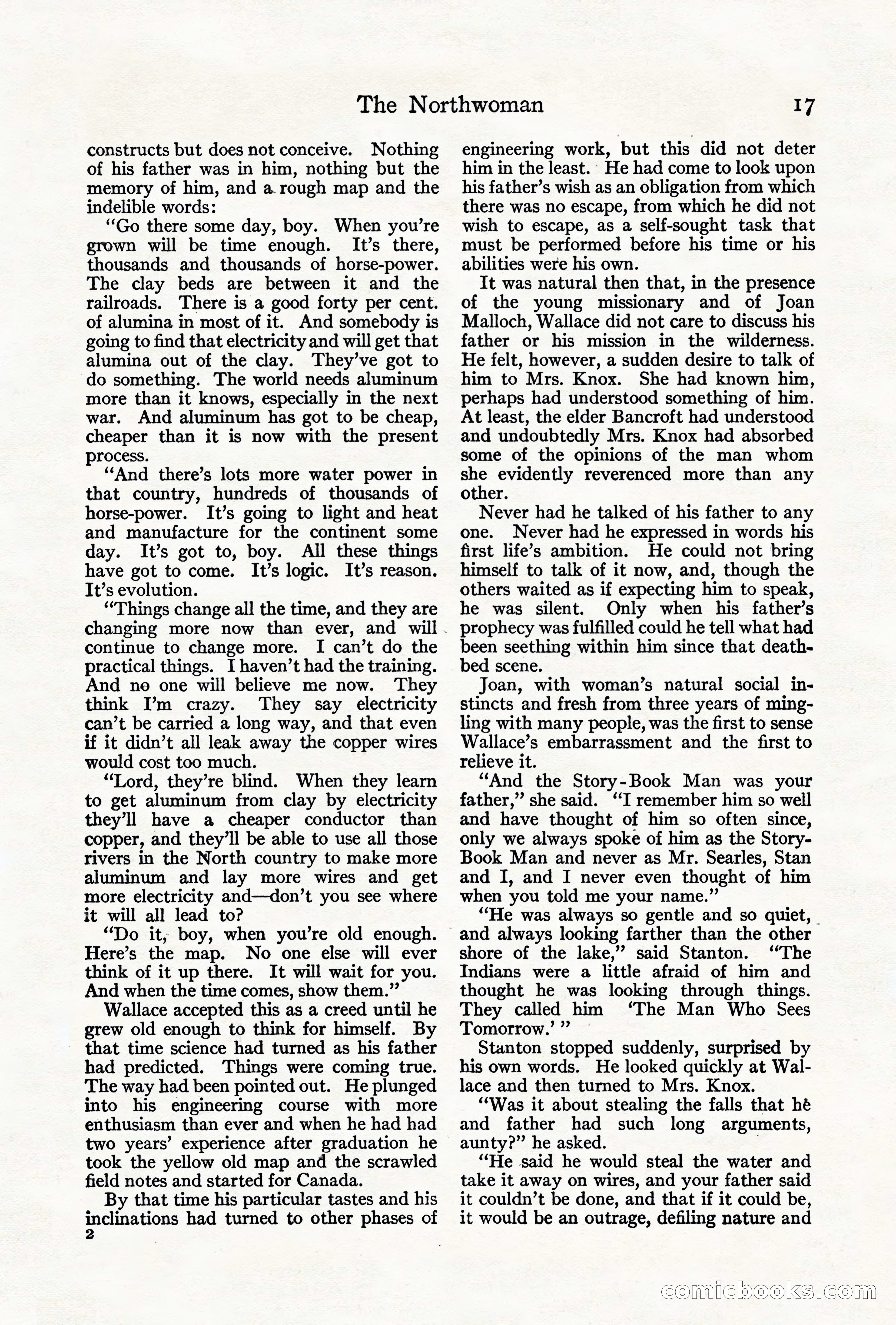
A restored page from Pulp Fiction, 1917. Page through the whole issue in the reader above.
📄 Transcribed text from this page (OCR, searchable)
Machine-transcribed from the original scan — historical spelling and the odd misread are preserved.
The Northwoman constructs but does not conceive. Nothing of his father was in him, nothing but the memory of him, and a.rough map and the indelible words: ‘““Go there some day, boy. When you’re grown will be time enough. It’s there, thousands and thousands of horse-power. The clay beds are between it and the railroads. There is a good forty per cent. of alumina in most of it. And somebody is going to find that electricity and will get that alumina out of the clay. They’ve got to do something. The world needs aluminum more than it knows, especially in the next war. And aluminum has got to be cheap, cheaper than it is now with the present process. ‘‘And there’s lots more water power in that country, hundreds of thousands of horse-power. It’s going to light and heat and manufacture for the continent some day. It’s got to, boy. All these things have got to come. It’s logic. It’s reason. It’s evolution. ‘“‘Things change all the time, and they are changing more now than ever, and will. continue to change more. I can’t do the practical things. I haven’t had the training. And no one will believe me now. They think I’m crazy. They say electricity can’t be carried a long way, and that even if it didn’t all leak away the copper wires would cost too much. “Lord, they’re blind. When they learn to get aluminum from clay by electricity they'll have a cheaper conductor than copper, and they’ll be able to use all those rivers in the North country to make more aluminum and lay more wires and get more electricity and—don’t you see where it will all lead to? “Do it; boy, when you're old enough. Here’s the map. No one else will ever think of it up there. It will wait for you. And when the time comes, show them.” Wallace accepted this as a creed until he grew old enough to think for himself. By _ that time science had turned as his father had predicted. Things were coming true. The way had been pointed out. He plunged into his engineering course with more enthusiasm than ever and when he had had two years’ experience after graduation he took the yellow old map and the scrawled field notes and started for Canada. By that time his particular tastes and his inclinations had turned to other phases of 17 engineering work, but this did not deter him in the least.’ He had come to look upon his father’s wish as an obligation from which there was no escape, from which he did not wish to escape, as a self-sought task that must be performed before his time or his abilities were his own. It was natural then that, in the presence of the young missionary and of Joan Malloch, Wallace did not care to discuss his father or his mission in the wilderness. He felt, however, a sudden desire to talk of him to Mrs. Knox. She had known him, perhaps had understood something of him. At least, the elder Bancroft had understood and undoubtedly Mrs. Knox had absorbed some of the opinions of the man whom she evidently reverenced more than any other. Never had he talked of his father to any one. Never had he expressed in words his first life’s ambition. He could not bring himself to talk of it now, and, though the others waited as if expecting him to speak, he was silent. Only when his father’s prophecy was fulfilled could he tell what had been seething within him since that death- bed scene. Joan, with woman’s natural social in- stincts and fresh from three years of ming- ling with many people, was the first to sense Wallace’s embarrassment and the first to relieve it. “And the Story-Book Man was your father,” she said. “I remember him so well and have thought of him so often since, only we always spoke of him as the Story- Book Man and never as Mr. Searles, Stan and I, and I never even thought of him when you told me your name.” “He was always so gentle and so quiet, and always looking farther than the other shore of the lake,’’ said Stanton. ‘The Indians were a little afraid of him and thought he was looking through things. They called him “The Man Who Sees Tomorrow.’ ”’ Stanton stopped suddenly, surprised by his own words. He looked quickly at Wal- lace and then turned to Mrs. Knox. ‘“‘Was it about stealing the falls that hé and father had such long arguments, aunty?” he asked. “He said he would steal the water and take it away on wires, and your father said it couldn’t be done, and that if it could be, it would be an outrage, defiling nature and cComiclsoo CO S|