
Pulp Fiction, 1917 · page 10 of 196
Adventure, August 1917 — page 10: what you’re looking at
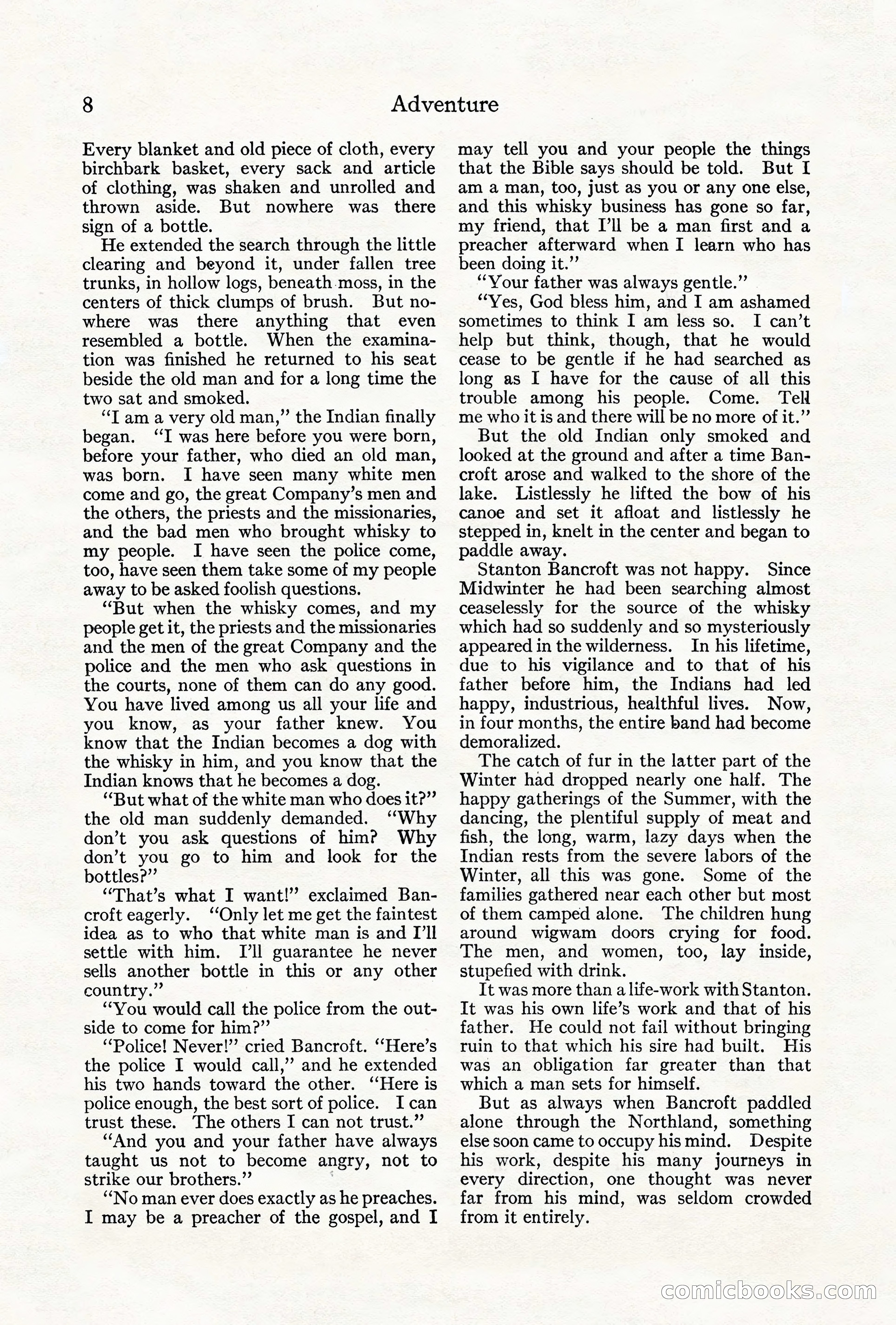
A restored page from Pulp Fiction, 1917. Page through the whole issue in the reader above.
📄 Transcribed text from this page (OCR, searchable)
Machine-transcribed from the original scan — historical spelling and the odd misread are preserved.
8 Adventure Every blanket and old piece of cloth, every birchbark basket, every sack and article of clothing, was shaken and unrolled and thrown aside. But nowhere was there sign of a bottle. He extended the search through the little clearing and beyond it, under fallen tree trunks, in hollow logs, beneath-moss, in the centers of thick clumps of brush. But no- where was there anything that even resembled a bottle. When the examina- tion was finished he returned to his seat beside the old man and for a long time the two sat and smoked. “T am a very old man,” the Indian finally began. “I was here before you were born, before your father, who died an old man, was born. I have seen many white men come and go, the great Company’s men and the others, the priests and the missionaries, and the bad men who brought whisky to my people. I have seen the police come, too, have seen them take some of my people away to be asked foolish questions. “But when the whisky comes, and my people get it, the priests and the missionaries and the men of the great Company and the police and the men who ask questions in the courts, none of them can do any good. You have lived among us all your life and you know, as your father knew. You know that the Indian becomes a dog with the whisky in him, and you know that the Indian knows that he becomes a dog. “But what of the white man who does it?” the old man suddenly demanded. “Why don’t you ask questions of him? Why don’t you go to him and look for the bottles?”’ “That’s what I want!” exclaimed Ban- croft eagerly. ‘‘Only let me get the faintest idea as to who that white man is and [ll settle with him. I'll guarantee he never sells another bottle in this or any other country.” “You would call the police from the out- side to come for him?” “Police! Never!” cried Bancroft. “‘Here’s the police I would call,’’ and he extended his two hands toward the other. ‘Here is police enough, the best sort of police. I can trust these. The others I can not trust.” “And you and your father have always taught us not to become angry, not to strike our brothers.” 3 ‘“‘No man ever does exactly as he preaches. I may be a preacher of the gospel, and I may tell you and your people the things that the Bible says should be told. But [ am a man, too, just as you or any one else, and this whisky business has gone so far, my friend, that I’ll be a man first and a preacher afterward when I learn who has been doing it.”’ “Your father was always gentle.”’ ‘Yes, God bless him, and I am ashamed sometimes to think I am less so. I can’t help but think, though, that he would cease to be gentle if he had searched as long as I have for the cause of all this trouble among his people. Come. Tell me who it is and there will be no more of it.’ But the old Indian only smoked and looked at the ground and after a time Ban- croft arose and walked to the shore of the lake. Listlessly he lifted the bow of his canoe and set it afloat and listlessly he stepped in, knelt in the center and began to paddle away. Stanton Bancroft was not happy. Since Midwinter he had been searching almost ceaselessly for the source of the whisky which had so suddenly and so mysteriously appeared in the wilderness. In his lifetime, due to his vigilance and to that of his father before him, the Indians had led happy, industrious, healthful lives. Now, in four months, the entire band had become demoralized. The catch of fur in the latter part of the Winter had dropped nearly one half. The happy gatherings of the Summer, with the dancing, the plentiful supply of meat and fish, the long, warm, lazy days when the Indian rests from the severe labors of the Winter, all this was gone. Some of the families gathered near each other but most of them camped alone. The children hung around wigwam doors crying for food. The men, and women, too, lay inside, stupefied with drink. It was more than a life-work with Stanton. It was his own life’s work and that of his father. He could not fail without bringing ruin to that which his sire had built. His was an obligation far greater than that which a man sets for himself. But as always when Bancroft paddled alone through the Northland, something else soon came to occupy hismind. Despite his work, despite his many journeys in every direction, one thought was never far from his mind, was seldom crowded from it entirely. cComiclook C© S|