
Pulp Fiction, 1917 · page 11 of 196
Adventure, August 1917 — page 11: what you’re looking at
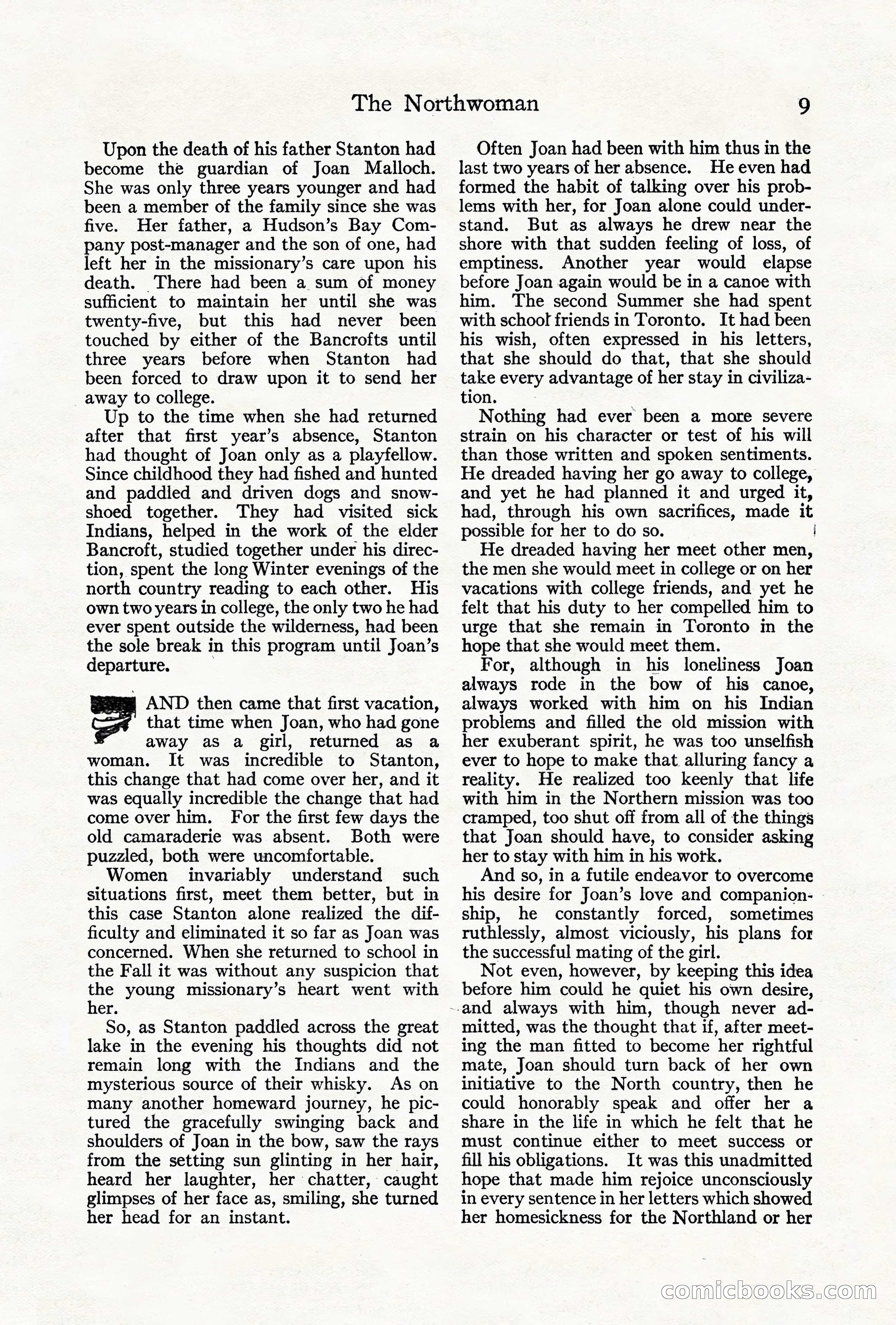
A restored page from Pulp Fiction, 1917. Page through the whole issue in the reader above.
📄 Transcribed text from this page (OCR, searchable)
Machine-transcribed from the original scan — historical spelling and the odd misread are preserved.
The Northwoman Upon the death of his father Stanton had become the guardian of Joan Malloch. She was only three years younger and had been a member of the family since she was five. Her father, a Hudson’s Bay Com- pany post-manager and the son of one, had left her in the missionary’s care upon his death. There had been a sum of money sufficient to maintain her until she was twenty-five, but this had never been touched by either of the Bancrofts until three years before when Stanton had been forced to draw upon it to send her away to college. Up to the time when she had returned after that first year’s absence, Stanton had thought of Joan only as a playfellow. Since childhood they had fished and hunted and paddled and driven dogs and snow- shoed together. They had visited sick Indians, helped in the work of the elder Bancroft, studied together under his direc- tion, spent the long Winter evenings of the north country reading to each other. His own two years in college, the only two he had ever spent outside the wilderness, had been the sole break in this program until Joan’s oes s AND then came that first vacation, that time when Joan, who had gone away as a girl, returned as a woman. It was incredible to Stanton, this change that had come over her, and it was equally incredible the change that had come over him. For the first few days the old camaraderie was absent. Both were puzzled, both were uncomfortable. Women invariably understand such situations first, meet them better, but in this case Stanton alone realized the dif- ficulty and eliminated it so far as Joan was concerned. When she returned to school in the Fall it was without any suspicion that the young missionary’s heart went with her. So, as Stanton paddled across the great lake in the evening his thoughts did not remain long with the Indians and the mysterious source of their whisky. As on many another homeward journey, he pic- tured the gracefully swinging back and shoulders of Joan in the bow, saw the rays from the setting sun glinting in her hair, heard her laughter, her chatter, caught glimpses of her face as, smiling, she turned her head for an instant. 9 Often Joan had been with him thus in the last two years of her absence. He even had formed the habit of talking over his prob- lems with her, for Joan alone could under- stand. But as always he drew near the shore with that sudden feeling of loss, of emptiness. Another year would elapse before Joan again would be in a canoe with him. The second Summer she had spent with school friends in Toronto. It had been his wish, often expressed in his letters, that she should do that, that she should take every advantage of her stay in civiliza- tion. Nothing had ever been a more severe strain on his character or test of his will than those written and spoken sentiments. He dreaded having her go away to college, and yet he had planned it and urged it, had, through his own sacrifices, made it possible for her to do so. He dreaded having her meet other men, the men she would meet in college or on her vacations with college friends, and yet he felt that his duty to her compelled him to urge that she remain in Toronto in the hope that she would meet them. For, although in his loneliness Joan always rode in the bow of his canoe, always worked with him on his Indian problems and filled the old mission with her exuberant spirit, he was too unselfish ever to hope to make that alluring fancy a reality. He realized too keenly that life with him in the Northern mission was too cramped, too shut off from all of the things that Joan should have, to consider asking her to stay with him in his work. And so, in a futile endeavor to overcome | his desire for Joan’s love and companion- - ship, he constantly forced, sometimes ruthlessly, almost viciously, his plans for the successful mating of the girl. Not even, however, by keeping this idea before him could he quiet his own desire, -and always with him, though never ad- mitted, was the thought that if, after meet- ing the man fitted to become her rightful mate, Joan should turn back of her own initiative to the North country, then he could honorably speak and offer her a share in the life in which he felt that he must continue either to meet success or fill his obligations. It was this unadmitted hope that made him rejoice unconsciously in every sentence in her letters which showed her homesickness for the Northland or her CoOMmiclsoo CO 5}