
Pulp Fiction, 1917 · page 9 of 196
Adventure, August 1917 — page 9: what you’re looking at
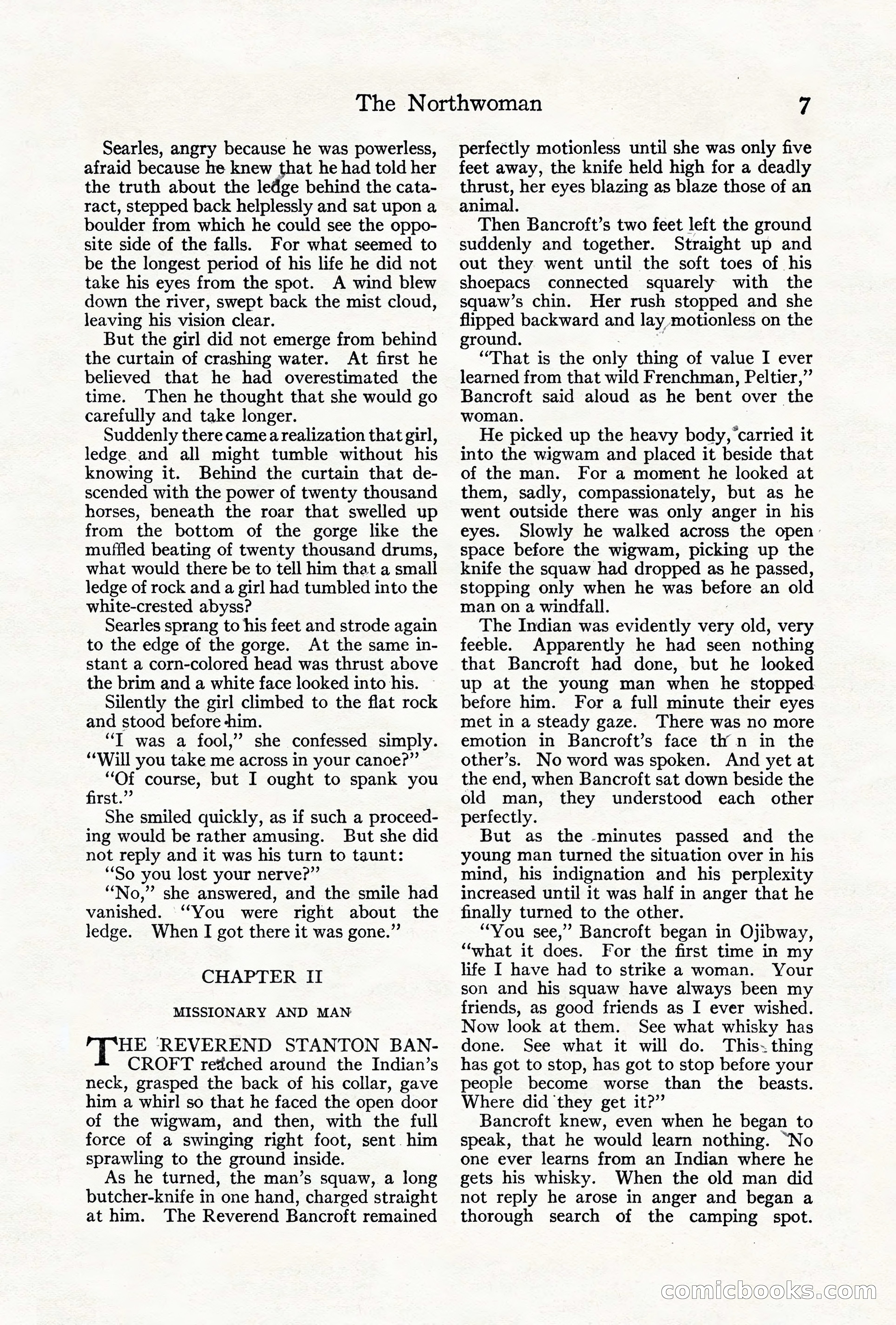
A restored page from Pulp Fiction, 1917. Page through the whole issue in the reader above.
📄 Transcribed text from this page (OCR, searchable)
Machine-transcribed from the original scan — historical spelling and the odd misread are preserved.
The Northwoman Searles, angry because he was powerless, afraid because he knew that he had told her the truth about the ledge behind the cata- ract, stepped back helplessly and sat upon a boulder from which he could see the Oppo- site side of the falls. For what seemed to be the longest period of his life he did not take his eyes from the spot. A wind blew down the river, swept back the mist cloud, leaving his vision clear. But the girl did not emerge from behind the curtain of crashing water. At first he believed that he had overestimated the time. Then he thought that she would go carefully and take longer. Suddenly there came a realization that girl, ledge. and all might tumble without his knowing it. Behind the curtain that de- scended with the power of twenty thousand horses, beneath the roar that swelled up from the bottom of the gorge like the muffled beating of twenty thousand drums, what would there be to tell him that a small ledge of rock and a girl had tumbled into the white-crested abyss? Searles sprang to his feet and strode again to the edge of the gorge. At the same in- stant a corn-colored head was thrust above the brim and a white face looked into his. Silently the girl climbed to the flat rock and stood before him. “T was a fool,’ she confessed simply. ‘Will you take me across in your canoe?”’ “Of course, but I ought to spank you first.” She smiled quickly, as if such a proceed- ing would be rather amusing. But she did not reply and it was his turn to taunt: ‘So you lost your nerve?” “No,” she answered, and the smile had vanished. ‘You were right about the ledge. When I got there it was gone.” CHAPTER II MISSIONARY AND MAN HE REVEREND STANTON BAN- CROFT reached around the Indian’s neck, grasped the back of his collar, gave him a whirl so that he faced the open door of the wigwam, and then, with the full force of a swinging right foot, sent. him sprawling to the ground inside. As he turned, the man’s squaw, a long butcher-knife in one hand, charged straight at him. The Reverend Bancroft remained 7 perfectly motionless until she was only five feet away, the knife held high for a deadly thrust, her eyes blazing as blaze those of an animal. Then Bancroft’s two feet left the ground suddenly and together. Straight up and out they went until the soft toes of his shoepacs connected squarely with the squaw’s chin. Her rush stopped and she flipped backward and lay motionless on the ground. “That is the only thing of value I ever learned from that wild Frenchman, Peltier,”’ Bancroft said aloud as he bent over ‘the woman. He picked up the heavy body, carried it into the wigwam and placed it beside that of the man. For a moment he looked at them, sadly, compassionately, but as he went outside there was only anger in his eyes. space before the wigwam, picking up the knife the squaw had dropped as he passed, stopping only when he was before an old man on a windfall. The Indian was evidently very old, very feeble. Apparently he had seen nothing that Bancroft had done, but he looked up at the young man when he stopped before him. For a full minute their eyes met in a steady gaze. There was no more emotion in Bancroft’s face th n in the other’s. No word was spoken. And yet at the end, when Bancroft sat down beside the old man, they understood each other perfectly. But as the minutes passed and the young man turned the situation over in his mind, his indignation and his perplexity increased until it was half in anger that he finally turned to the other. “You see,” Bancroft began in Ojibway, “what it does. For the first time in my hfe I have had to strike a woman. Your son and his squaw have always been my friends, as good friends as I ever wished. Now look at them. See what whisky has done. See what it will do. This- thing has got to stop, has got to stop before your people become worse than the beasts. Where did they get it?” Bancroft knew, even when he began to speak, that he would learn nothing. “No one ever learns from an Indian where he gets his whisky. When the old man did not reply he arose in anger and began a thorough search of the camping spot. cCoOMmiclsoo Slowly he walked across the open: CO 5}