
Pulp Fiction, 1911 · page 15 of 196
Adventure Magazine Cover — page 15: what you’re looking at
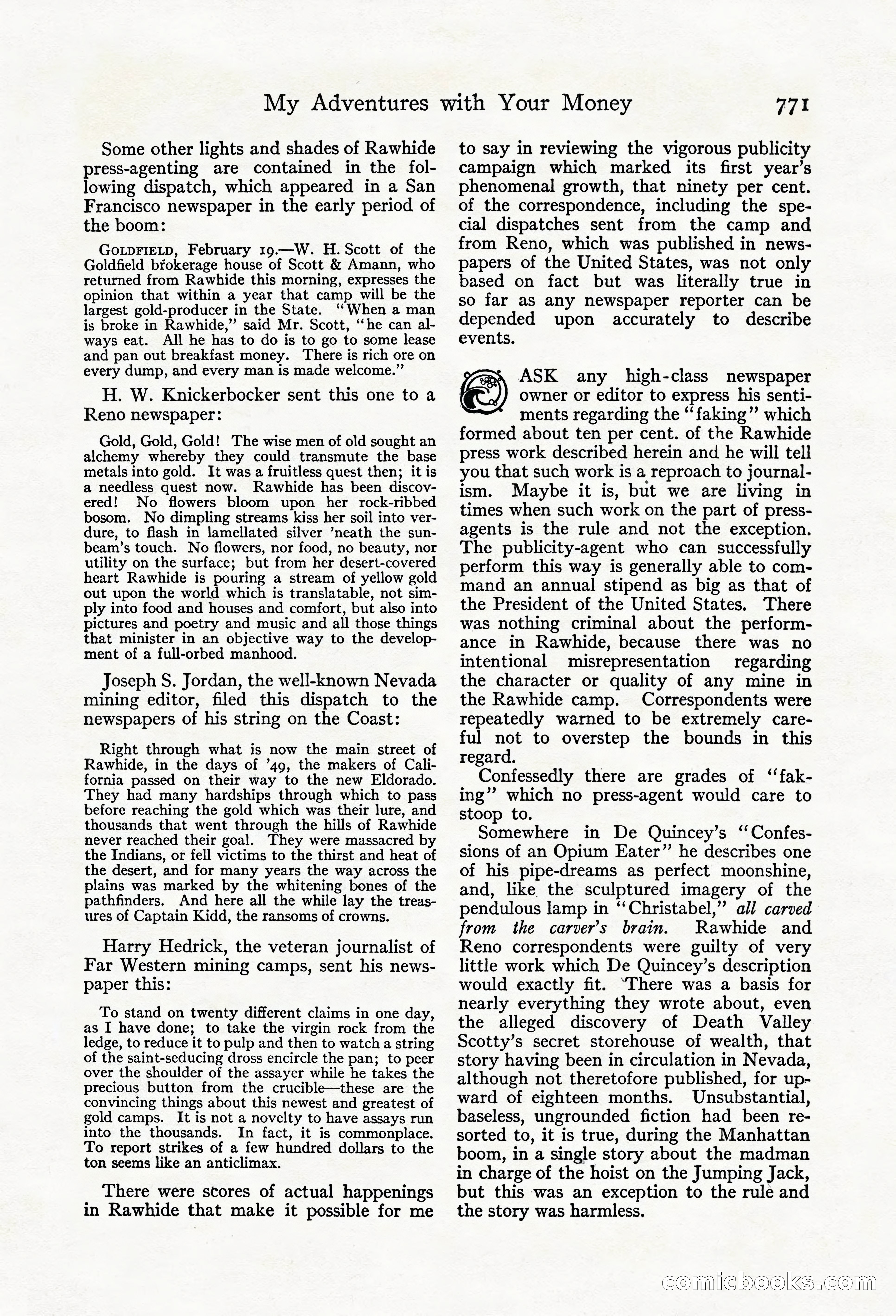
A restored page from Pulp Fiction, 1911. Page through the whole issue in the reader above.
📄 Transcribed text from this page (OCR, searchable)
Machine-transcribed from the original scan — historical spelling and the odd misread are preserved.
My Adventures with Your Money Some other lights and shades of Rawhide press-agenting are contained in the fol- lowing dispatch, which appeared in a San Francisco newspaper in the early period of the boom: GOLDFIELD, February 19.—W. H. Scott of the Goldfield brokerage house of Scott & Amann, who returned from Rawhide this morning, expresses the opinion that within a year that camp will be the largest gold-producer in the State. ‘‘When a man is broke in Rawhide,” said Mr. Scott, ‘“‘he can al- ways eat. All he has to do is to go to some lease and pan out breakfast money. There is rich ore on every dump, and every man is made welcome.” H. W. Knickerbocker sent this one to a Reno newspaper: Gold, Gold, Gold! The wise men of old sought an alchemy whereby they could transmute the base metals into gold. It was a fruitless quest then; it is a needless quest now. Rawhide has been discov- ered! No flowers bloom upon her rock-ribbed bosom. No dimpling streams kiss her soil into ver- dure, to flash in lamellated silver ’neath the sun- beam’s touch. No flowers, nor food, no beauty, nor utility on the surface; but from her desert-covered heart Rawhide is pouring a stream of yellow gold out upon the world which is translatable, not sim- ply into food and houses and comfort, but also into pictures and poetry and music and all those things that minister in an objective way to the develop- ment of a full-orbed manhood. Joseph S. Jordan, the well-known Nevada mining editor, filed this dispatch to the newspapers of his string on the Coast: Right through what is now the main street of Rawhide, in the days of ’49, the makers of Cali- fornia passed on their way to the new Eldorado. They had many hardships through which to pass before reaching the gold which was their lure, and thousands that went through the hills of Rawhide never reached their goal. They were massacred by the Indians, or fell victims to the thirst and heat of the desert, and for many years the way across the plains was marked by the whitening bones of the pathfinders. And here all the while lay the treas- ures of Captain Kidd, the ransoms of crowns. Harry Hedrick, the veteran journalist of Far Western mining camps, sent his news- paper this: To stand on twenty different claims in one day, as I have done; to take the virgin rock from the ledge, to reduce it to pulp and then to watch a string of the saint-seducing dross encircle the pan; to peer over the shoulder of the assayer while he takes the precious button from the crucible—these are the convincing things about this newest and greatest of gold camps. It is not a novelty to have assays run into the thousands. In fact, it is commonplace. To report strikes of a few hundred dollars to the ton seems like an anticlimax. There were scores of actual happenings in Rawhide that make it possible for me 771 to say in reviewing the vigorous publicity campaign which marked its first year’s phenomenal growth, that ninety per cent. of the correspondence, including the spe- cial dispatches sent from the camp and from Reno, which was published in news- papers of the United States, was not only based on fact but was literally true in so far as any newspaper reporter can be depended upon accurately to describe events. ©) owner or editor to express his senti- ments regarding the “‘faking”’ which formed about ten per cent. of the Rawhide press work described herein and he will tell you that such work is a reproach to journal- ism. Maybe it is, but we are living in times when such work on the part of press- agents is the rule and not the exception. The publicity-agent who can successfully perform this way is generally able to com- mand an annual stipend as big as that of the President of the United States. There was nothing criminal about the perform- ance in Rawhide, because there was no intentional misrepresentation regarding the character or quality of any mine in the Rawhide camp. Correspondents were repeatedly warned to be extremely care- ful not to overstep the bounds in this regard. Confessedly there are grades of ‘‘fak- ing’’ which no press-agent would care to stoop to. Somewhere in De Quincey’s ‘‘Confes- sions of an Opium Eater”’ he describes one of his pipe-dreams as perfect moonshine, and, like the sculptured imagery of the pendulous lamp in “‘Christabel,”’ all carved from the carver’s brain. Rawhide and Reno correspondents were guilty of very little work which De Quincey’s description would exactly fit. “There was a basis for nearly everything they wrote about, even the alleged discovery of Death Valley Scotty’s secret storehouse of wealth, that story having been in circulation in Nevada, although not theretofore published, for up- ward of eighteen months. Unsubstantial, baseless, ungrounded fiction had been re- sorted to, it is true, during the Manhattan boom, in a single story about the madman in charge of the hoist on the Jumping Jack, but this was an exception to the rule and the story was harmless. ASK any high-class newspaper co Ghbooks 5}