
Pulp Fiction, 1911 · page 14 of 196
Adventure Magazine Cover — page 14: what you’re looking at
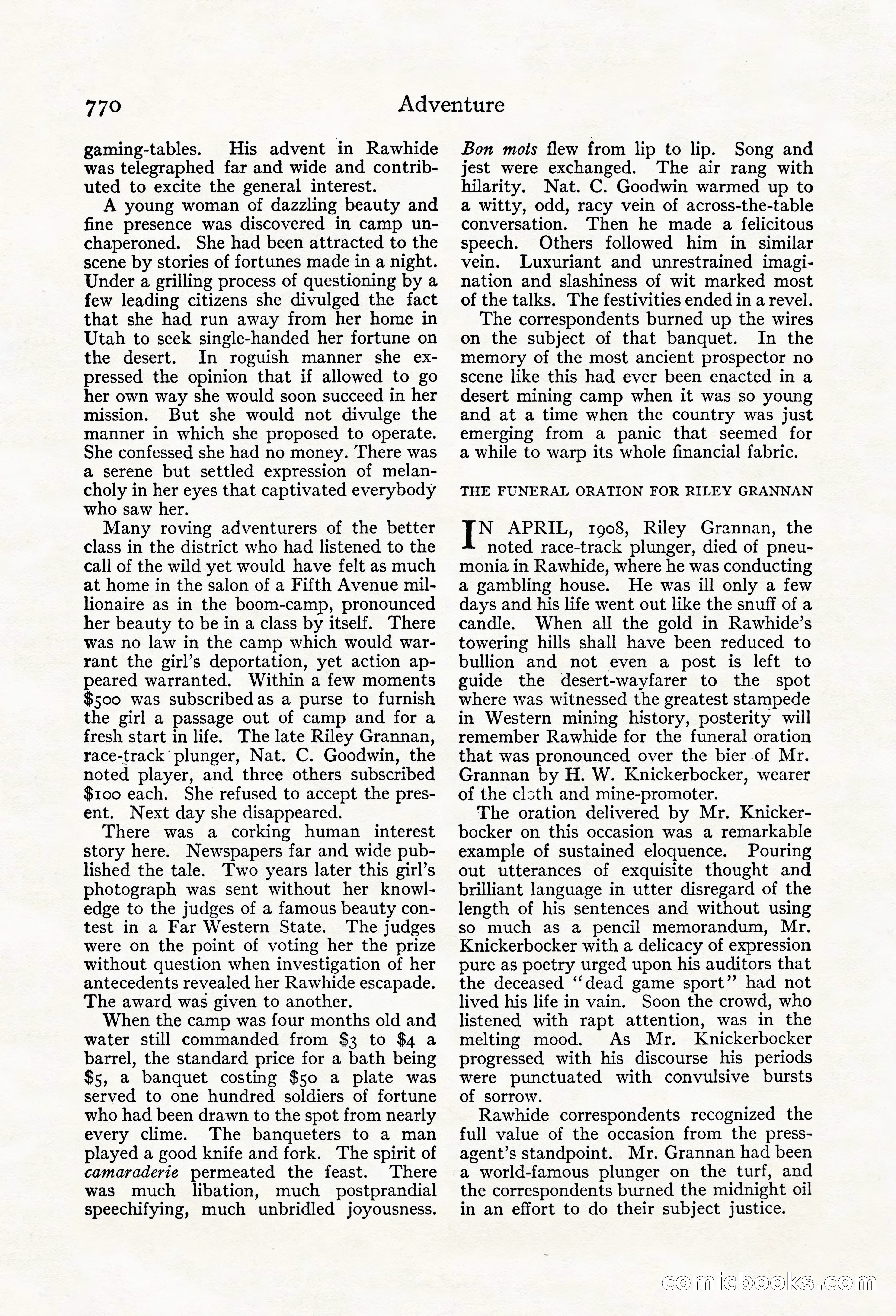
A restored page from Pulp Fiction, 1911. Page through the whole issue in the reader above.
📄 Transcribed text from this page (OCR, searchable)
Machine-transcribed from the original scan — historical spelling and the odd misread are preserved.
7/0 gaming-tables. His advent in Rawhide was telegraphed far and wide and contrib- uted to excite the general interest. A young woman of dazzling beauty and fine presence was discovered in camp un- chaperoned. She had been attracted to the scene by stories of fortunes made in a night. Under a grilling process of questioning by a few leading citizens she divulged the fact that she had run away from her home in Utah to seek single-handed her fortune on the desert. In roguish manner she ex- pressed the opinion that if allowed to go her own way she would soon succeed in her mission. But she would not divulge the manner in which she proposed to operate. She confessed she had no money. There was a serene but settled expression of melan- choly in her eyes that captivated everybody who saw her. Many roving adventurers of the better class in the district who had listened to the call of the wild yet would have felt as much at home in the salon of a Fifth Avenue mil- lionaire as in the boom-camp, pronounced her beauty to be in a class by itself. There was no law in the camp which would war- rant the girl’s deportation, yet action ap- peared warranted. Within a few moments $500 was subscribed as a purse to furnish the girl a passage out of camp and for a fresh start in life. The late Riley Grannan, race-track plunger, Nat. C. Goodwin, the noted player, and three others subscribed $100 each. She refused to accept the pres- ent. Next day she disappeared. There was a corking human interest story here. Newspapers far and wide pub- lished the tale. Two years later this girl’s photograph was sent without her knowl- edge to the judges of a famous beauty con- test in a Far Western State. The judges were on the point of voting her the prize without question when investigation of her antecedents revealed her Rawhide escapade. The award was given to another. When the camp was four months old and water still commanded from $3 to $4 a barrel, the standard price for a bath being $5, a banquet costing $50 a plate was served to one hundred soldiers of fortune who had been drawn to the spot from nearly every clime. The banqueters to a man played a good knife and fork. The spirit of camaraderie permeated the feast. There was much libation, much _ postprandial speechifying, much unbridled joyousness, Adventure Bon mots flew from lip to lip. Song and jest were exchanged. The air rang with hilarity. Nat. C. Goodwin warmed up to a witty, odd, racy vein of across-the-table conversation. Then he made a felicitous speech. Others followed him in similar vein. Luxuriant and unrestrained imagi- nation and slashiness of wit marked most of the talks. The festivities ended in a revel. The correspondents burned up the wires on the subject of that banquet. In the memory of the most ancient prospector no scene like this had ever been enacted in a desert mining camp when it was so young and at a time when the country was just emerging from a panic that seemed for a while to warp its whole financial fabric. THE FUNERAL ORATION FOR RILEY GRANNAN N APRIL, 1908, Riley Grannan, the noted race-track plunger, died of pneu- monia in Rawhide, where he was conducting a gambling house. He was ill only a few days and his life went out like the snuff of a candle. When all the gold in Rawhide’s towering hills shall have been reduced to bullion and not even a post is left to guide the desert-wayfarer to the spot where was witnessed the greatest stampede in Western mining history, posterity will remember Rawhide for the funeral oration that was pronounced over the bier-of Mr. Grannan by H. W. Knickerbocker, wearer of the clsth and mine-promoter. The oration delivered by Mr. Knicker- bocker on this occasion was a remarkable example of sustained eloquence. Pouring out utterances of exquisite thought and brilliant language in utter disregard of the length of his sentences and without using so much as a pencil memorandum, Mr. Knickerbocker with a delicacy of expression pure as poetry urged upon his auditors that the deceased ‘‘dead game sport” had not lived his life in vain. Soon the crowd, who listened with rapt attention, was in the melting mood. As Mr. Knickerbocker progressed with his discourse his periods were punctuated with convulsive bursts of sorrow. Rawhide correspondents recognized the full value of the occasion from the press- agent’s standpoint. Mr. Grannan had been a world-famous plunger on the turf, and the correspondents burned the midnight oil in an effort to do their subject justice. Conn Gbooks (©