
Pulp Fiction, 1911 · page 16 of 196
Adventure Magazine Cover — page 16: what you’re looking at
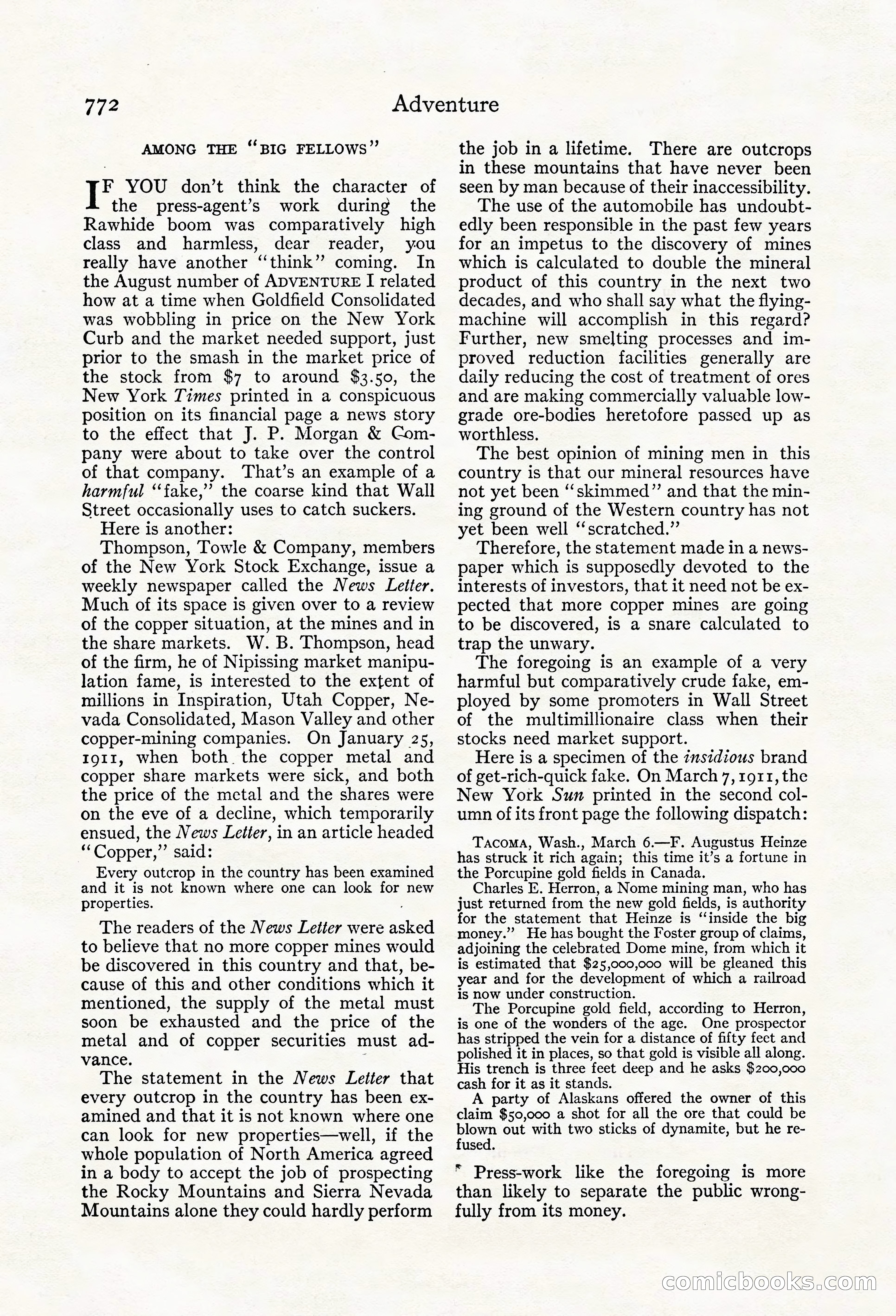
A restored page from Pulp Fiction, 1911. Page through the whole issue in the reader above.
📄 Transcribed text from this page (OCR, searchable)
Machine-transcribed from the original scan — historical spelling and the odd misread are preserved.
712 AMONG THE ‘BIG FELLOWS” F YOU don’t think the character of the press-agent’s work during the Rawhide boom was comparatively high class and harmless, dear reader, you really have another ‘‘think”? coming. In the August number of ADVENTURE I related how at a time when Goldfield Consolidated was wobbling in price on the New York Curb and the market needed support, just prior to the smash in the market price of the stock from $7 to around $3.50, the New York Times printed in a conspicuous position on its financial page a news story to the effect that J. P. Morgan & Com- pany were about to take over the control of that company. That’s an example of a harmful “‘fake,”’ the coarse kind that Wall Street occasionally uses to catch suckers. Here is another: Thompson, Towle & Company, members of the New York Stock Exchange, issue a weekly newspaper called the News Letter. Much of its space is given over to a review of the copper situation, at the mines and in the share markets. W. B. Thompson, head of the firm, he of Nipissing market manipu- lation fame, is interested to the extent of millions in Inspiration, Utah Copper, Ne- vada Consolidated, Mason Valley and other copper-mining companies. On January 25, 1911, when both the copper metal and copper share markets were sick, and both the price of the metal and the shares were on the eve of a decline, which temporarily ensued, the News Letter, in an article headed “Copper,” said: Every outcrop in the country has been examined and it is not known where one can look for new properties. The readers of the News Letter were asked to believe that no more copper mines would be discovered in this country and that, be- cause of this and other conditions which it mentioned, the supply of the metal must soon be exhausted and the price of the metal and of copper securities must ad- vance. : The statement in the News Letter that every outcrop in the country has been ex- amined and that it is not known where one can look for new properties—well, if the whole population of North America agreed in a body to accept the job of prospecting the Rocky Mountains and Sierra Nevada Mountains alone they could hardly perform Adventure the job in a lifetime. There are outcrops in these mountains that have never been seen by man because of their inaccessibility. The use of the automobile has undoubt- edly been responsible in the past few years for an impetus to the discovery of mines which is calculated to double the mineral product of this country in the next two decades, and who shall say what the flying- machine will accomplish in this regard? Further, new smelting processes and im- proved reduction facilities generally are daily reducing the cost of treatment of ores and are making commercially valuable low- grade ore-bodies heretofore passed up as worthless. The best opinion of mining men in this country is that our mineral resources have not yet been ‘“‘skimmed”’ and that the min- ing ground of the Western country has not yet been well ‘‘scratched.”’ Therefore, the statement made in a news- paper which is supposedly devoted to the interests of investors, that it need not be ex- pected that more copper mines are going to be discovered, is a snare calculated to trap the unwary. The foregoing is an example of a very harmful but comparatively crude fake, em- ployed by some promoters in Wall Street of the multimillionaire class when their stocks need market support. Here is a specimen of the zmsidious brand of get-rich-quick fake. On March 7, r911, the New York Sum printed in the second col- umn of its front page the following dispatch: Tacoma, Wash., March 6.—F. Augustus Heinze has struck it rich again; this time it’s a fortune in the Porcupine gold fields in Canada. Charles E. Herron, a Nome mining man, who has just returned from the new gold fields, is authority for the statement that Heinze is “inside the big money.” He has bought the Foster group of claims, adjoining the celebrated Dome mine, from which it is estimated that $25,000,000 will be gleaned this year and for the development of which a railroad is now under construction. The Porcupine gold field, according to Herron, is one of the wonders of the age. One prospector has stripped the vein for a distance of fifty feet and polished it in places, so that gold is visible all along. His trench is three feet deep and he asks $200,000 cash for it as it stands. A party of Alaskans offered the owner of this claim $50,000 a shot for all the ore that could be blown out with two sticks of dynamite, but he re- fused. " Press-work like the foregoing is more than likely to separate the public wrong- fully from its money. MICLOOOKS S|