
Pulp Fiction, 1922 · page 37 of 200
Adventure Magazine Cover, December 10, 1922 — page 37: what you’re looking at
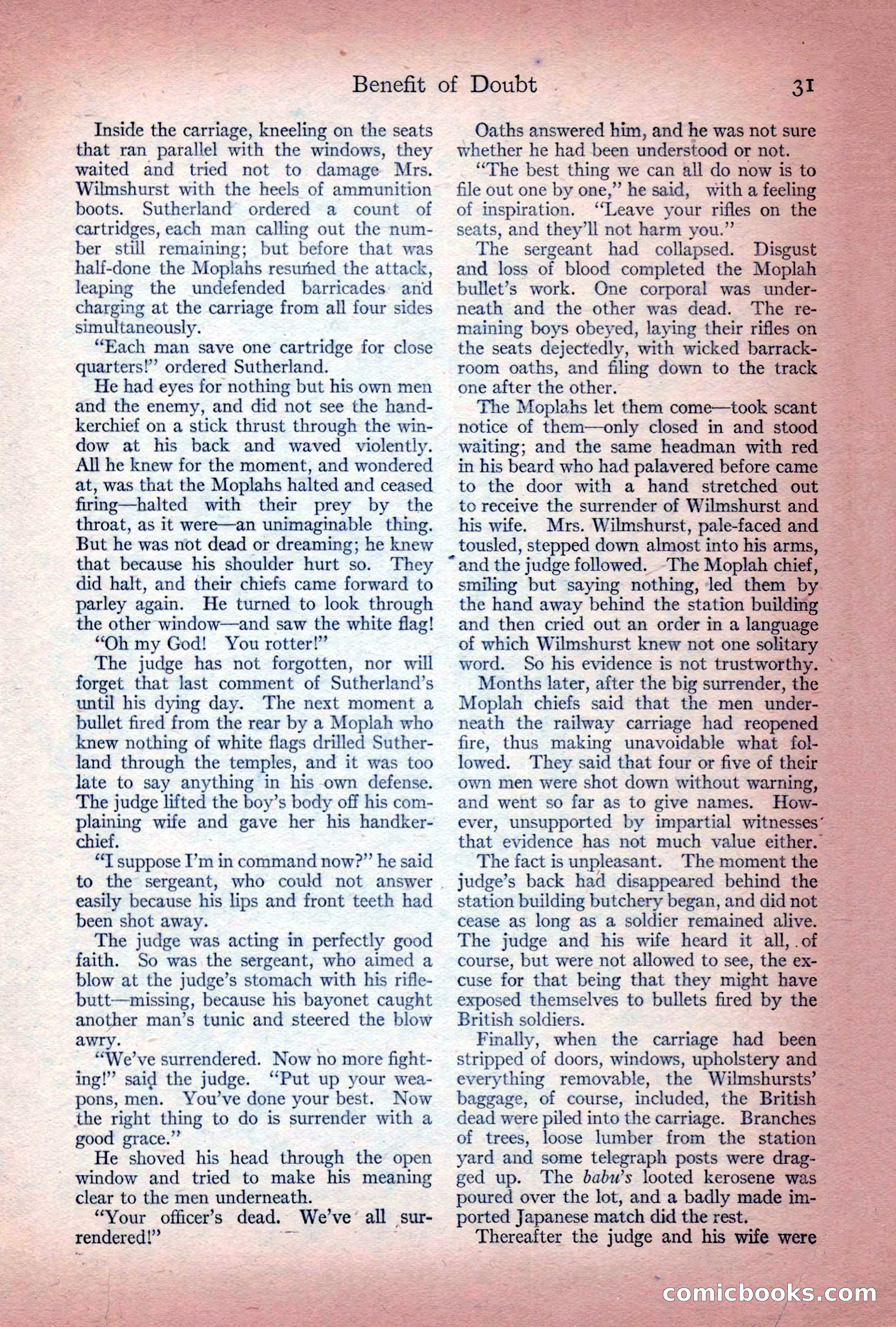
A restored page from Pulp Fiction, 1922. Page through the whole issue in the reader above.
📄 Transcribed text from this page (OCR, searchable)
Machine-transcribed from the original scan — historical spelling and the odd misread are preserved.
Benefit of Doubt Inside the carriage, kneeling on the seats that ran parallel with the windows, they waited and tried not to damage Mrs. Wilmshurst with the heels of ammunition boots. Sutherland ordered a count of cartridges, each man calling out the num- ber still remaining; but before that was half-done the Moplahs resurhed the attack, leaping the undefended barricades and charging at the carriage from all four sides simultaneously. “Each man save one cartridge for close quarters!” ordered Sutherland. He had eyes for nothing but his own men and the enemy, and did not see the hand- kerchief on a stick thrust through the win- dow at his back and waved violently. All he knew for the moment, and wondered at, was that the Moplahs halted and ceased firing—halted with their prey by the throat, as it were—an unimaginable thing. But he was not dead or dreaming; he knew that because his shoulder hurt so. They did halt, and their chiefs came forward to parley again. He turned to look through the other window—and saw the white flag! “Oh my God! You rotter!” The judge has not forgotten, nor will forget that last comment of Sutherland’s until his dying day. The next moment a bullet fired from the rear by a Moplah who knew nothing of white flags drilled Suther- land through the temples, and it was too late to say anything in his own defense. The judge lifted the boy’s body off his com- plaining wife and gave her his handker- chief. “T suppose I’m in command now?” he said to the sergeant, who could not answer easily because his lips and front teeth had been shot away. The judge was acting in perfectly good faith. So was the sergeant, who aimed a blow at the judge’s stomach with his rifle- butt—missing, because his bayonet caught another man’s tunic and steered the blow awry. “We've surrendered. Now no more fight- ing!” said the judge. “Put up your wea- pons, men. You’ve done your best. Now the right thing to do is surrender with a good grace.” He shoved his head through the open window and tried to make his meaning clear to the men underneath. “Vour officer’s dead. We've all sur- rendered!” = : 31 Oaths answered him, and he was not sure whether he had been understood or not. “The best thing we can all do now is to file out one by one,” he said, with a feeling of inspiration. ‘Leave your rifles on the seats, and they’ll not harm you.” The sergeant had collapsed. Disgust and loss of blood completed the Moplah — bullet’s work. One corporal was under- neath and the other was dead. ‘The re- maining boys obeyed, laying their rifles on the seats dejectedly, with wicked barrack- room oaths, and filing down to the track one after the other. The Moplahs let them come—took scant notice of them—only closed in and stood waiting; and the same headman with red in his beard who had palavered before came to the door with a hand stretched out to receive the surrender of Wilmshurst and his wife. Mrs. Wilmshurst, pale-faced and tousled, stepped down almost into his arms, “and the judge followed. ~The Moplah chief, smiling but saying nothing, led them by the hand away behind the station building and then cried out an order in a language of which Wilmshurst knew not one solitary word. So his evidence is not trustworthy. ° Months later, after the big surrender, the Moplah chiefs said that the men under- neath the railway carriage had reopened fire, thus making unavoidable what fol- lowed. They said that four or five of their own men were shot down without warning, and went so far as to give names. How- ever, unsupported by impartial witnesses‘ that evidence has not much value either. The fact is unpleasant. The moment the judge’s back had disappeared behind the station building butchery began, and did not cease as long as a soldier remained alive. The judge and his wife heard it all, of course, but were not allowed to see, the ex- cuse for that being that they might have exposed themselves to bullets fired by the British soldiers. Finally, when the carriage had beén stripped of doors, windows, upholstery and everything removable, the Wilmshursts’ baggage, of course, included, the British dead were piled into the carriage. Branches of trees, loose lumber from the station yard and some telegraph posts were drag- ged up. The babu’s looted kerosene was poured over the lot, and a badly made im- ported Japanese match did the rest. Thereafter the judge and his wife were ~ ECOMIGc 200KS (Efe)