
Pulp Fiction, 1922 · page 38 of 200
Adventure Magazine Cover, December 10, 1922 — page 38: what you’re looking at
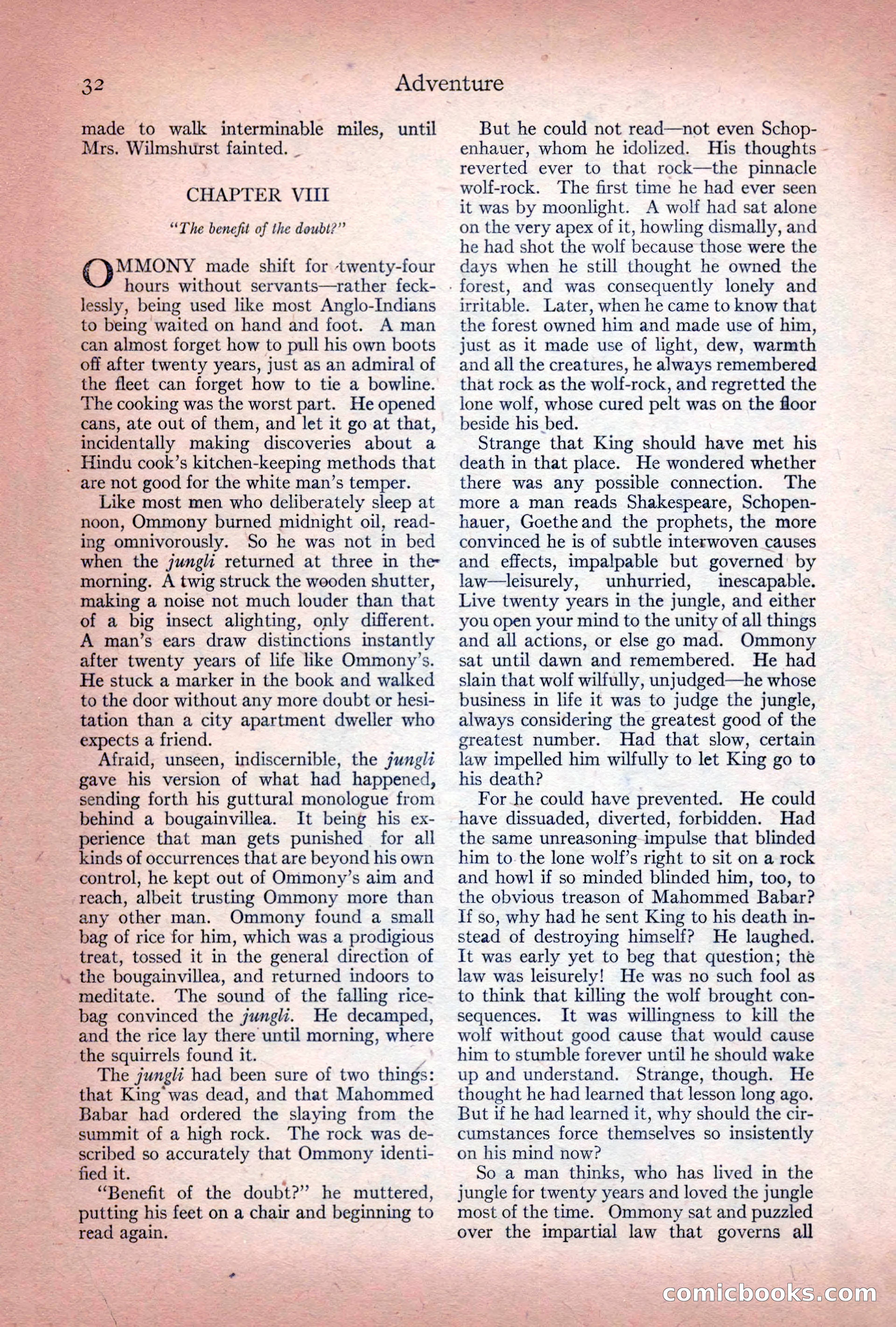
A restored page from Pulp Fiction, 1922. Page through the whole issue in the reader above.
📄 Transcribed text from this page (OCR, searchable)
Machine-transcribed from the original scan — historical spelling and the odd misread are preserved.
made to walk interminable miles, until Mrs. Wilmshurst fainted. _ CHAPTER VIII “The benefit of the doubt?” eee ONY. made shift for twenty-four hours without servants—rather feck- lessly, being used like most Anglo-Indians to being waited on hand and foot. A man can almost forget how to pull his own boots off after twenty years, just as an admiral of the fleet can forget how to tie a bowline. The cooking was the worst part. He opened cans, ate out of them, and let it go at that, incidentally making discoveries about a _ Hindu cook’s kitchen-keeping methods that are not good for the white man’s temper. Like most men who deliberately sleep at noon, Ommony burned midnight oil, read- Ing omnivorously. So he was not in bed when the jungli returned at three in the morning. A twig struck the wooden shutter, making a noise not much louder than that of a big insect alighting, only different. A man’s ears draw distinctions instantly after twenty years of life hke Ommony’s. He stuck a marker in the book and walked to the door without any more doubt or hesi- tation than a city apartment dweller who expects a friend. Afraid, unseen, indiscernible, the jungli gave his version of what had happened, sending forth his guttural monologue from behind a bougainvillea. It being his ex- perience that man gets punished for all kinds of occurrences that are beyond his own control, he kept out of Ommony’s aim and reach, albeit trusting Ommony more than any other man. Ommony found a small bag of rice for him, which was a prodigious treat, tossed it in the general direction of the bougainvillea, and returned indoors to meditate. The sound of the falling rice- bag convinced the jungli. He decamped, and the rice lay there until morning, where the squirrels found it. The jungli had been sure of two things: that King was dead, and that Mahommed Babar had ordered the slaying from the summit of a high rock. The rock was de- scribed so accurately that Ommony identi- fied it. Ses “Benefit of the doubt?” he muttered, putting his feet on a chair and beginning to read again. Adventure But he could not read—not even Schop- enhauer, whom he idolized. His thoughts - reverted ever to that rock—the pinnacle wolf-rock. The first time he had ever seen it was by moonlight. A wolf had sat alone on the very apex of it, howling dismally, and he had shot the wolf because those were the days when he still thought he owned the - forest, and was consequently lonely and irritable. Later, when he came to know that the forest owned him and made use of him, just as it made use of light, dew, warmth and all the creatures, he always remembered that rock as the wolf-rock, and regretted the lone wolf, whose cured pelt was on the floor beside his bed. Strange that King should have met his death in that place. He wondered whether there was any possible connection. The more a man reads Shakespeare, Schopen- hauer, Goethe and the prophets, the more convinced he is of subtle interwoven causes and effects, impalpable but governed by law—leisurely, unhurried, inescapable. Live twenty years in the jungle, and either you open your mind to the unity of all things and all actions, or else go mad. Ommony sat until dawn and remembered. He had slain that wolf wilfully, unjudged—he whose business in life it was to judge the jungle, always considering the greatest good of the greatest number. Had that slow, certain law impelled him wilfully to let King go to his death? For he could have prevented. He could have dissuaded, diverted, forbidden. Had the same unreasoning impulse that blinded him to the lone wolf’s right to sit on a rock and howl if so minded blinded him, too, to the obvious treason of Mahommed Babar? If so, why had he sent King to his death in- stead of destroying himself? He laughed. It was early yet to beg that question; the law was leisurely! He was no such fool as to think that killing the wolf brought con- sequences. It was willingness to kill the wolf without good cause that would cause him to stumble forever until he should wake up and understand. Strange, though. He thought he had learned that lesson long ago. But if he had learned it, why should the cir- cumstances force themselves so insistently on his mind now? So a man thinks, who has lived in the jungle for twenty years and loved the jungle most of the time. Ommony sat and puzzled over the impartial law that governs all GEomichbooks (E(o)