
Pulp Fiction, 1922 · page 36 of 200
Adventure Magazine Cover, December 10, 1922 — page 36: what you’re looking at
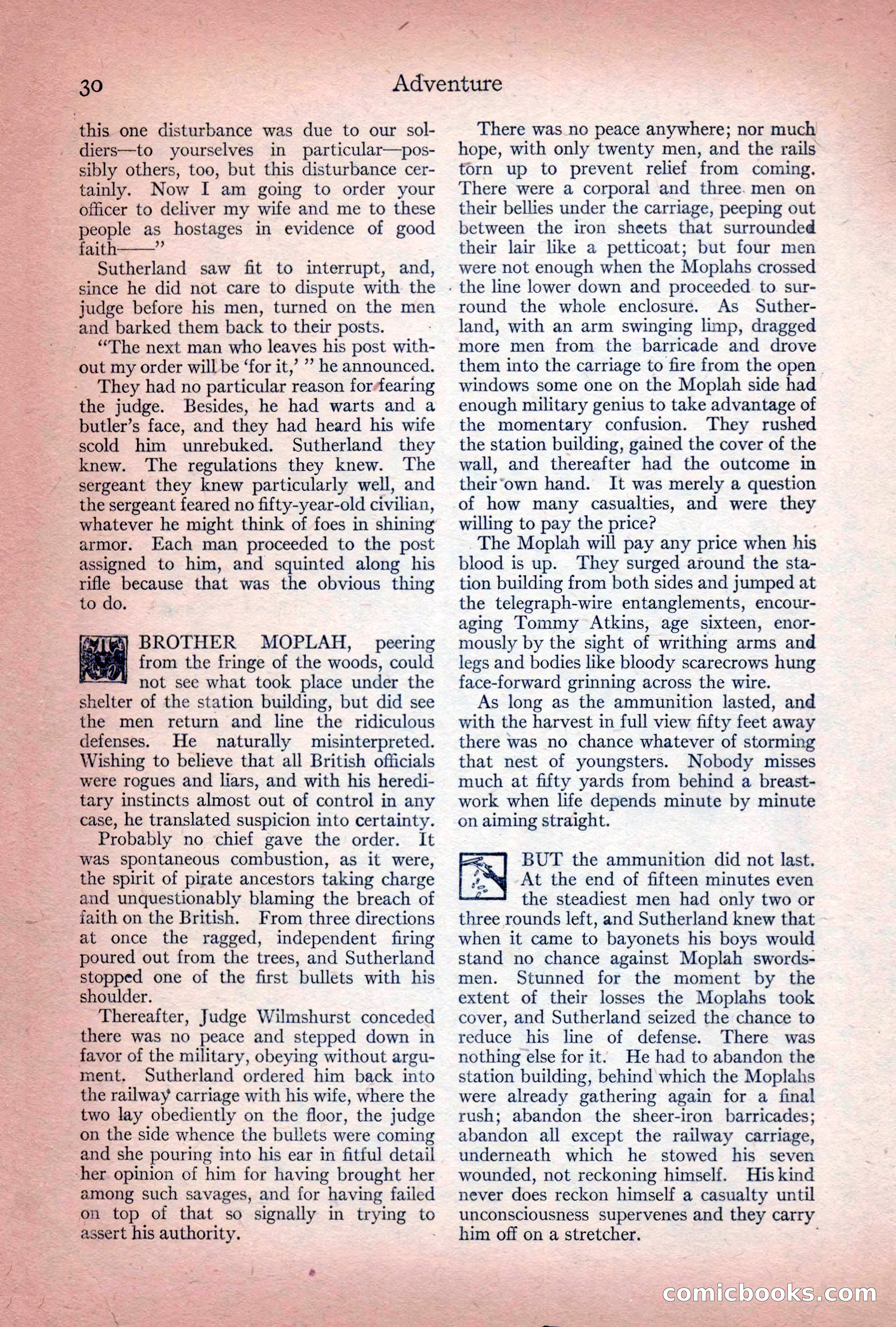
A restored page from Pulp Fiction, 1922. Page through the whole issue in the reader above.
📄 Transcribed text from this page (OCR, searchable)
Machine-transcribed from the original scan — historical spelling and the odd misread are preserved.
30 this one disturbance was due to our sol- diers—to yourselves in particular—pos- sibly others, too, but this disturbance cer- tainly. Now I am going to order your officer to deliver my wife and me to these people as hostages in evidence of good faath=-——’ Sutherland saw fit to interrupt, and, since he did not care to dispute with the judge before his men, turned on the men and barked them back to their posts. “The next man who leaves his post with- out my order will be ‘for it,’ ’”? he announced. They had no particular reason forfearing the judge. Besides, he had warts and a butler’s face, and they had heard his wife scold him unrebuked. Sutherland they knew. The regulations they knew. ‘The sergeant they knew particularly well, and the sergeant feared no fifty-year-old civilian, whatever he might think of foes in shining armor. Each man proceeded to the post assigned to him, and squinted along his rifle because that was the obvious thing to do. fae | m BROTHER MOPLAH, peering | from the fringe of the woods, could , not see what took place under the shelter of the station building, but did see the men return and line the ridiculous defenses. He naturally misinterpreted. Wishing to believe that all British officials were rogues and liars, and with his heredi- tary instincts almost out of control in any case, he translated suspicion into certainty. Probably no chief gave the order. It was spontaneous combustion, as it were, the spirit of pirate ancestors taking charge and unquestionably blaming the breach of faith on the British. From three directions at once the ragged, independent firing poured out from the trees, and Sutherland stopped one of the first bullets with his shoulder. Thereafter, Judge Wilmshurst conceded there was no peace and stepped down in favor of the military, obeying without argu- ment. Sutherland ordered him back into the railway carriage with his wife, where the two lay obediently on the floor, the judge on the side whence the bullets were coming and she pouring into his ear in fitful detail her opinion of him for having brought her among such savages, and for having failed on top of that so signally in trying to assert his authority. Adventure There was no peace anywhere; nor much hope, with only twenty men, and the rails torn up to prevent relief from coming. There were a corporal and three. men on their bellies under the carriage, peeping out between the iron sheets that surrounded their lair like a petticoat; but four men were not enough when the Moplahs crossed - the line lower down and proceeded to sur- round the whole enclosure. As Suther- land, with an arm swinging limp, dragged more men from the barricade and drove them into the carriage to fire from the open windows some one on the Moplah side had enough military genius to take advantage of the momentary confusion. They rushed the station building, gained the cover of the wall, and thereafter had the outcome in their‘own hand. It was merely a question of how many casualties, and were they willing to pay the price? The Moplah will pay any price when his blood is up. They surged around the sta- tion building from both sides and jumped at the telegraph-wire entanglements, encour- aging Tommy Atkins, age sixteen, enor- mously by the sight of writhing arms and legs and bodies like bloody scarecrows hung face-forward grinning across the wire. As long as the ammunition lasted, and with the harvest in full view fifty feet away there was no chance whatever of storming that nest of youngsters. Nobody misses much at fifty yards from behind a breast- work when life depends minute by minute on aiming straight. ae BUT the ammunition did not last. a wq At the end of fifteen minutes even “I the steadiest men had only two or three rounds left, and Sutherland knew that when it came to bayonets his boys would stand no chance against Moplah swords- men. Stunned for the moment by the extent of their losses the Moplahs took cover, and Sutherland seized the chance to reduce his line of defense. There was nothing else for it. He had to abandon the station building, behind which the Moplahs were already gathering again for a final rush; abandon the sheer-iron barricades; abandon all except the railway carriage, underneath which he stowed his seven wounded, not reckoning himself. His kind never does reckon himself a casualty until unconsciousness supervenes and they carry him off on a stretcher. Gomichbooks (E(0)