
Pulp Fiction, 1922 · page 28 of 200
Adventure Magazine Cover, December 10, 1922 — page 28: what you’re looking at
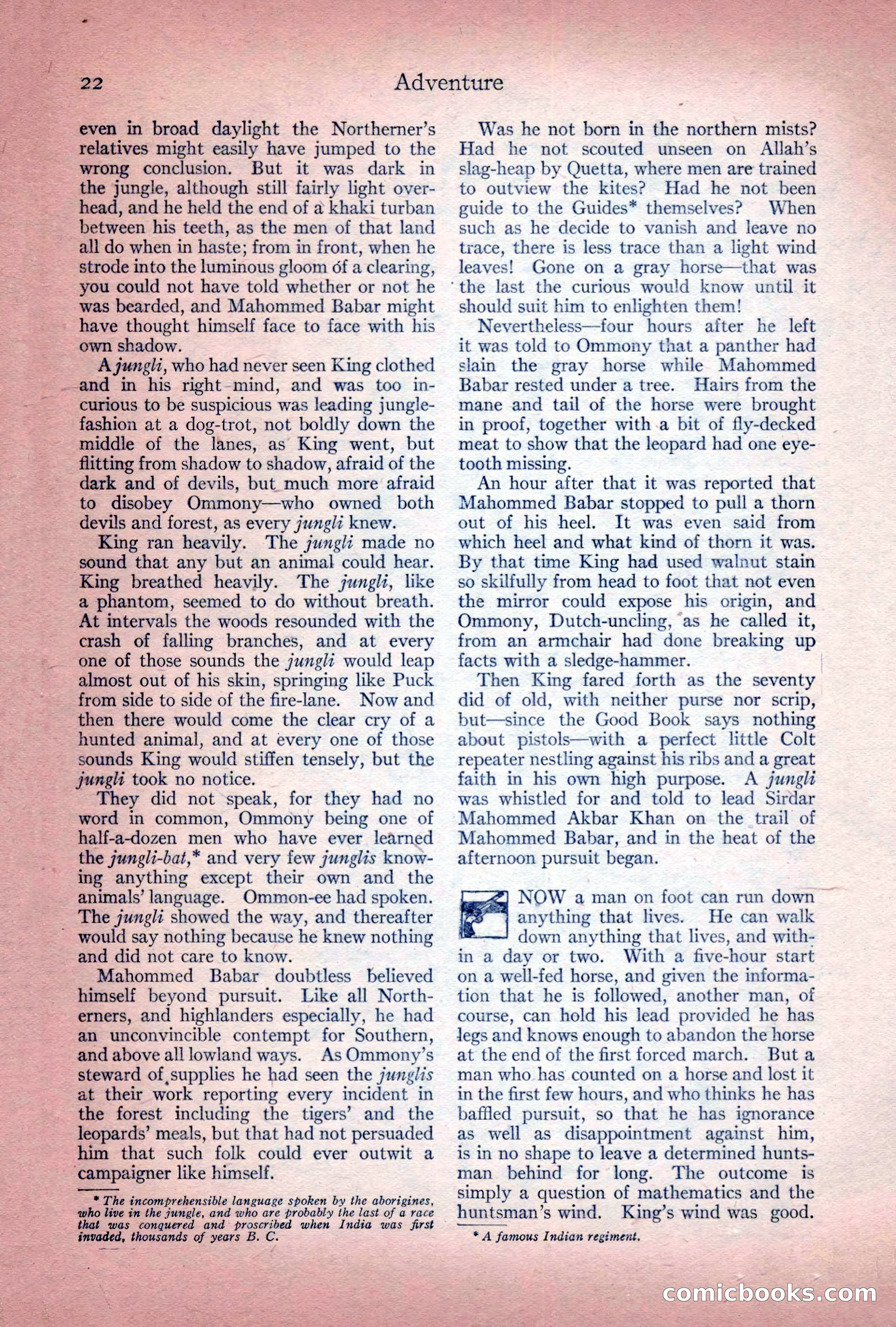
A restored page from Pulp Fiction, 1922. Page through the whole issue in the reader above.
📄 Transcribed text from this page (OCR, searchable)
Machine-transcribed from the original scan — historical spelling and the odd misread are preserved.
22 even in broad daylight the Northerner’s relatives might easily have jumped to the wrong conclusion. But it was dark in the jungle, although still fairly light over- head, and he held the end of a khaki turban between his teeth, as the men of that land all do when in haste; from in front, when he strode into the luminous gloom of a clearing, you could not have told whether or not he was bearded, and Mahommed Babar might have thought himself face to face with his own shadow. A jungli, who had never seen King clothed and in his right-mind, and was too in- curious to be suspicious was leading jungle- fashion at a dog-trot, not boldly down the middle of the lanes, as King went, but flitting from shadow to shadow, afraid of the dark and of devils, but much more afraid to disobey Ommony—who owned both devils and forest, as every jungli knew. King ran heavily. The jungli made no sound that any but an animal could hear. King breathed heavily. The junglz, like a phantom, seemed to do without breath. At intervals the woods resounded with the crash of falling branches, and at every one of those sounds the jungli would leap almost out of his skin, springing like Puck from side to side of the fire-lane. Now and then there would come the clear cry of a hunted animal, and at every one of those sounds King would stiffen tensely, but the jungli took no notice. They did not speak, for they had no word in common, Ommony being one of half-a-dozen men who have ever learned the jungli-bat,* and very few junglis know- ing anything except their own and the animals’ language. Ommon-ee had spoken. The jungli showed the way, and thereafter - would say nothing because he knew nothing and did not care to know. Mahommed Babar doubtless believed himself beyond pursuit. Like all North- erners, and highlanders especially, he had an unconvincible contempt for Southern, and above all lowland ways. As Ommony’s steward of supplies he had seen the junglis at their work reporting every incident in the forest including the tigers’ and the leopards’ meals, but that had not persuaded him that such folk could ever outwit a campaigner like himself. * The incomprehensible language spoken by the aborigines, who live in the jungle, and who are probably the last of a race that was conquered and proscribed when India was first invaded, thousands of years B. C. Adventure Was he not born in the northern mists? Had he not scouted unseen on Allah’s slag-heap by Quetta, where men are trained to outview the kites? Had he not been guide to the Guides* themselves? When such as he decide to vanish and leave no trace, there is less trace than a light wind leaves! Gone on a gray horse—that was ‘the last the curious wou!ld know until it should suit him to enlighten them! Nevertheless—four hours after he left it was told to Ommony that a panther had slain the gray horse while Mahommed Babar rested under a tree. Hairs from the mane and tail of the horse were brought in proof, together with.a bit of fly-decked meat to show that the leopard had one eye- tooth missing. An hour after that it was reported that Mahommed Babar stopped to pull a thorn out of his heel. It was even said from which heel and what kind of thorn it was. By that time King had used walnut stain so skilfully from head to foot that not even the mirror could expose his origin, and Ommony, Dutch-uncling, as he called it, from an armchair had done breaking up facts with a sledge-hammer. Then King fared forth as the seventy did of old, with neither purse nor scrip, but—since the Good Book says nothing about pistols—with a perfect little Colt repeater nestling against his ribs and a great faith in his own high purpose. A jungli was whistled for and told to lead Sirdar Mahommed Akbar Khan on the trail of Mahommed Babar, and in the heat of the afternoon pursuit began. eee) NOW a man on foot can run down a anything that lives. He can walk down anything that lives, and with- in a day or two. With a five-hour start on a well-fed horse, and given the informa- tion that he is followed, another man, of course, can hold his lead provided he has Jegs and knows enough to abandon the horse at the end of the first forced march. Buta man who has counted on a horse and lost it in the first few hours, and who thinks he has baffled pursuit, so that he has ignorance as well as disappointment against him, is in no shape to leave a determined hunts- man behind for long. The outcome is simply a question of mathematics and the huntsman’s wind. King’s wind was good. *A famous Indian regiment. ecomiecbooks (EO)