
Pulp Fiction, 1922 · page 29 of 200
Adventure Magazine Cover, December 10, 1922 — page 29: what you’re looking at
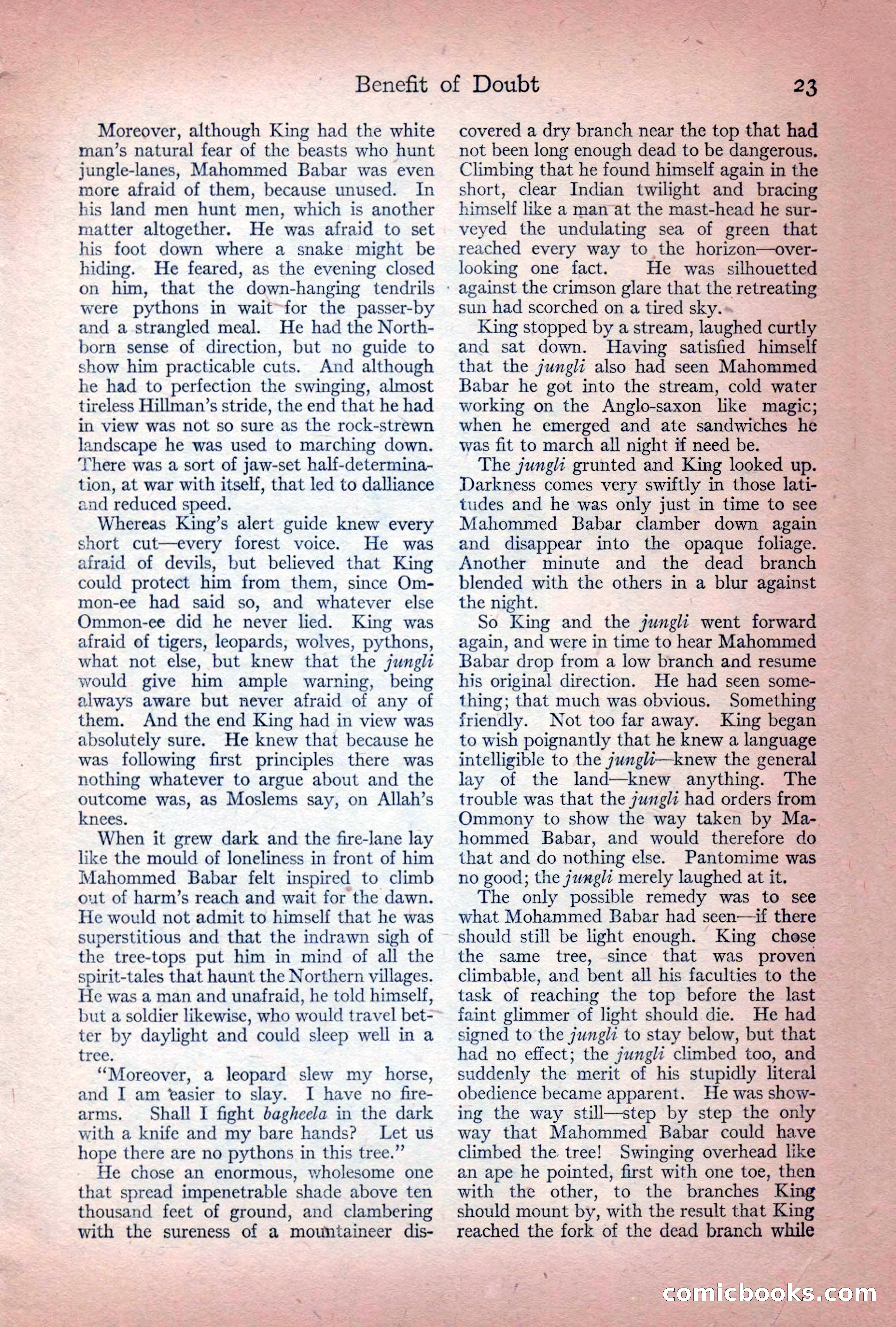
A restored page from Pulp Fiction, 1922. Page through the whole issue in the reader above.
📄 Transcribed text from this page (OCR, searchable)
Machine-transcribed from the original scan — historical spelling and the odd misread are preserved.
Benefit of Doubt Moreover, although King had the white man’s natural fear of the beasts who hunt jungle-lanes, Mahommed Babar was even more afraid of them, because unused. In his land men hunt men, which is another matter altogether. He was afraid to set his foot down where a snake might be hiding. He feared, as the evening closed on him, that the down-hanging tendrils were pythons in wait~for the passer-by and a strangled meal. He had the North- born sense of direction, but no guide to show him practicable cuts. And although he had to perfection the swinging, almost tireless Hillman’s stride, the end that he had in view was not so sure as the rock-strewn landscape he was used to marching down. ‘There was a sort of jaw-set half-determina- tion, at war with itself, that led to dalliance and reduced speed. Whereas King’s alert guide knew every short cut—every forest voice. He was afraid of devils, but believed that King could protect him from them, since Om- mon-ee had said so, and whatever else Ommon-ee did he never lied. King was afraid of tigers, leopards, wolves, pythons, what not else, but knew that the jungli would give him ample warning, being always aware but never afraid of any of them. And the end King had in view was absolutely sure. He knew that because he was following first principles there was nothing whatever to argue about and the outcome was, as Moslems say, on Allah’s knees. When it grew dark and the fire-lane lay like the mould of loneliness in front of him Mahommed Babar felt inspired to climb out of harm’s reach and wait for the dawn. He would not admit to himself that he was superstitious and that the indrawn sigh of the tree-tops put him in mind of all the spirit-tales that haunt the Northern villages. He was a man and unafraid, he told himself, but a soldier likewise, who would travel bet- ter by daylight and could sleep well in a tree. “Moreover, a leopard slew my horse, and I am ‘easier to slay. I have no fire- arms. Shall I fight bagheela in the dark with a knife and my bare hands? Let us hope there are no pythons in this tree.” He chose an enormous, wholesome one that spread impenetrable shade above ten thousand feet of ground, and clambering with the sureness of a mountaineer dis- 23 covered a dry branch near the top that had not been long enough dead to be dangerous. Climbing that he found himself again in the short, clear Indian twilight and bracing himself like a man at the mast-head he sur- veyed the undulating sea of green that reached every way to the horizon—over- looking one fact. He was silhouetted ‘ against the crimson glare that the retreating sun had scorched on a tired sky. » King stopped by a stream, laughed curtly and sat down. Having satisfied himself that the jungli also had seen Mahommed Babar he got into the stream, cold water working on the Anglo-saxon like magic; when he emerged and ate sandwiches he was fit to march all night if need be. The jungli grunted and King looked up. Darkness comes very swiftly in those lati- tudes and he was only just in time to see © Mahommed Babar clamber down again and disappear into the opaque foliage. Another minute and the dead branch blended with the others in a blur against the night. So King and the jungli went forward again, and were in time to hear Mahommed Babar drop from a low branch and resume his original direction. He had seen some- thing; that much was obvious. Something friendly. Not too far away. King began to wish poignantly that he knew a language intelligible to the jungh—knew the general lay of the land—knew anything. The trouble was that the jugli had orders from Ommony to show the way taken by Ma- hommed Babar, and would therefore do that and do nothing else. Pantomime was no good; the jumgli merely laughed at it. The only possible remedy was to see what Mohammed Babar had seen—if there should still be light enough. King chose the same tree, since that was proven climbable, and bent all his faculties to the task of reaching the top before the last faint glimmer of light should die. He had signed to the jungli to stay below, but that had no effect; the jungli climbed too, and suddenly the merit of his stupidly literal obedience became apparent. He was show- ing the way still—step by step the only way that Mahommed Babar could have climbed the tree! Swinging overhead like an ape he pointed, first with one toe, then with the other, to the branches King should mount by, with the result that King reached the fork of the dead branch while Eomicbooks (EO)