
Pulp Fiction, 1922 · page 85 of 196
Adventure Magazine Cover — page 85: what you’re looking at
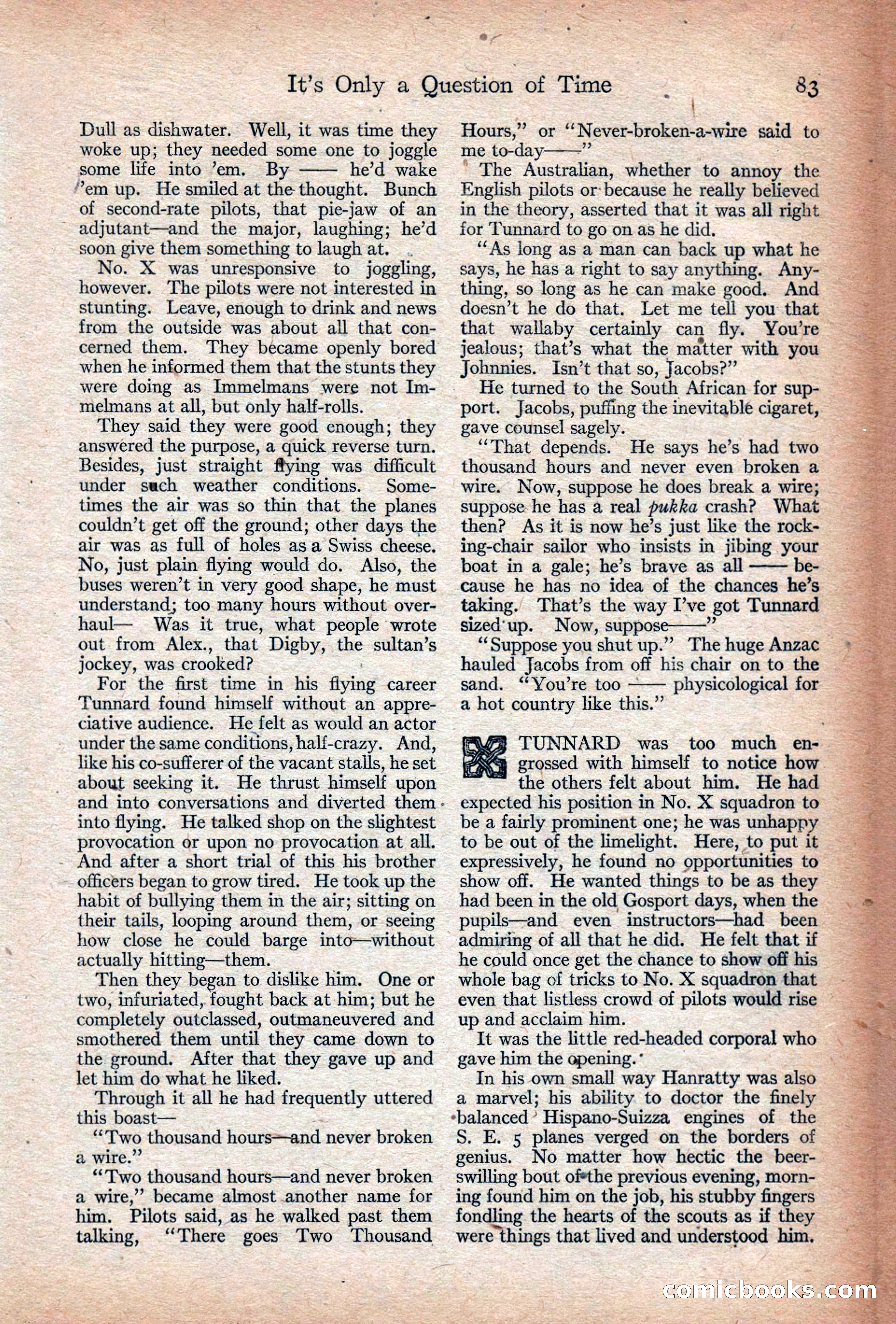
A restored page from Pulp Fiction, 1922. Page through the whole issue in the reader above.
📄 Transcribed text from this page (OCR, searchable)
Machine-transcribed from the original scan — historical spelling and the odd misread are preserved.
It’s Only a Question of Time — Dull as dishwater. Well, it was time they woke up; they needed some one to joggle some life into ’em. By —— he’d wake "em up. He smiled at the thought. Bunch of second-rate pilots, that pie-jaw of an adjutant—and the major, laughing; he’d soon give them something to laugh at. No. X was unresponsive to joggling, however. The pilots were not interested in stunting. Leave, enough to drink and news from the outside was about all that con- cerned them. They became openly bored when he informed them that the stunts they were doing as Immelmans were not Im- melmans at all, but only half-rolls. They said they were good enough; they answered the purpose, a quick reverse turn. Besides, just straight ftying was difficult under such weather conditions. Some- times the air was so thin that the planes couldn’t get off the ground; other days the air was as full of holes asa Swiss cheese. No, just plain flying would do. Also, the buses weren’t in very good shape, he must understand; too many hours without over- haul— Was it true, what people wrote out from Alex., that Digby, the sultan’s jockey, was crooked? For the first time in his — career Tunnard found himself without an appre- ciative audience. He felt as would an actor under the same conditions, half-crazy. And, like his co-sufferer of the vacant stalls, he set about seeking it. He thrust himself upon and into conversations and diverted them - into flying. He talked shop on the slightest provocation or upon no provocation at all. - And after a short trial of this his brother - officers began to grow tired. He took up the habit of bullying them in the air; sitting on their tails, looping around them, or seeing how close he could barge into—without actually hitting—them. Then they began to dislike him. One or two, infuriated, fought back at him; but he completely outclassed, outmaneuvered and smothered them until they came down to the ground. After that they gave up and let him do what he liked. Through it all he had frequently uttered this boast— ~ Pwo thousand hours—and never broken a wire.’ “Two thousand hours—and never broken a wire,’’ became almost another name for him. Pilots said, as he walked past them talking, “There goes Two Thousand —e ee . ~*~. . - . ~ o% = vw — « . = $ —~. ad - Hours,” me ae : ’ The Australian, whether to annoy the : English pilots or because he really believed — in the theory, asserted that it was all right for Tunnard to go on as he did. ‘As long as a man can back up what he says, he has a right to say anything. Any-— thing, so long as he can make good. And doesn’t he do that. Let me tell you that — that wallaby certainly can fly. You're — ‘‘ Never-broken-a-wire said to. he his fi 4 > A >) Hi as | eX ‘ eid ee | i , AS sie \ Piet ey ahs , A} Ale? ‘ pe wild ‘ * iy t Jait,. 4 i are vil Ley feb v. wi? ae FS Ae hae yd rite a Me'Y b neagsl cat yt , ‘ i, am CSatt PACE LU NG) rh a ES twh'f aT rated . ‘ea eae Pegi op hs itt jealous; that’s what the matter with you — : = = Johnnies. Isn’t that so, Jacobs?” Hie turned to the South African for sup- — z port. Jacobs, puffing the inevitable cigaret, gave counsel sagely. “That depends. wire. He says he’s had two thousand hours and never even broken a See Now, suppose he does break a wire; suppose-he has a real pukka crash? What = then? As it is now he’s just like the rock- ing-chair sailor who insists in jibing your boat in a gale; he’s brave as all——be- cause he has no idea of the chances he’s Ages taking. That’s the way I’ve got Tunnard sized'up. Now, suppose——” “Suppose you shut up.”” The huge Anzac» = 3 hauled Jacobs from off his chair on to the “VYou’re too —— physicological for sand. a hot country like this.”’ is G TUNNARD was “ too much en-— 3 = ‘G grossed with himself to notice how the others felt about him. He had expected his position in No. X squadron to be a fairly prominent one; he was unhappy to be out of the limelight. Here, to put it expressively, he found no opportunities tos show off. He wanted things to be as they = a: had been in the old Gosport days, when the . = pupils—and even instructors—had been — admiring of all that he did. He felt that if he could once get the chance to show off his — Ss whole bag of tricks to No. X squadron that = even that listless crowd of pilots would rise up and acclaim him. It was the little red-headed corporal who — gave him the opening.’ In his own small way Hanratty was also — = =: : a marvel; his ability to doctor the finely —__ ‘balanced ° Hispano-Suizza engines of the S. E. 5 planes verged on the borders of Z genius. fondling the hearts of the scouts as if they were things that lived and understood him. a (E@) ANU No matter how hectic the beer- swilling bout ofthe previous evening, morn- ing found him on the job, his stubby fingers = 000) S