
Pulp Fiction, 1922 · page 84 of 196
Adventure Magazine Cover — page 84: what you’re looking at
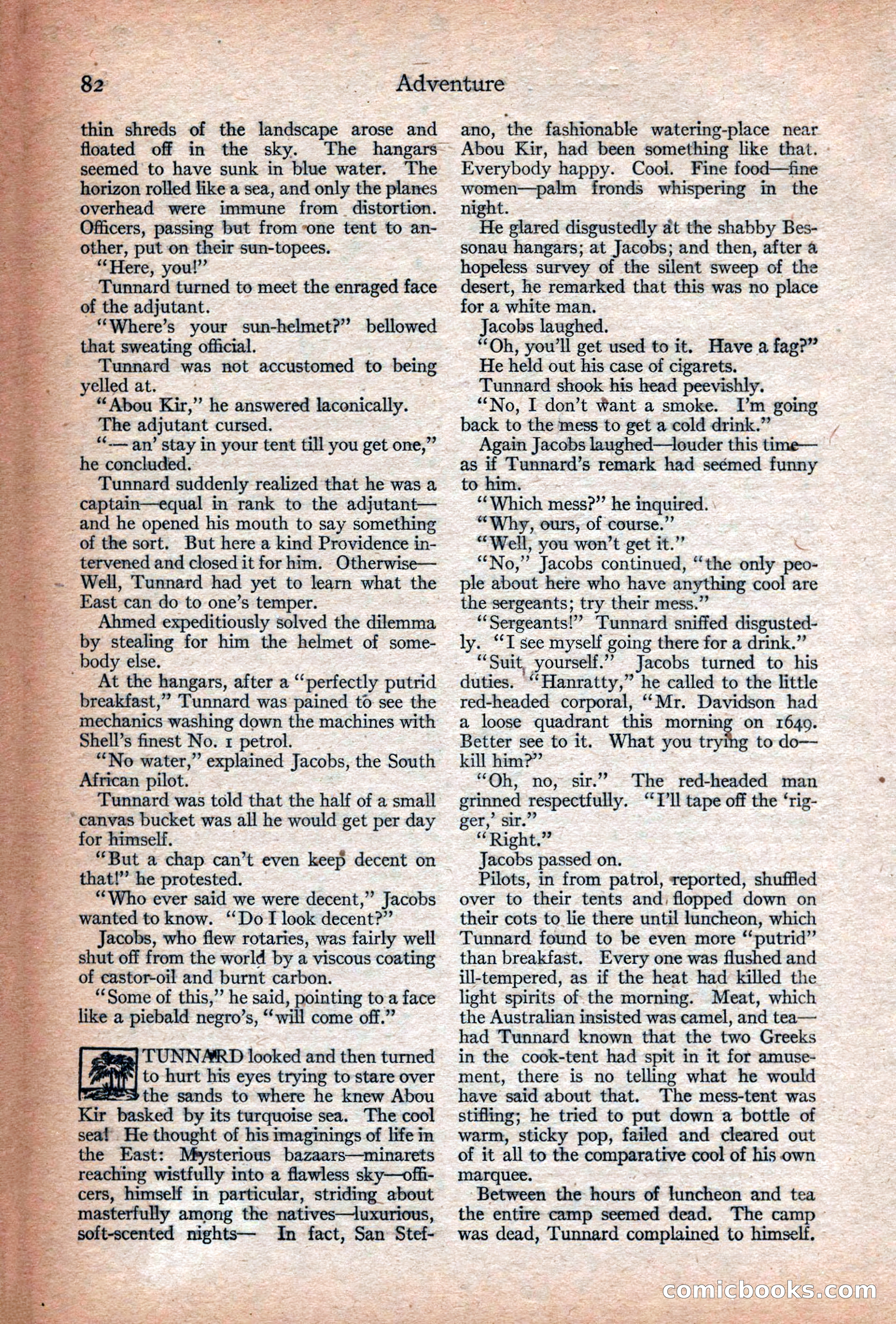
A restored page from Pulp Fiction, 1922. Page through the whole issue in the reader above.
📄 Transcribed text from this page (OCR, searchable)
Machine-transcribed from the original scan — historical spelling and the odd misread are preserved.
SES msgs Fe = iin shreds of the landscape arose and pe: floated off in the sky. - seemed to have sunk in blue water. The horizon rolled like a sea, and only the planes overhead were immune from _ distortion. - Officers, passing but from one tent to an- ae Ss gape put on their sun-topees. . _ “Here, you!” _ Tunnard turned to meet the enraged face ae Sal the adjutant. % ae ~**Where’s your sun-helmet?” bellowed Be _ that sweating official. - Tunnard was not accustomed to being Bel ate 4 _“ Abou Kir,” he answered laconically. The adjutant cursed. ae - ae oY 2 Re Pe concluded. = ee. Tunnard suddenly realized that he was a aS | Shrertabee in rank to the adjutant— ___and he opened his mouth to say something of the sort. But here a kind Providence in- _tetvened and closed it for him. Otherwise— ~~ Well, Tunnard had yet to learn what the i - East can do to one’s temper. Ahmed expeditiously solved the Paras Be by stealing for him the helmet of some- am peody else. - breakfast, ” Tunnard was pained to see the neo _ mechanics washing down the machines with fee a finest No. t petrol. = = “No water,” explained Jacobs, the South African pilot. = _ Tunnard was told that the half of a smail = 2 canvas bucket was all he would get per day for himself. “But a chap can’t even keep decent on | that!” he protested. ae = __ “Who ever said we were decent,” Jacobs a = _ wanted to know. ‘DoT look decent?” 3 Jacobs, who flew rotaries, was fairly well = _ of eastor-oil and burnt carbon. = Some of this,” he said, pointing to a face ~ ee a » piebald negro’s, “will come off.” Seaea| TUNNARD looked and then turned | vial to hurt his eyes trying tostare over Tess the sands to where he knew Abou _ Kir basked by its turquoise sea. The cool _ seat He thought of his imaginings of life in a the East: Mysterious bazaars—minarets a reaching wistfully into a flawless sky—ofh- i cers, himself in particular, striding about The hangars— ‘-- an’ stay in your tent till you get one,’ At the hangars, after a “perfectly putrid shut off from the world by a viscous coating oe __ Inasterfully among the natives—luxurious, 3 peered meee In fact, San Stef- | Rdventire ano, the fashionable watering-place near Abou Kir, had been something like that. - Everybody happy. Cool. Fine food—fine women—palm fronds whispering in the night. He glared disgustedly at the shabby Bes- sonau hangars; at Jacobs; and then, after 4 hopeless survey of the silent sweep of the desert, he remarked that this was no place for a white man. Jacobs laughed. “Oh, you'll get used to it. Have a fag?” He held out his case of cigarets. Tunnard shook his head peevishly. “No, I don’t Want a smoke. I’m going back to the mess to get a cold drink.” Again Jacobs laughed—louder this time— — as if Tunnard’s remark had —— funny to him. “Which mess?? ” he inquired. “Why, ours, of course.’ “Well, you won’t get it.” “No, u Jacobs continued, “the only a ple about here who have anything cool are the sergeants; try their mess.” “Sergeants!” Tunnard sniffed disgusted- ly. “I see myself going there for a drink.” “Suit, yourself.” Jacobs turned to his duties. ‘‘Hanratty,” he called to the little red-headed corporal, ‘Mr. Davidson had a loose quadrant this morning on 1640. Better see to it. What you trying to do— kill him?” “Oh, no, sir.” grinned respectfully. ger,’ sir.” ce Right,” Jacobs passed on. Pilots, in from patrol, reported, shuffled over to their tents and: flopped down on their cots to lie there until luncheon, which Tunnard found to be even more “putrid” than breakfast. Every one was flushed and ill-tempered, as if the heat had killed the light spirits of the morning. Meat, which the Australian insisted was camel, and tea— had Tunnard known that the two Greeks in the cook-tent had spit in it for amuse- ment, there is no telling what he would have said about that. The mess-tent was stifling; he tried to put down a bottle of warm, sticky pop, failed and cleared out of it all to the comparative cool of his own marquee. ‘Between the hours of tuncheon and tea The red-headed man “*T’ll tape off the ‘rig- the entire camp seemed dead. The camp ~ was dead, Tunnard complained to himself, GOMIE = ee ere ee oe ee, JOOKS 2, ee (66)