
Pulp Fiction, 1922 · page 182 of 196
Adventure Magazine Cover — page 182: what you’re looking at
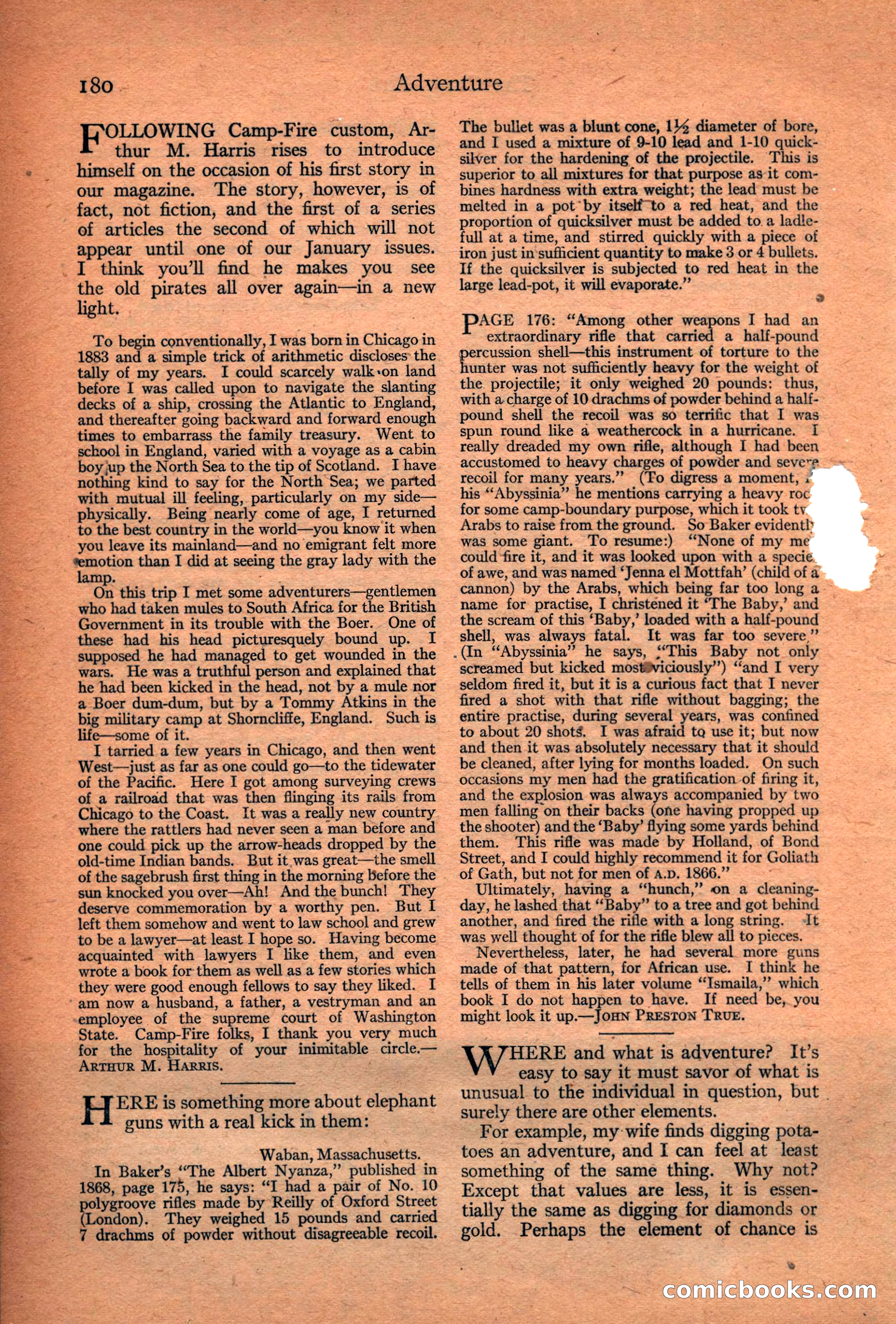
A restored page from Pulp Fiction, 1922. Page through the whole issue in the reader above.
📄 Transcribed text from this page (OCR, searchable)
Machine-transcribed from the original scan — historical spelling and the odd misread are preserved.
180. LLOWING Camp-Fire custom, Ar- thur M. Harris rises to introduce himself on the occasion of his first story in our magazine. The story, however, is of fact, not fiction, and the first of a series of articles the second of which will not appear until one of our January issues. I think you’ll find he makes you see the old pirates all over again—in a new light. | To begin conventionally, I was born in Chicago in 1883 and a simple trick of arithmetic discloses: the tally of my years. I could scarcely walk+on land before I was called upon to navigate the slanting decks of a ship, crossing the Atlantic to England, and thereafter going backward and forward enough times to embarrass the family treasury. Went to school in England, varied with a voyage as a cabin boy jup the North Sea to the tip of Scotland. I have nothing kind to say for the North Sea; we parted with mutual ill feeling, particularly on my side— physically. Being nearly come of age, I returned _ to the best country in the world—you know it when you leave its mainland—and no emigrant felt more ne emotion than I did at seeing the gray lady with the lamp. On this trip I met some adventurers—gentlemen who had taken mules to South Africa for the British Government in its trouble with the Boer. One of these had his head picturesquely bound up. I supposed he had managed to get wounded in the wars. He was a truthful person and explained that he had been kicked in the head, not by a mule nor a Boer dum-dum, but by a Tommy Atkins in the big military camp at Shorncliffe, England. Such is life—some of it. I tarried a few years in Chicago, and then went - West—just as far as one could go—to the tidewater of the Pacific. Here I got among surveying crews of a railroad that was then flinging its rails from Chicago to the Coast. It was a really new country where the rattlers had never seen a man before and one could pick up the arrow-heads dropped by the old-time Indian bands. But it was great—the smell of the sagebrush first thing in the morning Before the . sun knocked you over—Ah! And the bunch! They deserve commemoration by a worthy pen. But 1 left them somehow and went to law school and grew to be a lawyer—at least I hope so. Having become acquainted with lawyers I like them, and even wrote a book for them as well as a few stories which they were good enough fellows to say they liked. I ‘am now a husband, a father, a vestryman and an -semployee of the supreme court of Washington State. Camp-Fire folks, I thank you very much for the hospitality of your inimitable circle.— ARTHUR M. Harris. REX is something more about elephant | guns with a real kick in them: Waban, Massachusetts. In Baker’s “The Albert Nyanza,” published in 1868, page 175, he says: “I had a pair of No. 10 olygroove rifles made by Reilly of Oxford Street ndon). They weighed 15 pounds and carried 7 drachms of powder without disagreeable recoil. Adventure .(In “Abyssinia” he says ee we and I used a mixture of 9-10 lead and 1-10 quick- silver for the hardening of the projectile. This is superior to all mixtures for that purpose as it com- bines hardness with extra weight; the lead must be melted in a pot by itselfto a red heat, and the proportion of quicksilver must be added to. a ladle- full at a time, and stirred quickly with a piece of iron just in‘suflicient quantity to make 3 or 4 bullets. If the quicksilver is subjected to red heat in the large lead-pot, it will evaporate.” ‘The bullet was a blunt cone, 144 diameter of bore, _ 2 PAGE 176: “Among other weapons I had an extraordinary rifle that carried a half-pound percussion shell—this instrument of torture to the unter was not sufficiently heavy for the weight of the projectile; it only weighed 20 pounds: thus, with a charge of 10 drachms of powder behind a hali- pound shell the recoil was so terrific that I was spun round like a weathercock in a hurricane. [I really dreaded my own rifle, although I had been accustomed to heavy charges of powder and severe recoil for many years.’’ (To digress a moment, . his “‘Abyssinia” he mentions carrying a heavy roc for some camp-boundary purpose, which it took tv Arabs to raise from the ground. So Baker evident! was some giant. To resume:) “None of my me could fire it, and it was looked upon with a specie of awe, and was named ‘Jenna el Mottfah’ (child of a cannon) by the Arabs, which being far too long a name for practise, I christened it “The Baby,’ and the scream of this ‘Baby,’ loaded with a half-pound shell, was always fatal. It was far too severe,” , “This Baby not only screamed but kicked most®viciously”) ‘and I very seldom fired it, but it is a curious fact that I never fired a shot with that rifle without bagging; the entire practise, during several years, was confined to about 20 shots. I was afraid tq use it; but now and then it was absolutely necessary that it should be cleaned, after lying for months loaded. On such occasions my men had the gratification of firing it, and the explosion was always accompanied by two men falling on their backs (one having propped up the shooter) and the ‘Baby’ flying some yards behind them. This rifle was made by Holland, of Bond Street, and I could highly recommend it for Goliath of Gath, but not for men of A.p. 1866.” Ultimately, having a “hunch,” on a cleaning- day, he lashed that “Baby” to a tree and got behind another, and fired the rifle with a long string. It was well thought of for the rifle blew all to pieces. _ Nevertheless, later, he had several more guns made of that pattern, for African use. I think he tells of them in his later volume “‘Ismaila,’’ which book I do not happen to have. If need be, you might look it up.—JoHN PRESTON TRUE. { THERE and what is adventure? It’s easy to say it must savor of what is unusual to the individual in question, but . surely there are other elements. For example, my wife finds digging pota- toes an adventure, and I can feel at least something of the same thing. Why not? Except that values are less, it is essen- tially the same as digging for diamonds or gold. Perhaps the element of chance is » (eo) 900 cS NIG (e( 0)