
Pulp Fiction, 1922 · page 181 of 196
Adventure Magazine Cover — page 181: what you’re looking at
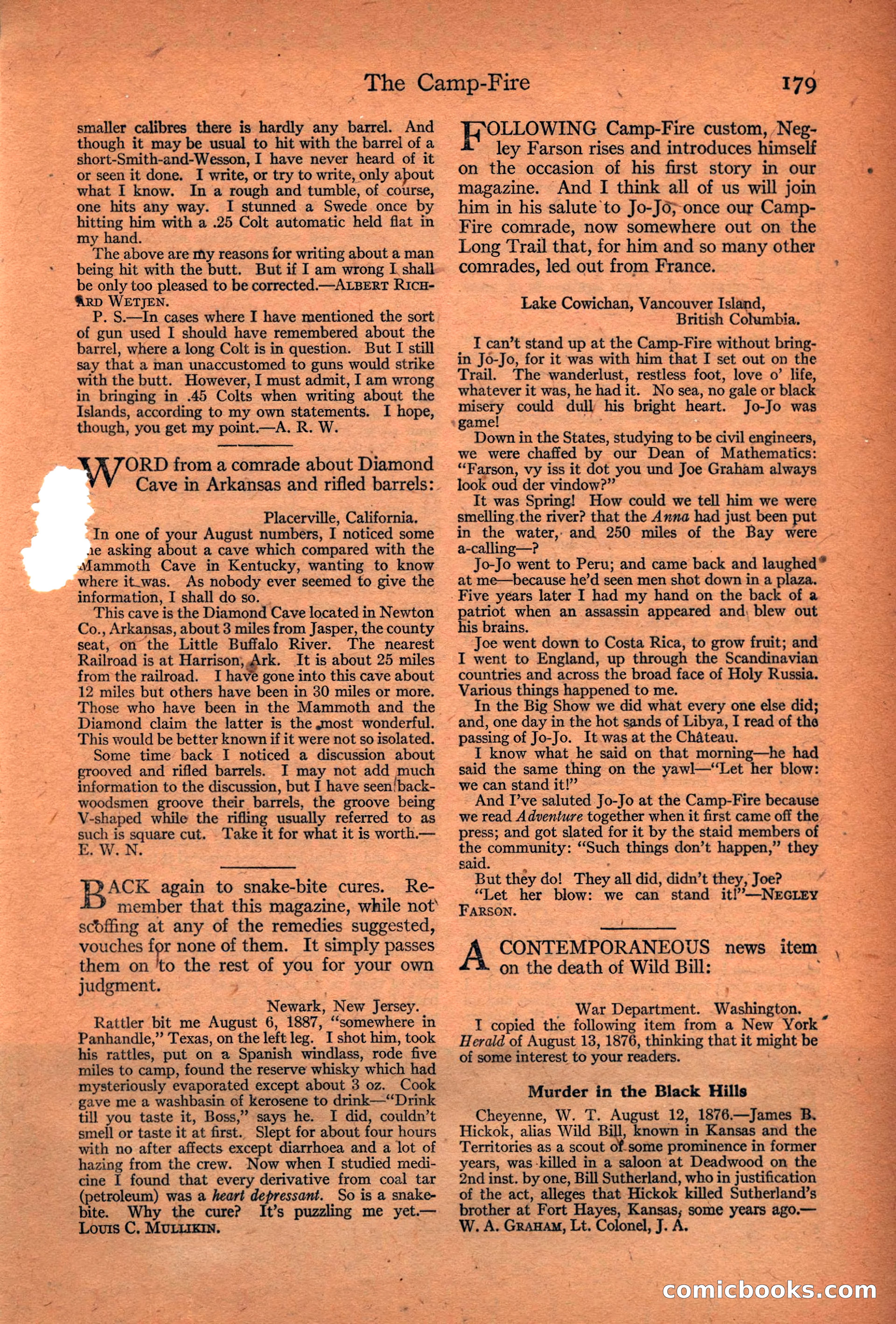
A restored page from Pulp Fiction, 1922. Page through the whole issue in the reader above.
📄 Transcribed text from this page (OCR, searchable)
Machine-transcribed from the original scan — historical spelling and the odd misread are preserved.
4 smaller calibres there is hardly any barrel. And though it may be usual to hit with the barrei of a short-Smith-and-Wesson, I have never heard of it - or seen it done. I write, or try to write, only about what I know. In a rough and tumble, of course, one hits any way. I stunned a Swede once by hitting him with a .25 Colt automatic held flat in my hand. The above are my reasons for writing about a man being hit with the butt. But if I am wrong I shall be only too pleased to be corrected.—ALBERT RIcH- frp WETJEN. P. S.—In cases where I have mentioned the sort of gun used I should have remembered about the barrel, where a long Colt is in question. But I still say that a man unaccustomed to guns would strike with the butt. However, I must admit, I am wrong in bringing in .45 Colts when writing about the Islands, according to my own statements. I hope, though, you get my point.—A. R. W. ORD from a comrade about Diamond Cave in Arkansas and rifled barrels:. Placerville, California, In one of your August numbers, I noticed some ae asking about a cave which compared with the Mammoth Cave in Kentucky, wanting to know where it_was. As nobody ever seemed to give the information, I shall do so. | This cave is the Diamond Cave located in Newton Co., Arkansas, about 3 miles from Jasper, the county seat, on the Little Buffalo River. The nearest Railroad is at Harrison, kes It is about 25 miles from the railroad. I have gone into this cave about 12 miles but others have been in 30 miles or more. Those who have been in the Mammoth and the Diamond claim the latter is the most wonderful. This would be better known if it were not so isolated. Some time back I noticed a discussion about grooved and rifled barrels. I may not add much information to the discussion, but I have seen!back- woodsmen groove their barrels, the groove being V-shaped while the rifling usually referred to as such is square cut. Take it for what it is worth.— E. W. N. 1 Oe again to snake-bite cures. Re- member that this magazine, while not scdffing at any of the remedies suggested, vouches for none of them. It simply passes _ them on 'to the rest of you for your own judgment. | | e Newark, New Jersey. Rattler bit me August 6, 1887, “somewhere in Panhandle,” Texas, on the left leg. I shot him, took his rattles, put on a Spanish windlass, rode five miles to camp, found the reserve whisky which had mysteriously evaporated except about 3 0z. Cook _ gave me a washbasin of kerosene to drink—“Drink till you taste it, Boss,” says he. I did, couldn’t smell or taste it at first. Slept for about four hours with no after affects except diarrhoea and a lot of hazing from the crew. Now when [I studied medi- cine I found that every derivative from coal tar (petroleum) was a heart depressant. So is a snake- bite. Why the cure? It’s puzzling me yet.— Louis C, MULLIKIN. _ The Camp-Fire ‘game! 179 Paes Camp-Fire custom, Neg- ley Farson rises and introduces himself on the occasion of his first story in our magazine. And I think all of us will join him in his salute to Jo-J6;once our Camp- Fire comrade, now somewhere out on the Long Trail that, for him and so many other comrades, led out from France. Lake Cowichan, Vancouver Island, British Columbia, T can’t stand up at the Camp-Fire without bring- in Jo-Jo, for it was with him that I set out on the Trail. The wanderlust, restless foot, love o’ life, whatever it was, he hadit. No sea, no gale or black misery could dull his bright heart. Jo-Jo was Down in the States, studying to be civil engineers, we were chaffed by our Dean of Mathematics: “Farson, vy iss it dot you und Joe Graham always look oud der vindow?” It was Spring! How could we tell him we were smelling.the river? that the Anna had just been put in the water, and 250 miles of the Bay were . a-calling—? at me—because he’d seen men shot down in a plaza. -Five years later I had my hand on the back of a patriot when an assassin appeared and: blew out his brains. Joe went down to Costa Rica, to grow fruit; and I went to England, up through the Scandinavian countries and across the broad face of Holy Russia. Various things happened to me. In the Big Show we did what every one else did; ~ and, one day in the hot sands of Libya, I read of the passing of Jo-Jo. It was at the Chateau. | I know what he said on that morning—he had said the same thing on the yawl—“Let her blow: we can stand it!” | And I’ve saluted Jo-Jo at the Camp-Fire because we read Adventure together when it first came off the. press; and got slated for it by the staid members of ie, ae “Such things don’t happen,” they said. But they do! They all did, didn’t they, Joe? ‘ “Let her blow: we can stand it!”—NEGLEY FARSON. ‘ CONTEMPORANEOUS news item on the death of Wild Bill: : : War Department. Washington. Jo-Jo went to Peru; and came back and laughed® . I copied the following item from a New York ~ Herald of August 13, 1876, thinking that it might be of some interest to your readers. . Murder in the Black Hills Cheyenne, W. T. August 12, 1876.—James B. Hickok, alias Wild Bill, known in Kansas and the Territories as a scout of. some prominence in former years, was killed in a saloon at Deadwood on the 2nd inst. by one, Bill Sutherland, who in justification of the act, alleges that Hickok killed Sutherland’s brother at Fort Hayes, Kansas; some years ago.— W. A. Granam, Lt. Colonel, J. A. (eo) p00kK co pace ay z — Ce hs as + * 35 i 2 cj bs aay) a les VISE Se iss +f Pe. a 4d ive ray yet i\ “Fit My _ ¥ #, sais , meh wes ‘ieee’ neers uate th A 4 AY: ’ is at ee tky Fr < > 4 4 Abd siieegs ind 4 < els { a8 ae hora | Be VO Pe aC GES .\ e otU Sh re 4: 7 / PEIN Ser Ss SYORL ms ae OA \) . Ped ot LL PENN ral pcr ig an’ t Liat ee £09 tae der) Lineer ee AN am tat td o.4 : ae | * (eae ak eS su - t fh, Y iy ’ ars Cn Eg rela ahs MON coe NKTern a rr ah + AA y é: ae oe Phy it See ae (itd } Soaks sees i ; ty Ar fy OSPF 6-14 54 * Ona Ray he Wy Se Sy ety 3 i ved rah aay fe at ris Waa ws , * 1 ahi i Jed py ates DA ( 3 fy . , : tonal ,* « ~ t