
Pulp Fiction, 1922 · page 175 of 196
Adventure Magazine Cover — page 175: what you’re looking at
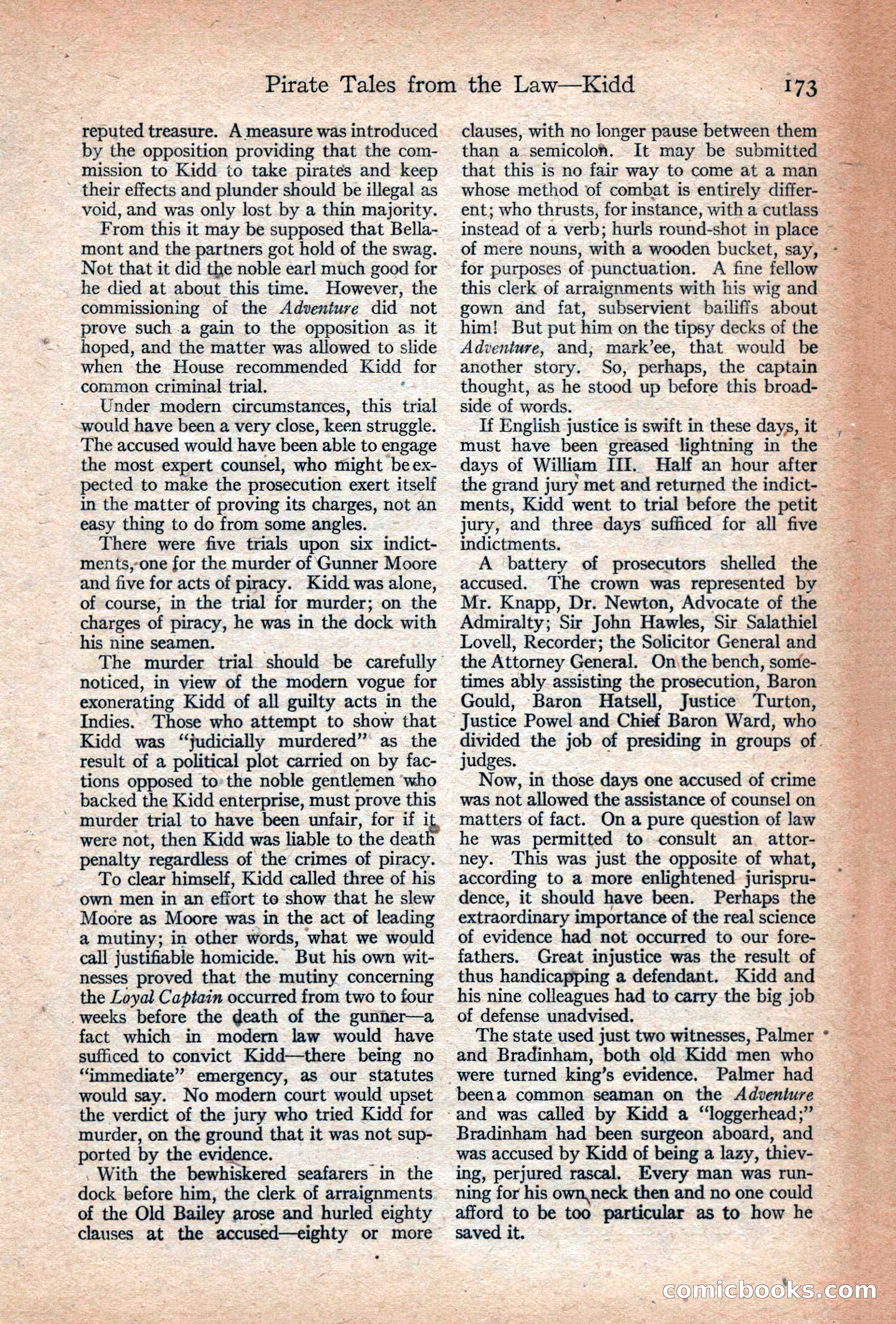
A restored page from Pulp Fiction, 1922. Page through the whole issue in the reader above.
📄 Transcribed text from this page (OCR, searchable)
Machine-transcribed from the original scan — historical spelling and the odd misread are preserved.
Pirate Tales from the Law—Kidd reputed treasure. A measure was introduced by the opposition providing that the com- mission to Kidd to take pirates and keep - their effects and plunder should be illegal as void, and was only lost by a thin majority. From this it may be supposed that Bella- mont and the partners got hold of the swag. Not that it did the noble earl much good for he died at about this time. However, the commissioning of the Adventure did not prove such .a gain to the opposition as it hoped, and the matter was allowed to slide when the House recommended Kidd for common criminal trial. Under modern circumstances, this trial would have been a very close, keen struggle. The accused would have been able to engage the most expert counsel, who might be ex- pected to make the prosecution exert itself in the matter of proving its charges, not an easy thing to do from some angles. There were five trials upon six indict- ments,-one for the murder of Gunner Moore and five for acts of piracy. Kidd was alone, - of course, in the trial for murder; on the charges of piracy, he was in the dock with his nine seamen. The murder trial should be carefully noticed, in view of the modern vogue for exonerating Kidd of all guilty acts in the Indies. Those who attempt to show that Kidd was “judicially murdered” as the result of a political plot carried on by fac- tions opposed to»the noble gentlemen ‘who backed the Kidd enterprise, must prove this ' murder trial to have been unfair, for if i were not, then Kidd was liable to the dea penalty regardless of the crimes of piracy. To clear himself, Kidd called three of his own men in an efiort te show that he slew Moore as Moore was in the act of leading a mutiny; in other words, what we would call justifiable homicide. But his own wit- nesses proved that the mutiny concerning the Loyal Captain occurred from two to four -weeks before the death of the gunher—a fact which in modern law would have sufficed to convict Kidd—there being no “immediate” emergency, as our statutes would say. No modern court would upset the verdict of the jury who tried Kidd for murder, on the ground that it was not sup- ported by the evidence. With the bewhiskered seafarers in the dock before him, the clerk of arraignments of the Old Bailey arose and hurled eighty clauses at the accused—eighty or more 173 clauses, with no longer pause between them than a semicoloh. It may be submitted that this is no fair way to come ata man whose method of combat is entirely differ- = ent; who thrusts, for instance, witha cutlass = instead of a verb; hurls round-shot in place = of mere nouns, with a wooden bucket, say, - for purposes of punctuation. A fine fellow this clerk of arraignments with his wig and — 59 2 oes gown and fat, subservient bailifis about ——— him! But put him on the tipsy decks of the Adventure, and; mark’ee, that would be another story. So, perhaps, the captain thought, as he stood up before this broad- side of words. If English justice is swift in these days, it~ must have been greased lightning in the days of William IIT. Half an hour after — the grand jury met and returned the indict-_ ments, Kidd went to trial before the petit jury, and three days sufficed for all five indictments. A battery of prosecutors shelled the — accused. The crown was represented by Mr. Knapp, Dr. Newton, Advocate of the Admiralty; Sir John Hawes, Sir Salathiel Lovell, Recorder; the Solicitor General and the Attorney General. On the bench, somie- times ably assisting the prosecution, Baron — Gould, Baron Hatsell, Justice Turton, Justice Powel and Chief Baron Ward, who divided the job of presiding in groups of judges. Now, in those days one accused of crime was hot allowed the assistance of counsel on — matters of fact. On a pure question of law he was permitted to consult an attor- © ney. This was just the opposite of what, according to a more enlightened jurispru- dence, it should have been. Perhaps the — extraordinary importance of the real science of evidence had not occurred to our fore- fathers. Great injustice was the result of thus handicapping a defendant. Kidd and his nine colleagues had to carry the big job of defense unadvised. The state used just two witnesses, Palmer and Bradinham, both old Kidd men who were turned king’s evidence. Palmer had beena common seaman on the Adventure ‘and was called by Kidd a “loggerhead;” Bradinham had been surgeon aboard, and was accused by Kidd of being a lazy, thiev- ing, perjured rascal. Every man was run- ning for his o saved it. w- 000) neck then and no one could — afford to be too particular as to how he © ; ‘ ' . AS t pial Ws) VA ia ee, } J MiG eee » ae phe ods US WP» Py) ee a se 4) fist > elt Se ATT SV NE = Plas har’ we hate ane ar ets. Th ON of . Le I) ' ’ vee ? Lh ae +i aie ‘ ete a AY 5 . ae e ) ‘ ? { ¥ a oar, beds rat . a J Ab’ any? h? at Di oly A La & “he Te , P 4 mi So 2. - :