
Pulp Fiction, 1922 · page 174 of 196
Adventure Magazine Cover — page 174: what you’re looking at
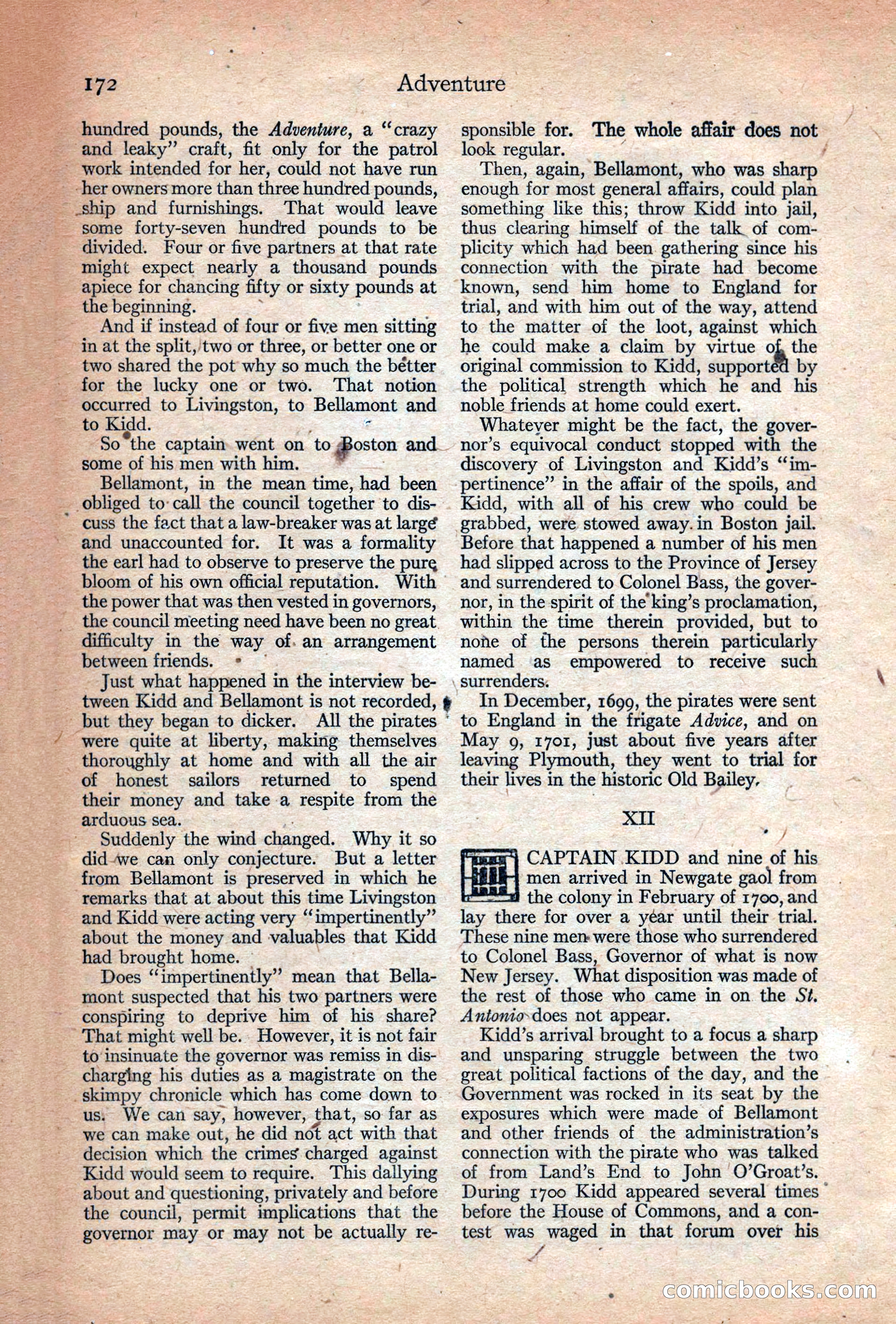
A restored page from Pulp Fiction, 1922. Page through the whole issue in the reader above.
📄 Transcribed text from this page (OCR, searchable)
Machine-transcribed from the original scan — historical spelling and the odd misread are preserved.
x y a fy 4, | =e ee -) some of his men with him. . pad. Exiatidred pounds, the Adventure, a ‘crazy and leaky” craft, fit only for ‘the patrol ~ work intended for her, could not have run her owners more than three hundred pounds, That would leave - some forty-seven hundred pounds to be divided. Four or five partners at that rate might expect nearly a thousand pounds apiece for chancing fifty or sixty pounds at the beginning. And if instead of four or five men sitting In at the split,/two or three, or better one or __ two shared the pot why so much the better for the lucky one or two. That notion occurred to Livingston, to Bellamont and to Kidd. So the captain went on ‘to Bellamont, in the mean time, had been obliged to: call the council together to dis- cuss the fact that a law-breaker was at large eee and unaccounted for. It was a formality the earl had to observe to preserve the pure bloom of his own official reputation. With ____ the power that was then vested in governors, ad tween Kidd and Bellamont is not recorded, $ the council meeting need have been no great. - difficulty in the way of. an arrangement _ between friends. ° _ Just what happened in the interview be- ~ but they began to dicker. All the pirates * “were quite at liberty, making themselves E thoowhly at home and with all the air of honest sailors returned to spend _ their money and take.a respite from the arduous sea. Suddenly the wind changed. Why it so did ave can only conjecture. But a letter from Bellamont is preserved in which he remarks that at about this time Livingston and Kidd were acting very “‘impertinently” about the money and valuables that Kidd had brought home. — Does ““impertinently” mean that Bella- mont suspected that his two partners were conspiring to deprive him of his share? That might well be. However, it is not fair to insinuate the governor was remiss in dis- charging his duties as a magistrate on the _. Skimpy chronicle which has come down to. fox ASS We can say, however, that, so far as we can make out, he did not act with that decision which the crimes charged against Kidd would seem to require. This dallying about and questioning, privately and before the council, permit implications that the governor may or may not be actually re- Poston and_ Adventure ponaible for. The whole affair does not look regular. Then, again, Bellamont, who was sharp enough ‘for most general affairs, could plan something like this; throw Kidd into jail, thus clearing himself of the talk of com- plicity which had been. gathering since his connection with the pirate had become ‘known, send him home to England for trial, and with him out of the way, attend to the matter of the loot, against which he could make a claim by virtue of the original commission to Kidd, supported by the political strength which he and his noble friends at home could exert. Whatever might be the fact, the gover- nor’s equivocal conduct stopped with the discovery of Livingston and Kidd’s “im pertinence”’ in the affair of the spoils, and Kidd, with all of his crew who could be grabbed, were stowed away.in Boston jail. Before that happened a number of his men had slipped across to the Province of Jersey and surrendered to Colonel Bass, the gover- nor, in the spirit of the king’s proclamation, within the time therein provided, but to none of the persons therein particularly named as empowered to receive such . surrenders. In December, 1699, the pirates were sent to England in the frigate Advice, and on May 9, 1701, just about five years after leaving Plymouth, they went to trial for their lives in the historic Old Bailey, XI es CAPTAIN .KIDD and nine of his men arrived in Newgate gaol from the colony in February of 1700, and lay there for over a year until their trial. These nine mem were those who surrendered to Colonel Bass, Governor of what is now New Jersey. What disposition was made of the rest of those who came in on the Si. Antonio»does not appear. Kidd’s arrival brought to a focus a sharp and unsparing struggle between the two great political factions of the day, and the Government was rocked in its seat by the exposures which were made of Bellamont and other friends of the administration’s connection with the pirate who was talked of from Land’s End to John O’Groat’s. Fane Bsa ; During 1700 Kidd appeared several times before the House of Commons, and a con- test was waged in that forum over his vA - ; Eomichoo (Sc S (E@)