
Pulp Fiction, 1922 · page 188 of 200
Adventure Magazine Cover — page 188: what you’re looking at
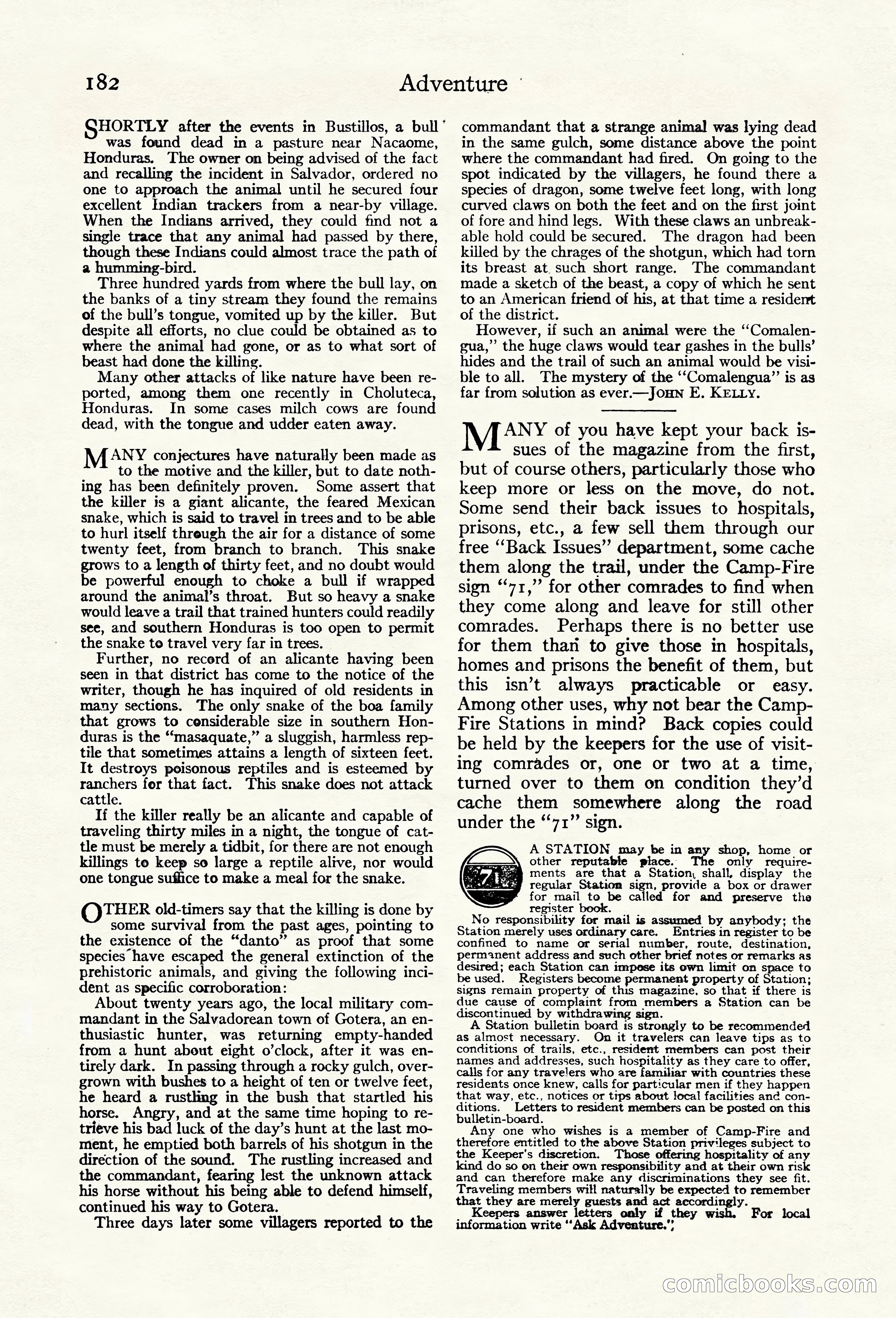
A restored page from Pulp Fiction, 1922. Page through the whole issue in the reader above.
📄 Transcribed text from this page (OCR, searchable)
Machine-transcribed from the original scan — historical spelling and the odd misread are preserved.
182 HORTLY after the events in Bustillos, a bull’ was found dead in a pasture near Nacaome, Honduras. The owner on being advised of the fact and recalling the incident in Salvador, ordered no one to approach the animal until he secured four excellent Indian trackers from a near-by village. When the Indians arrived, they could find not a single trace that any animal had passed by there, though these Indians could almost trace the path of a humming-bird. Three hundred yards from where the bull lay, on the banks of a tiny stream they found the remains of the bull’s tongue, vomited up by the killer. But despite all efforts, no clue could be obtained as to where the animal had gone, or as to what sort of beast had done the killing. Many other attacks of like nature have been re- ported, among them one recently in Choluteca, Honduras. In some cases milch cows are found dead, with the tongue and udder eaten away. MANY conjectures have naturally been made as to the motive and the killer, but to date noth- ing has been definitely proven. Some assert that the killer ts a giant alicante, the feared Mexican snake, which is said to travel in trees and to be able to hurl itself threugh the air for a distance of some twenty feet, from branch to branch. This snake grows to a length of thirty feet, and no doubt would be powerful enough to choke a bull if wrapped around the animal’s throat. But so heavy a snake would leave a trail that trained hunters could readily see, and southern Honduras is too open to permit the snake to travel very far in trees. Further, no record of an alicante having been seen in that district has come to the notice of the writer, though he has inquired of old residents in many sections. The only snake of the boa family that grows to censiderable size in southern Hon- duras is the “‘masaquate,” a sluggish, harmless rep- tile that sometimes attains a length of sixteen feet. It destroys poisonous reptiles and is esteemed by ranchers for that fact. This snake does not attack cattle. If the killer really be an alicante and capable of traveling thirty miles in a night, the tongue of cat- tle must be merely a tidbit, for there are not enough killings to keep so large a reptile alive, nor would one tongue suffice to make a meal for the snake. THER old-timers say that the killing is done by some survival from the past ages, pointing to the existence of the “danto” as proof that some species have escaped the general extinction of the prehistoric animals, and giving the following inci- dent as specific corroboration: About twenty years ago, the local military com- mandant in the Salvadorean town of Gotera, an en- thusiastic hunter, was returning empty-handed from a hunt about eight o’clock, after it was en- tirely dark. In passing through a rocky gulch, over- grown with bushes to a height of ten or twelve feet, he heard a rusthng in the bush that startled his horse. Angry, and at the same time hoping to re- trieve his bad luck of the day’s hunt at the last mo- ment, he emptied both barrels of his shotgun in the direction of the sound. The rustling increased and the commandant, fearing lest the unknown attack his horse without his being able to defend himself, continued his way to Gotera. Three days later some villagers reported to the Adventure commandant that a strange animal was lying dead in the same gulch, some distance above the point where the commandant had fired. On going to the spot indicated by the villagers, he found there a species of dragon, some twelve feet long, with long curved claws on both the feet and on the first joint of fore and hind legs. With these claws an unbreak- able hold could be secured. The dragon had been killed by the chrages of the shotgun, which had torn its breast at. such short range. The commandant made a sketch of the beast, a copy of which he sent to an American friend of his, at that time a resident of the district. However, if such an animal were the “‘Comalen- gua,” the huge claws would tear gashes in the bulls’ hides and the trail of such an animal would be visi- ble to all. The mystery of the ‘‘Comalengua”’ is as far from solution as ever.—JOHN E. KELLY. 1h eh of you have kept your back is- sues of the magazine from the first, but of course others, particularly those who keep more or less on the move, do not. Some send their back issues to hospitals, prisons, etc., a few sell them through our free “Back Issues’’ department, some cache them along the trail, under the Camp-Fire sign “71,” for other comrades to find when they come along and leave for still other comrades. Perhaps there is no better use for them than to give those in hospitals, homes and prisons the benefit of them, but this isn’t always practicable or easy. Among other uses, why not bear the Camp- Fire Stations in mind? Back copies could be held by the keepers for the use of visit- ing comrades or, one or two at a time, turned over to them on condition they’d cache them somewhere along the road under the ‘‘71”’ sign. A STATION may be in any shop, home or —\ other reputable piace. e only require- ga ments are that a Station, shall, display the regular Station sign, provide a box or drawer for mail to be called for and preserve the register No responsibility for mail is assumed by anybody; the Station merely uses ordinary care. Entries in register to be confined to name or serial number, route, destination, permanent address and such other brief notes or remarks as desired; each Station can impose its own limit on space to be used. Registers become permanent property of Station; signs remain property of this magazine, so that +f there is due cause of complaint from members a Station can be discontinued by withdrawing sign. A Station bulletin board is strongly to be recommended as almost necessary. On it travelers can leave tips as to conditions of trails, etc., resident members can post their names and addresses, such hospitality as they care to offer, calls for any travelers who are familiar with countries these residents once knew, calls for particular men if they happen that way, etc., notices or trps about local facilities and con- ditions. Letters to resident members can be posted on this bulletin-board. Any one who wishes is a member of Camp-Fire and therefore entitled to the above Station privileges subject to the Keeper's discretion. Those hospitality of any kind do so on their own responsibility and at their own risk and can therefore make any discriminations they see fit. Traveling members wit! naturally be expected to remember that they are merely guests and act accordingly. ers answer letters only if they wi: For local information write “Ask Adventure.”; MICLOO© (©