
Pulp Fiction, 1922 · page 187 of 200
Adventure Magazine Cover — page 187: what you’re looking at
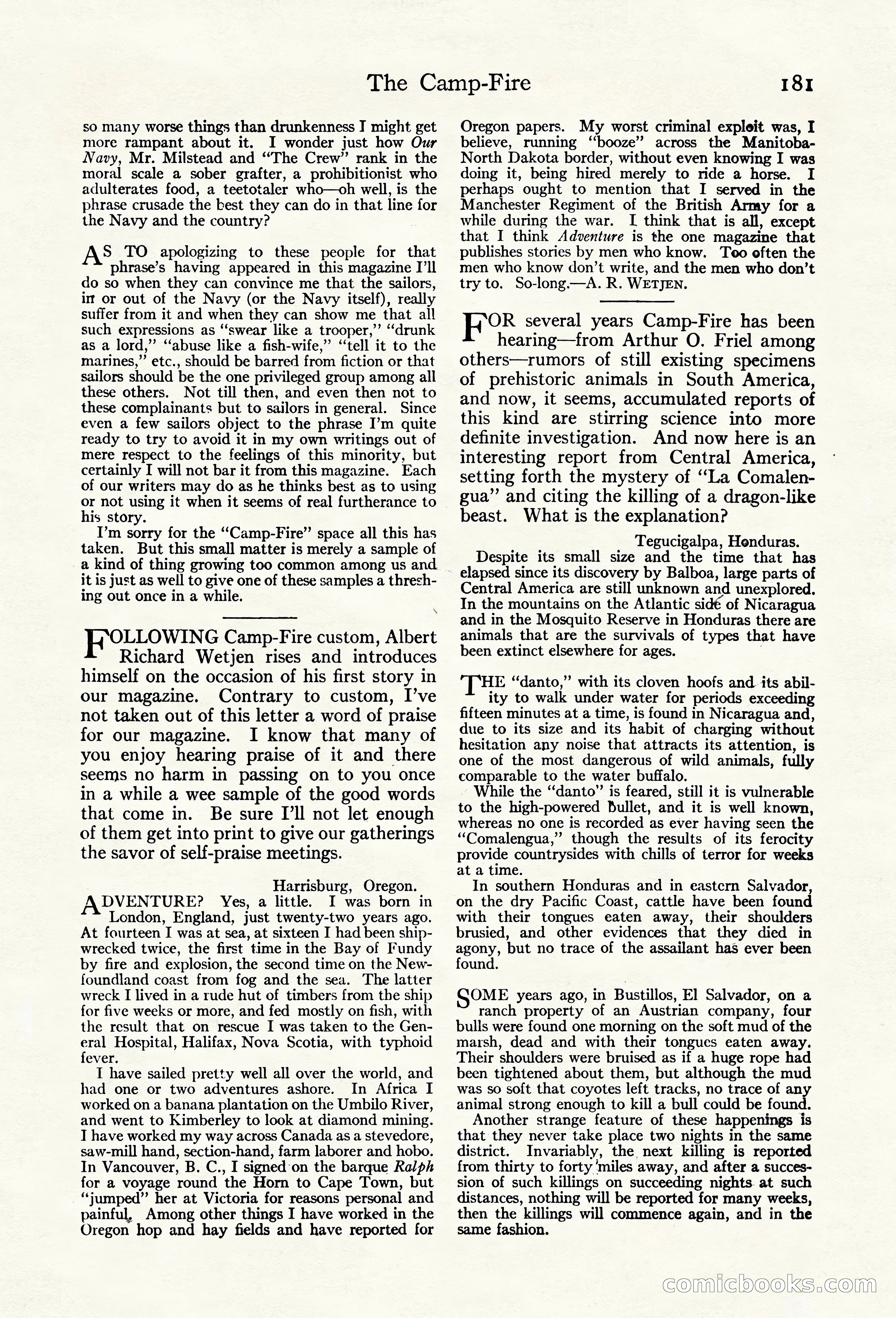
A restored page from Pulp Fiction, 1922. Page through the whole issue in the reader above.
📄 Transcribed text from this page (OCR, searchable)
Machine-transcribed from the original scan — historical spelling and the odd misread are preserved.
The Camp-Fire so many worse things than drunkenness J might get more rampant about it. I wonder just how Our Navy, Mr. Milstead and “The Crew’’ rank in the moral scale a sober grafter, a prohibitionist who adulterates food, a teetotaler who—oh well, is the phrase crusade the best they can do in that line for the Navy and the country? S TO apologizing to these people for that phrase’s having appeared in this magazine I'll do so when they can convince me that the sailors, it or out of the Navy (or the Navy itself), really suffer from it and when they can show me that all such expressions as “swear like a trooper,” ‘drunk as a lord,” “‘abuse like a fish-wife,” “tell it to the marines,” etc., should be barred from fiction or that sailors should be the one privileged group among all these others. Not till then, and even then not to these complainants but to sailors in general. Since even a few sailors object to the phrase I’m quite ready to try to avoid it in my own writings out of mere respect to the feelings of this minority, but certainly I will not bar it from this magazine. Each of our writers may do as he thinks best as to using or not using it when it seems of real furtherance to his story. I’m sorry for the ‘‘Camp-Fire’’ space all this has taken. But this small matter is merely a sample of _a kind of thing growing too common among us and. it is just as well to give one of these samples a thresh- ing out once in a while. | BRED ak Camp-Fire custom, Albert Richard Wetjen rises and introduces himself on the occasion of his first story in our magazine. Contrary to custom, I’ve not taken out of this letter a word of praise for our magazine. I know that many of you enjoy hearing praise of it and there seems no harm in passing on to you once in a while a wee sample of the good words that come in. Be sure [’ll not let enough of them get into print to give our gatherings the savor of self-praise meetings. Harrisburg, Oregon. ADVENTURE? Yes, a little. I was born in London, England, just twenty-two years ago. At fourteen I was at sea, at sixteen I had been ship- wrecked twice, the first time in the Bay of Fundy by fire and explosion, the second time on the New- foundland coast from fog and the sea. The latter wreck I lived in a rude hut of timbers from the ship for five weeks or more, and fed mostly on fish, with the result that on rescue I was taken to the Gen- eral Hospital, Halifax, Nova Scotia, with typhoid fever. I have sailed pretty well all over the world, and had one or two adventures ashore. In Africa I worked on a banana plantation on the Umbilo River, and went to Kimberley to look at diamond mining. T have worked my way across Canada as a stevedore, saw-mill hand, section-hand, farm laborer and hobo. In Vancouver, B. C., I signed'on the barque Ralph for a voyage round the Horn to Cape Town, but “jumped” her at Victoria for reasons personal and painful, Among other things I have worked in the Oregon hop and hay fields and have reported for 18I Oregon papers. My worst criminal expleit was, I believe, running ‘‘booze”’ across the Manitoba- North Dakota border, without even knowing I was doing it, being hired merely to ride a horse. I perhaps ought to mention that I served in the Manchester Regiment of the British Army for a while during the war. I think that is all, except that I think Adventure is the one magazine that publishes stories by men who know. Too often the men who know don’t write, and the men who don’t try to. So-long.—A. R. WETJEN. Por several years Camp-Fire has been hearing—from Arthur O. Friel among others—rumors of still existing specimens of prehistoric animals in South America, and now, it seems, accumulated reports of this kind are stirring science into more definite investigation. And now here is an interesting report from Central America, setting forth the mystery of “La Comalen- gua” and citing the killing of a dragon-like beast. What is the explanation? Tegucigalpa, Henduras. Despite its small size and the time that has - elapsed since its discovery by Balboa, large parts of Central America are still unknown and unexplored. In the mountains on the Atlantic sid€é of Nicaragua and in the Mosquito Reserve in Honduras there are animals that are the survivals of types that have been extinct elsewhere for ages. : HE “danto,” with its cloven hoofs and its abil- ity to walk under water for periods exceeding fifteen minutes at a time, is found in Nicaragua and, due to its size and its habit of charging without hesitation any noise that attracts its attention, is one of the most dangerous of wild animals, fully comparable to the water buffalo. ~ While the ‘‘danto” is feared, still it is vulnerable to the high-powered bullet, and it is well known, whereas no one is recorded as ever having seen the ‘“‘Comalengua,” though the results of its ferocity provide countrysides with chills of terror for weeks at a time. In southern Honduras and in eastern Salvador, on the dry Pacific Coast, cattle have been found with their tongues eaten away, their shoulders brusied, and other evidences that they died in agony, but no trace of the assailant has ever been found. OME years ago, in Bustillos, E] Salvador, on a ranch property of an Austrian company, four bulls were found one morning on the soft mud of the marsh, dead and with their tongues eaten away. Their shoulders were bruised as if a huge rope had been tightened about them, but although the mud was so soft that coyotes left tracks, no trace of any animal strong enough to kill a bull could be found. Another strange feature of these happenings is that they never take place two nights in the same district. Invariably, the next killing is reported from thirty to forty ‘miles away, and after a succes- sion of such killings on succeeding nights at such distances, nothing will be reported for many weeks, then the killings will commence again, and in the same fashion. DOOLK (C@