
Pulp Fiction, 1922 · page 161 of 200
Adventure Magazine Cover — page 161: what you’re looking at
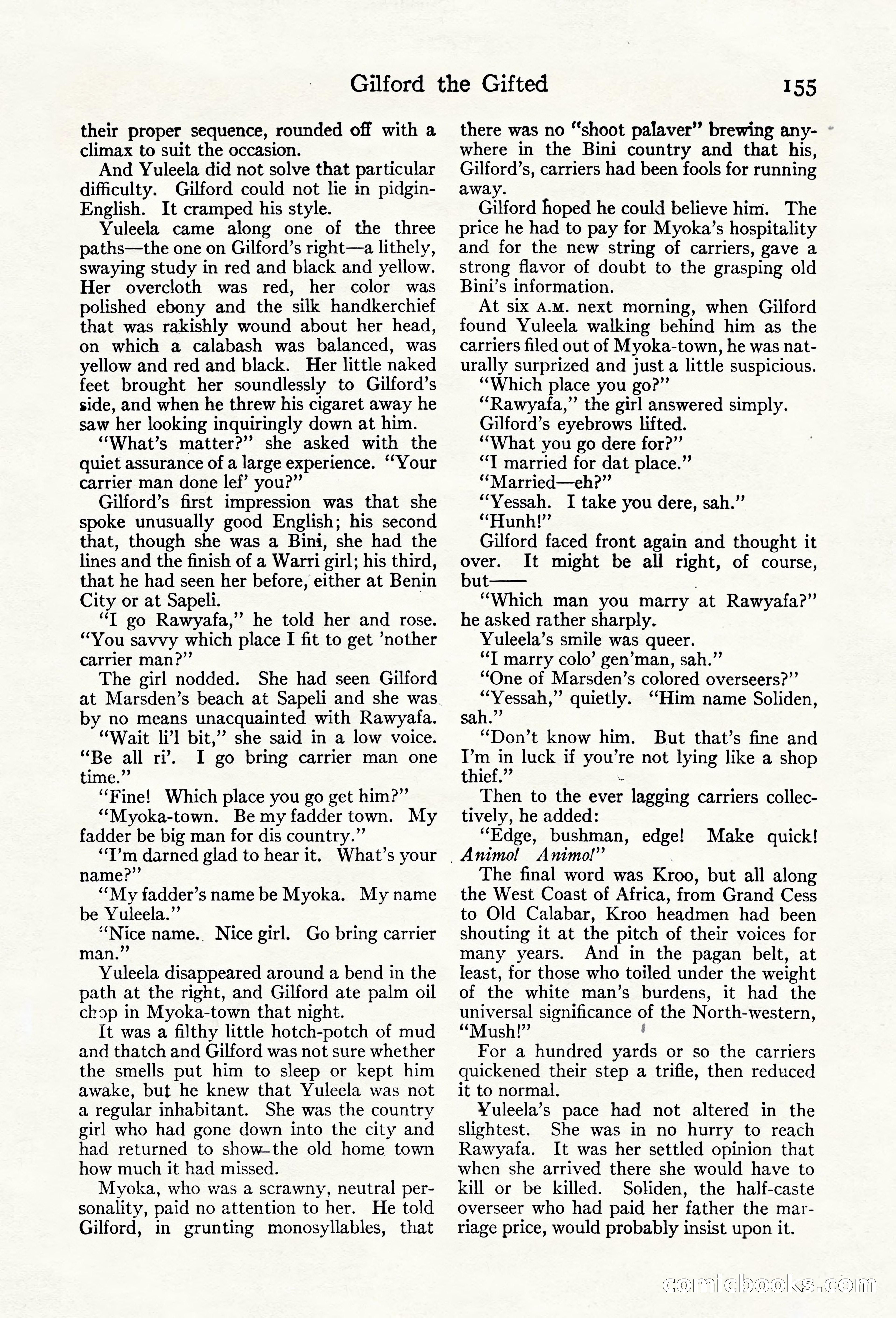
A restored page from Pulp Fiction, 1922. Page through the whole issue in the reader above.
📄 Transcribed text from this page (OCR, searchable)
Machine-transcribed from the original scan — historical spelling and the odd misread are preserved.
Gilford the Gifted their proper sequence, rounded off with a climax to suit the occasion. And Yuleela did not solve that particular difficulty. Gilford could not lie in pidgin- English. It cramped his style. Yuleela came along one of the three paths—the one on Gilford’s right—a lithely, swaying study in red and black and yellow. Her overcloth was red, her color was polished ebony and the silk handkerchief that was rakishly wound about her head, on which a calabash was balanced, was yellow and red and black. Her little naked feet brought her soundlessly to Gilford’s side, and when he threw his cigaret away he saw her looking inquiringly down at him. “‘What’s matter?” she asked with the quiet assurance of a large experience. ‘Your carrier man done lef’ you?” Gilford’s first impression was that she spoke unusually good English; his second that, though she was a Bini, she had the lines and the finish of a Warri girl; his third, that he had seen her before, either at Benin City or at Sapell. “T go Rawyafa,” he told her and rose. “You savvy which place I fit to get ’nother carrier man?” The girl nodded. She had seen Gilford at Marsden’s beach at Sapeli and she was. by no means unacquainted with Rawyafa. “Wait li’l bit,” she said in a low voice. “Be all ri’. I go bring carrier man one time.” “Fine! Which place you go get him?” ““Myoka-town. Be my fadder town. My fadder be big man for dis country.”’ “I’m darned glad to hear it. What’s your name?” ““My fadder’s name be Myoka. My name be Yuleela.” “Ni ice name.. Nice girl. man.’ Yuleela disappeared around a bend in the path at the right, and Gilford ate palm oil ckop in Myoka-town that night. It was a filthy little hotch-potch of mud and thatch and Gilford was not sure whether the smells put him to sleep or kept him awake, but he knew that Yuleela was not a regular inhabitant. She was the country girl who had gone down into the city and had returned to show-the old home town how much it had missed. Myoka, who was a scrawny, neutral per- sonality, paid no attention to her. He told Gilford, in grunting monosyllables, that Go bring carrier 155 there was no “shoot palaver” brewing any- ~ where in the Bini country and that his, Gilford’s, carriers had been fools for running away Gilford hoped he could believe him. The price he had to pay for Myoka’s hospitality and for the new string of carriers, gave a strong flavor of doubt to the grasping old Bini’s information. At six A.M. next morning, when Gilford found Yuleela walking behind him as the carriers filed out of Myoka-town, he was nat- urally surprized and just a little suspicious. ‘Which place you go?” “Rawyafa,” the girl answered simply. Gilford’s eyebrows lifted. ‘What you go dere for?”’ “TY married for dat place.” ““Married—eh?”’ ““Yessah. I take you dere, sah.” “Hunh!”’ Gilford faced front again and thought it er It might be all right, of course, ut “Which man you marry at Rawyafa?”’ he asked rather sharply. Yuleela’s smile was queer. “T marry colo’ gen’man, sah.” ‘“‘One of Marsden’s colored overseers?” Sener quietly. ‘Him name Soliden, sah.” “Don’t know him. But that’s fine and I’m in luck if you re not lying like a shop thief.” Then to the ever - lagging carriers collec- tively, he added: “Edge, bushman, edge! Make quick! Animo! Animo!’’ The final word was Kroo, but all along the West Coast of Africa, from Grand Cess to Old Calabar, Kroo headmen had been shouting it at the pitch of their voices for many years. And in the pagan belt, at least, for those who toiled under the weight of the white man’s burdens, it had the universal significance of the North- western, For a hundred ae or so the carriers quickened their step a trifle, then reduced it to normal. Yuleela’s pace had not altered in the slightest. She was in no hurry to reach Rawyafa. It was her settled opinion that when she arrived there she would have to kill or be killed. Soliden, the half-caste overseer who had paid her father the mar- riage price, would probably insist upon it. COmiclboook Cc (C@