
Pulp Fiction, 1922 · page 160 of 200
Adventure Magazine Cover — page 160: what you’re looking at
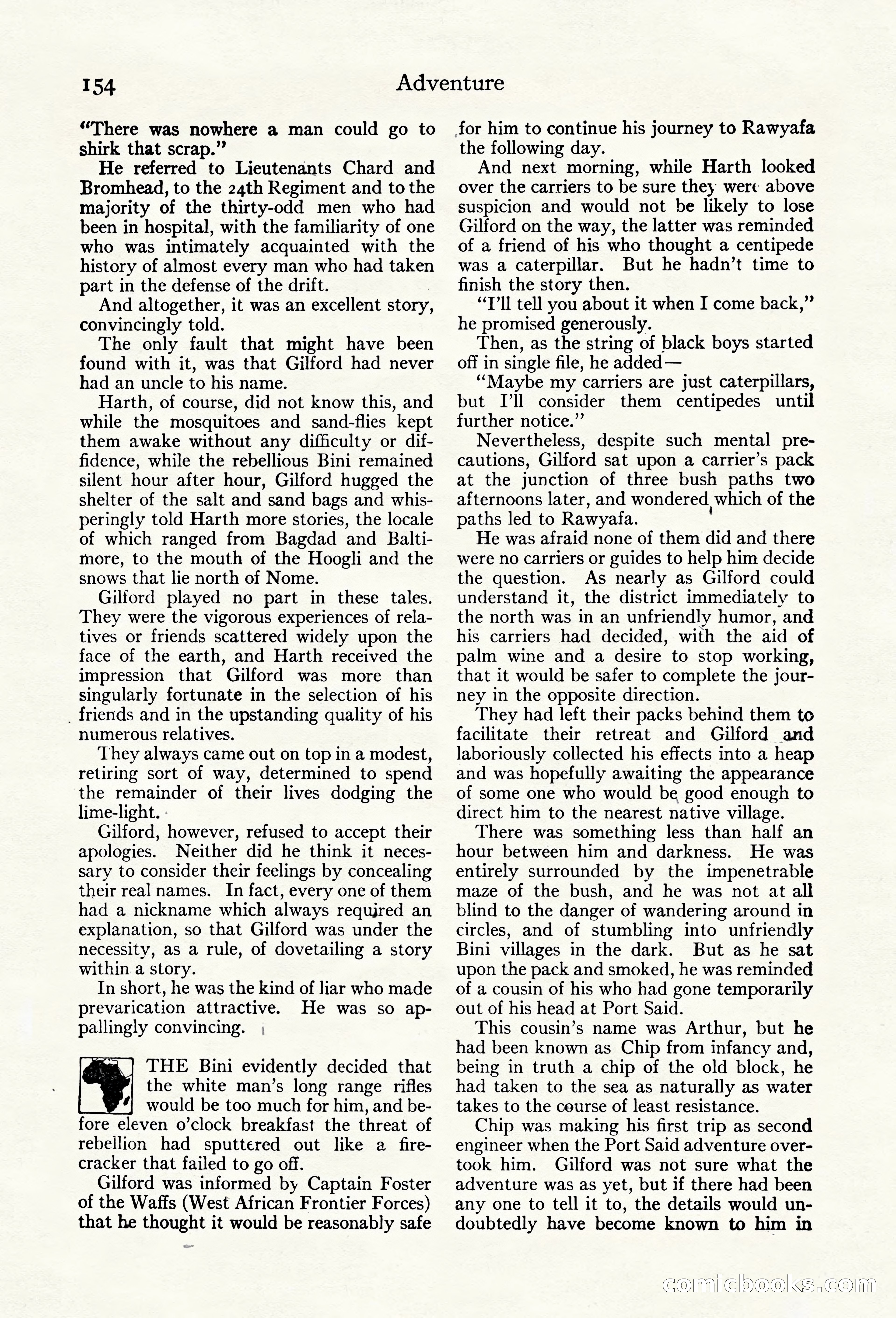
A restored page from Pulp Fiction, 1922. Page through the whole issue in the reader above.
📄 Transcribed text from this page (OCR, searchable)
Machine-transcribed from the original scan — historical spelling and the odd misread are preserved.
154 “There was nowhere a man could go to shirk that scrap.” He referred to Lieutenants Chard and Bromhead, to the 24th Regiment and to the majority of the thirty-odd men who had been in hospital, with the familiarity of one who was intimately acquainted with the history of almost every man who had taken part in the defense of the drift. And altogether, it was an excellent story, convincingly told. The only fault that might have been found with it, was that Gilford had never had an uncle to his name. Harth, of course, did not know this, and while the mosquitoes and sand-flies kept them awake without any difficulty or dif- fidence, while the rebellious Bini remained silent hour after hour, Gilford hugged the shelter of the salt and sand bags and whis- peringly told Harth more stories, the locale of which ranged from Bagdad and Balti- more, to the mouth of the Hoogli and the snows that lie north of Nome. Gilford played no part in these tales. They were the vigorous experiences of rela- tives or friends scattered widely upon the face of the earth, and Harth received the impression that Gilford was more than singularly fortunate in the selection of his _ friends and in the upstanding quality of his numerous relatives. They always came out on top in a modest, retiring sort of way, determined to spend the remainder of their lives dodging the lime-light. Gilford, however, refused to accept their apologies. Neither did he think it neces- sary to consider their feelings by concealing their real names. In fact, every one of them had a nickname which always required an explanation, so that Gilford was under the necessity, as a rule, of dovetailing a story within a story. In short, he was the kind of liar who made prevarication attractive. He was so ap- pallingly convincing. THE Bini evidently decided that the white man’s long range rifles y “} would be too much for him, and be- fore eleven o’clock breakfast the threat of rebellion had sputtered out like a fire- cracker that failed to go off. Gilford was informed by Captain Foster of the Waffs (West African Frontier Forces) that he thought it would be reasonably safe Adventure for him to continue his journey to Rawyafa the following day. And next morning, while Harth looked over the carriers to be sure they were above suspicion and would not be likely to lose Gilford on the way, the latter was reminded of a friend of his who thought a centipede was a caterpillar. But he hadn’t time to finish the story then. “Tl tell you about it when I come back,”’ he promised generously. Then, as the string of black boys started off in single file, he added — “Maybe my carriers are just caterpillars, but Ill consider them centipedes until further notice.”’ Nevertheless, despite such mental pre- cautions, Gilford sat upon a carrier’s pack at the junction of three bush paths two afternoons later, and wondered, which of the paths led to Rawyafa. He was afraid none of them did and there were no carriers or guides to help him decide the question. As nearly as Gilford could understand it, the district immediately to the north was in an unfriendly humor, and his carriers had decided, with the aid of palm wine and a desire to stop working, that it would be safer to complete the jour- ney in the opposite direction. They had left their packs behind them to facilitate their retreat and Gilford and laboriously collected his effects into a heap and was hopefully awaiting the appearance of some one who would be good enough to direct him to the nearest native village. There was something less than half an hour between him and darkness. He was entirely surrounded by the impenetrable maze of the bush, and he was not at all blind to the danger of wandering around in circles, and of stumbling into unfriendly Bini villages in the dark. But as he sat upon the pack and smoked, he was reminded of a cousin of his who had gone temporarily out of his head at Port Said. This cousin’s name was Arthur, but he had been known as Chip from infancy and, being in truth a chip of the old block, he had taken to the sea as naturally as water takes to the course of least resistance. Chip was making his first trip as second engineer when the Port Said adventure over- took him. Gilford was not sure what the adventure was as yet, but if there had been any one to tell it to, the details would un- doubtedly have become known to him in COnniclboooks (C@