
Pulp Fiction, 1922 · page 106 of 202
Adventure Magazine Cover — page 106: what you’re looking at
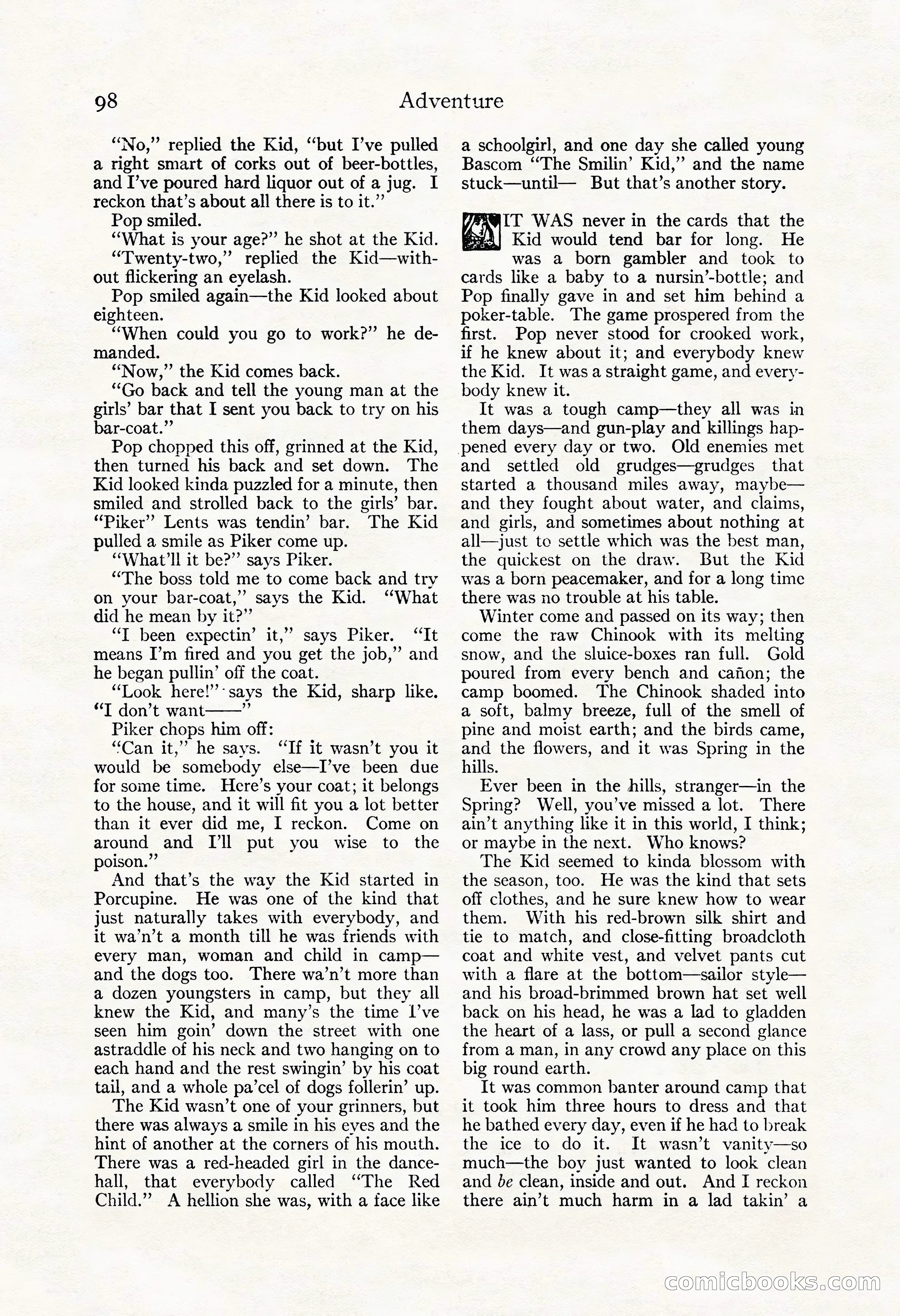
A restored page from Pulp Fiction, 1922. Page through the whole issue in the reader above.
📄 Transcribed text from this page (OCR, searchable)
Machine-transcribed from the original scan — historical spelling and the odd misread are preserved.
98 “No,” replied the Kid, “but I’ve pulled a right smart of corks out of beer-bottles, and I’ve poured hard liquor out of a jug. I reckon that’s about all there is to it.” Pop smiled. ‘“‘What is your age?” he shot at the Kid. “Twenty-two,” replied the Kid—with- out flickering an eyelash. Pop smiled again—the Kid looked about eighteen. “When could you go to work?” he de- manded. “Now,” the Kid comes back. ““Go back and tell the young man at the girls’ bar that I sent you back to try on his bar-coat.” Pop chopped this off, grinned at the Kid, then turned his back and set down. The Kid looked kinda puzzled for a minute, then smiled and strolled back to the girls’ bar. “Piker” Lents was tendin’ bar. The Kid pulled a smile as Piker come up. “What’ll it be?” says Piker. “The boss told me to come back and try on your bar-coat,” says the Kid. “What did he mean by it?” “YT been expectin’ it,” says Piker. “It means I’m fired and you get the job,” and he began pullin’ off the coat. “Look here!’’-says the Kid, sharp like. “I don’t want df Piker chops him off: “Can it,” he says. “If it wasn’t you it would be somebody else—I’ve been due for some time. Here’s your coat; it belongs to the house, and it will fit you a lot better than it ever did me, I reckon. Come on around and [ll put you wise to the poison.”’ And that’s the way the Kid started in Porcupine. He was one of the kind that just naturally takes with everybody, and it wa’n’t a month till he was friends with every man, woman and child in camp— and the dogs too. There wa’n’t more than a dozen youngsters in camp, but they all knew the Kid, and many’s the time l’ve seen him goin’ down the street with one astraddle of his neck and two hanging on to each hand and the rest swingin’ by his coat tail, and a whole pa’cel of dogs follerin’ up. The Kid wasn’t one of your grinners, but there was always a smile in his eves and the hint of another at the corners of his mouth. There was a red-headed girl in the dance- hall, that everybody called ‘The Red Child.”” A hellion she was, with a face like Adventure a schoolgirl, and one day she called young Bascom ‘‘The Smilin’ Kid,” and the name stuck—until— But that’s another story. WIT WAS never in the cards that the ma! Kid would tend bar for long. He was a born gambler and took to cards like a baby to a nursin’-bottle; and Pop finally gave in and set him behind a poker-table. The game prospered from the first. Pop never stood for crooked work, if he knew about it; and everybody knew the Kid. It wasa straight game, and every- body knew it. It was a tough camp—they all was in them days—and gun-play and killings hap- pened every day or two. Old enemies met and settled old grudges—grudges that started a thousand miles away, maybe— and they fought about water, and claims, and girls, and sometimes about nothing at all—just to settle which was the best man, the quickest on the draw. But the Kid was a born peacemaker, and for a long time there was no trouble at his table. Winter come and passed on its way; then come the raw Chinook with its melting snow, and the sluice-boxes ran full. Gold poured from every bench and cafion; the camp boomed. The Chinook shaded into a soft, balmy breeze, full of the smell of pine and moist earth; and the birds came, and the flowers, and it was Spring in the hills. Ever been in the hills, stranger—in the Spring? Well, you’ve missed a lot. There ain’t anything like it in this world, I think; or maybe in the next. Who knows? The Kid seemed to kinda blossom with the season, too. He was the kind that sets off clothes, and he sure knew how to wear them. With his red-brown silk shirt and tie to match, and close-fitting broadcloth coat and white vest, and velvet pants cut with a flare at the bottom—sailor style— and his broad-brimmed brown hat set well back on his head, he was a lad to gladden the heart of a lass, or pull a second glance from a man, in any crowd any place on this big round earth. It was common banter around camp that it took him three hours to dress and that he bathed every day, even if he had to break the ice to do it. It wasn’t vanity—so much—the boy just wanted to look clean and de clean, inside and out. And I reckon there ain’t much harm in a lad takin’ a COMmicboo <S) C@