
Pulp Fiction, 1922 · page 105 of 202
Adventure Magazine Cover — page 105: what you’re looking at
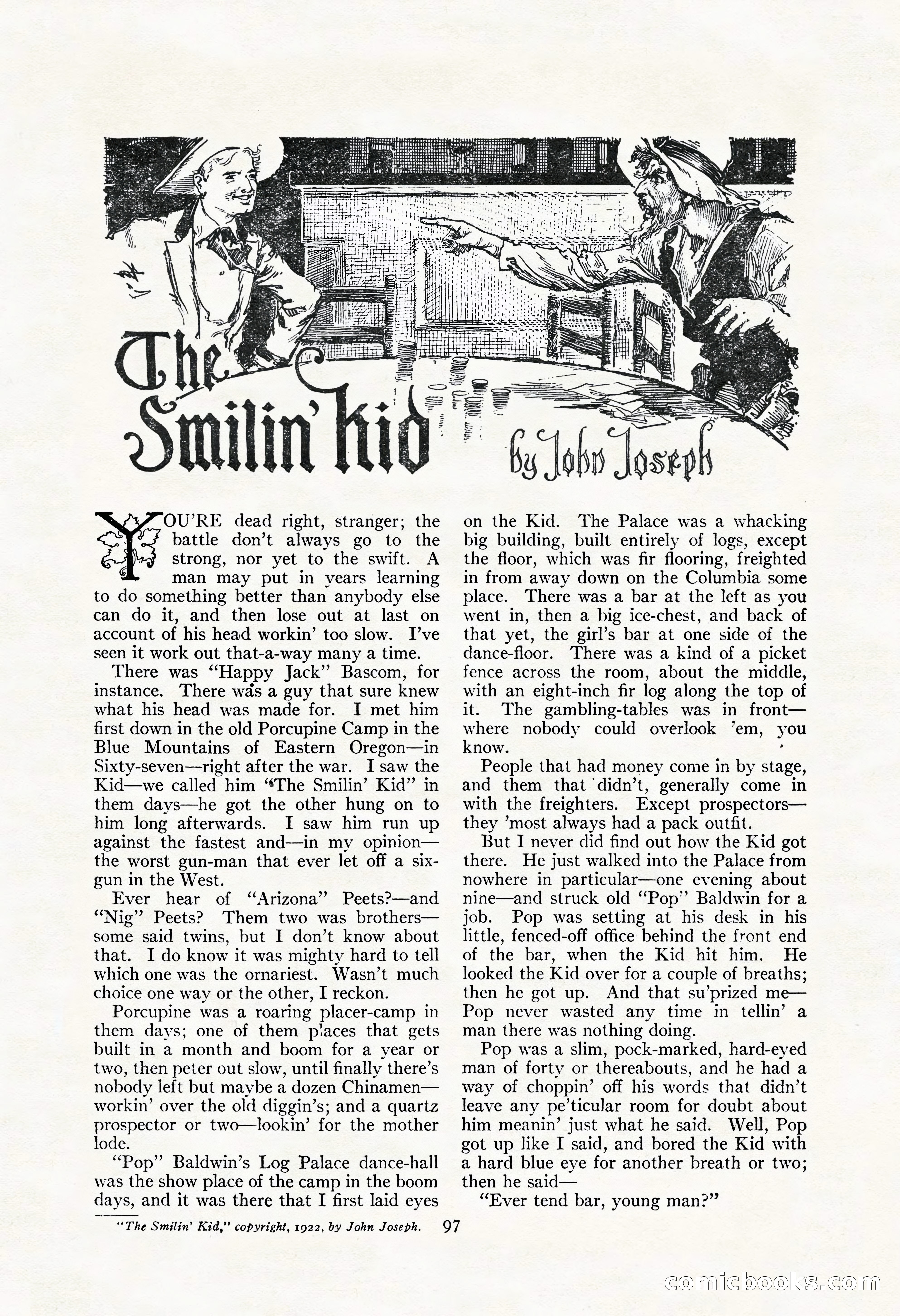
A restored page from Pulp Fiction, 1922. Page through the whole issue in the reader above.
📄 Transcribed text from this page (OCR, searchable)
Machine-transcribed from the original scan — historical spelling and the odd misread are preserved.
OU’RE dead right, stranger; the battle don’t always go to the strong, nor yet to the swift. A man may put in years learning to do something better than anybody else can do it, and then lose out at last on account of his head workin’ too slow. I’ve seen it work out that-a-way many a time. There was “Happy Jack” Bascom, for instance. There wds a guy that sure knew what his head was made for. I met him first down in the old Porcupine Camp in the Blue Mountains of Eastern Oregon—in Sixty-seven—right after the war. I saw the Kid—we called him ‘The Smilin’ Kid” in them days—he got the other hung on to him long afterwards. I saw him run up against the fastest and—in my opinion— the worst gun-man that ever let off a six- gun in the West. Ever hear of ‘Arizona’? Peets?—and “Nig” Peets? Them two was brothers— some said twins, but I don’t know about that. I do know it was mighty hard to tell which one was the ornariest. Wasn’t much choice one way or the other, I reckon. Porcupine was a roaring placer-camp in them days; one of them puaces that gets built in a month and boom for a year or two, then peter out slow, until finally there’s nobody left but mavbe a dozen Chinamen— workin’ over the old diggin’s; and a quartz prospector or two—lookin’ for the mother lode. “Pop” Baldwin’s Log Palace dance-hall was the show place of the camp in the boom days, and it was there that I first laid eyes “The Smilin’ Kid,” copyright, 1922, by John Joseph. Yer-aees! = Se Ricks on the Kid. The Palace was a whacking big building, built entirely of logs, except the floor, which was fir flooring, freighted in from away down on the Columbia some place. There was a bar at the left as you went in, then a big ice-chest, and back of that yet, the girl’s bar at one side of the dance-floor. There was a kind of a picket fence across the room, about the middle, with an eight-inch fir log along the top of it. The gambling-tables was in front— where nobody could overlook ’em, you know. ; People that had money come in by stage, and them that ‘didn’t, generally come in with the freighters. Except prospectors— they ’most always had a pack outfit. But I never did find out how the Kid got there. He just walked into the Palace from nowhere in particular—one evening about nine—and struck old “Pop” Baldwin for a job. Pop was setting at his desk in his little, fenced-off office behind the front end of the bar, when the Kid hit him. He looked the Kid over for a couple of breaths; then he got up. And that su’prized me— Pop never wasted any time in tellin’ a man there was nothing doing. Pop was a slim, pock-marked, hard-eyed man of forty or thereabouts, and he had a way of choppin’ off his words that didn’t leave any pe’ticular room for doubt about him meanin’ just what he said. Well, Pop got up like I said, and bored the Kid with a hard blue eye for another breath or two; then he said— “Ever tend bar, young man?” Conn clooolks C@