
Pulp Fiction, 1922 · page 107 of 202
Adventure Magazine Cover — page 107: what you’re looking at
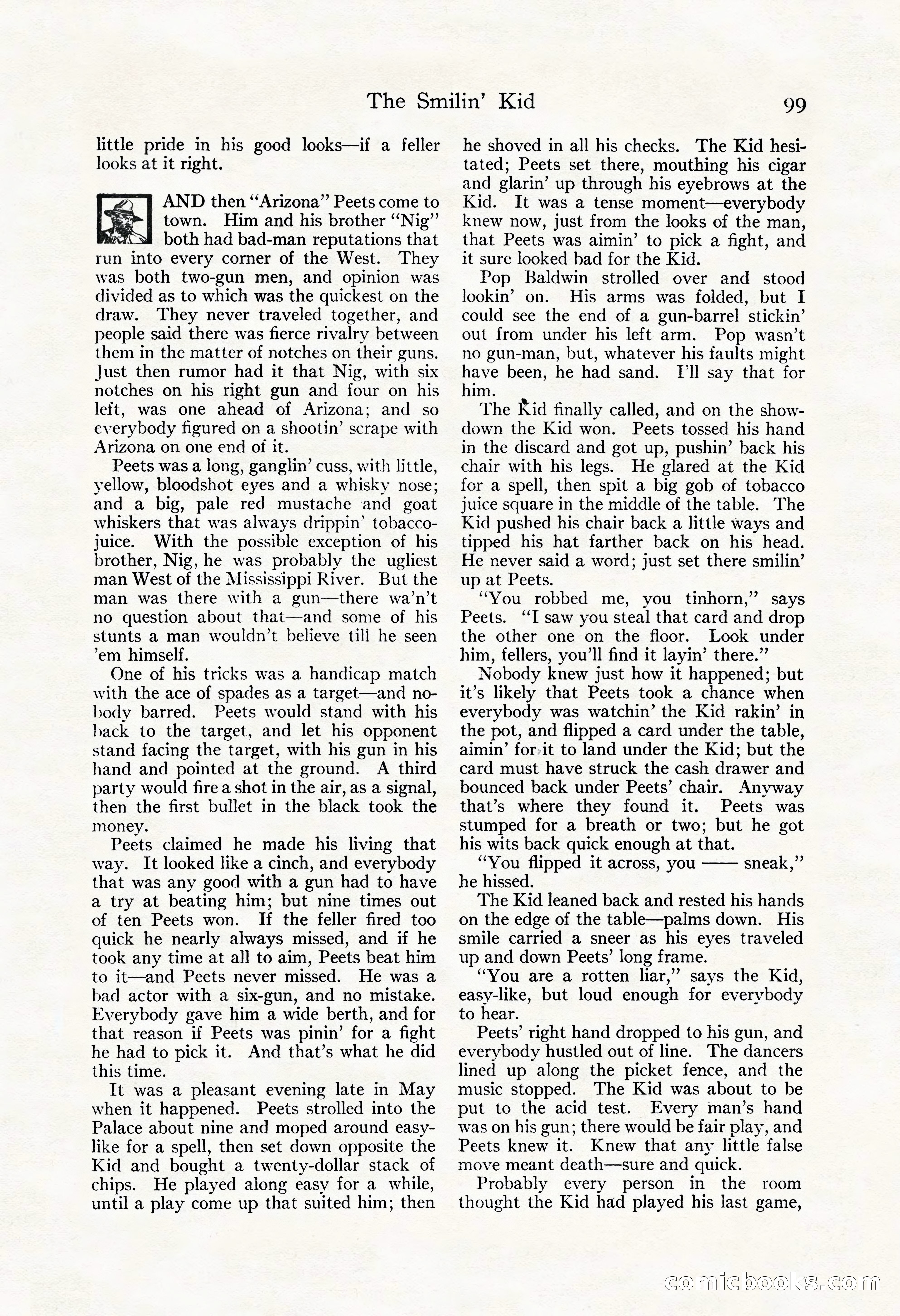
A restored page from Pulp Fiction, 1922. Page through the whole issue in the reader above.
📄 Transcribed text from this page (OCR, searchable)
Machine-transcribed from the original scan — historical spelling and the odd misread are preserved.
The Smilin’ Kid little pride in his good looks—if a feller looks at it right. AND then ‘“‘Arizona”’ Peets come to } town. Him and his brother “Nig” w4\ <A both had bad-man reputations that run into every corner of the West. They was both two-gun men, and opinion was divided as to which was the quickest on the draw. They never traveled together, and people said there was fierce rivalry between them in the matter of notches on their guns. Just then rumor had it that Nig, with six notches on his right gun and four on his left, was one ahead of Arizona; and so everybody figured on a shootin’ scrape with Arizona on one end of it. Peets was a long, ganglin’ cuss, with little, yellow, bloodshot eyes and a whisky nose; and a big, pale red mustache and goat whiskers that was always drippin’ tobacco- juice. With the possible exception of his brother, Nig, he was probably the ugliest man West of the Mississippi River. But the man was there with a gun—there wa’n’t no question about that—and some of his stunts a man wouldn’t believe tili he seen "em himself. One of his tricks was a handicap match with the ace of spades as a target—and no- body barred. Peets would stand with his hack to the target, and let his opponent stand facing the target, with his gun in his hand and pointed at the ground. A third party would fire a shot in the air, as a signal, then the first bullet in the black took the money. Peets claimed he made his living that way. It looked like a cinch, and everybody that was any good with a gun had to have a try at beating him; but nine times out of ten Peets won. If the feller fired too quick he nearly always missed, and if he took any time at all to aim, Peets beat him to it—and Peets never missed. He was a bad actor with a six-gun, and no mistake. Everybody gave him a wide berth, and for that reason if Peets was pinin’ for a fight he had to pick it. And that’s what he did this time. It was a pleasant evening late in May when it happened. Peets strolled into the Palace about nine and moped around easy- like for a spell, then set down opposite the Kid and bought a twenty-dollar stack of chips. He played along easy for a while, until a play come up that suited him; then 99 he shoved in all his checks. The Kid hesi- tated; Peets set there, mouthing his cigar and glarin’ up through his eyebrows at the Kid. It was a tense moment—everybody knew now, just from the looks of the man, that Peets was aimin’ to pick a fight, and it sure looked bad for the Kid. Pop Baldwin strolled over and stood lookin’ on. His arms was folded, but I could see the end of a gun-barrel stickin’ out from under his left arm. Pop wasn’t no gun-man, but, whatever his faults might have been, he had sand. IU'll say that for him. The Kid finally called, and on the show- down the Kid won. Peets tossed his hand in the discard and got up, pushin’ back his chair with his legs. He glared at the Kid for a spell, then spit a big gob of tobacco Juice square in the middle of the table. The Kid pushed his chair back a little ways and tipped his hat farther back on his head. He never said a word; just set there smilin’ up at Peets. “You robbed me, you tinhorn,” says Peets. “I saw you steal that card and drop the other one on the floor. Look under him, fellers, you’ll find it layin’ there.” Nobody knew just how it happened; but it’s likely that Peets took a chance when everybody was watchin’ the Kid rakin’ in the pot, and flipped a card under the table, aimin’ for-it to land under the Kid; but the card must have struck the cash drawer and bounced back under Peets’ chair. Anyway that’s where they found it. Peets was stumped for a breath or two; but he got his wits back quick enough at that. “You flipped it across, you —— sneak,” he hissed. The Kid leaned back and rested his hands on the edge of the table—palms down. His smile carried a sneer as his eyes traveled up and down Peets’ long frame. “You are a rotten liar,’ says the Kid, easy-like, but loud enough for everybody to hear. Peets’ right hand dropped to his gun, and everybody hustled out of line. The dancers lined up along the picket fence, and the music stopped. The Kid was about to be put to the acid test. Every man’s hand was on his gun; there would be fair play, and Peets knew it. Knew that any little false move meant death—sure and quick. Probably every person in the room thought the Kid had played his last game, (C@ DOOLK S C@