
Pulp Fiction, 1920 · page 28 of 208
Adventure Magazine Cover — page 28: what you’re looking at
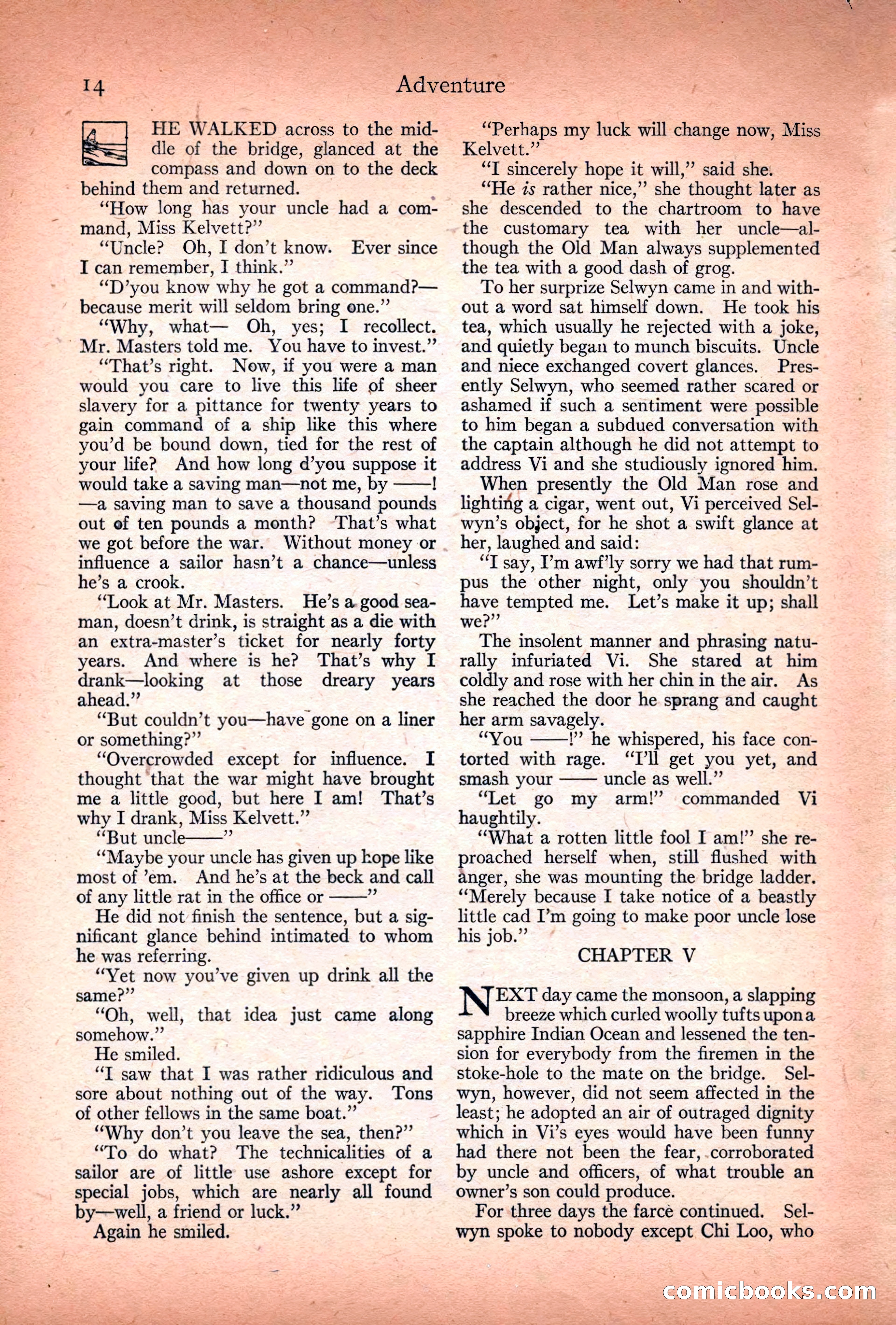
A restored page from Pulp Fiction, 1920. Page through the whole issue in the reader above.
📄 Transcribed text from this page (OCR, searchable)
Machine-transcribed from the original scan — historical spelling and the odd misread are preserved.
HE WALKED across to the mid- dle of the bridge, glanced at the compass and down on to the deck Behind them and returned. “How long has your uncle had a com- mand, Miss Kelvett?”’ “Uncle? Oh, I don’t know. Ever since I can remember, I think.” “T)’you know why he got a command?— - because merit will seldom bring one.” “Why, what— Oh, yes; I recollect. ' Mr. Masters told me. You have to invest.” “That’s right. Now, if you were a man would you care to live this life of sheer slavery for a pittance for twenty years to gain command of a ship like this where you’d be bound down, tied for the rest of your life? And how long d’you suppose it would take a saving man—not me, by ——! —a saving man to save a thousand pounds out of ten pounds a month? That’s what we got before the war. influence a sailor hasn’t a chance—unless he’s a crook. . “Took at Mr. Masters. He’s a. good sea- man, doesn’t drink, is straight as a die with an extra-master’s ticket for nearly forty years. And where is he? That’s why I drank—looking at those dreary years ahead.” : “But couldn’t you—have gone on a liner or something?” “Overcrowded except for influence. I thought that the war might have brought me a little good, but here I am! That’s why I drank, Miss Kelvett.” “But uncle—” “Maybe your uncle has given up kope like most of ’em. And he’s at the beck and call of any little rat in the office or He did not finish the sentence, but a sig- nificant glance behind intimated to whom he was referring. “Yet now you’ve given up drink all the same?” “Oh, well, that idea just came along somehow.” He smiled. “T saw that I was rather ridiculous and sore about nothing out of the way. Tons of other fellows in the same boat.” “Why don’t you leave the sea, then?” “To do what? The technicalities of a sailor are of little use ashore except for special jobs, which are nearly all found by—well, a friend or luck.” Again he smiled. Without money or | Kelvett.” — “I sincerely hope it will,” said hee “He zs rather nice,” she thought later as | or she descended to the chartroom to have == -the customary tea with her uncle—al- though the Old Man always supplemented the tea with a good dash of grog. To her surprize Selwyn came in and with- out a word sat himself down. He took his tea, which usually he rejected with a joke, and quietly began to munch biscuits. Uncle and niece exchanged covert glances. Pres- ently Selwyn, who seemed rather scared or ashamed if such a sentiment were possible to him began a subdued conversation with the captain although he did not attempt to address Vi and she studiously ignored him. When presently the Old Man rose and lightifig a cigar, went out, Vi perceived Sel- wyn’s object, for he shot a swift glance at her, laughed and said: “T say, I’m awf’ly sorry we had that rum- pus the other night, only you shouldn’t have tempted me. Let’s make it up; shall we?” The insolent manner and phrasing natu- rally infuriated Vi. She stared at him coldly and rose with her chin in the air. As she reached the door he sprang and caught her arm savagely. “You ——!” he whispered, his face con- torted with rage. ‘“T’ll get you yet, and smash your —— uncle as well.” “Let go my arm!” commanded Vi haughtily. “What a rotten little fool I am!” she re- proached herself when, still flushed with anger, she was mounting the bridge ladder. ““Merely because I take notice of a beastly little cad I’m going to make poor uncle lose his job.” CHAPTER V NE*! day came the monsoon, a slapping breeze which curled woolly tufts upona | sapphire Indian Ocean and lessened the ten- sion for everybody from the firemen in the stoke-hole to the mate on the bridge. Sel- wyn, however, did not seem affected in the least; he adopted an air of outraged dignity which in Vi’s eyes would have been funny had there not been the fear, .corroborated by uncle and officers, of what trouble an — owner’s son could produce. For three days the farce continued. Sel- wyn spoke to nobody except Chi Loo, who — 8 aS = > © - i. > — ee . . 2 —— ~~ a _ ~ » « od - ° ~ ,. “ a " f pe . Fe f he YY of ‘ , rite hs il f 3