
Pulp Fiction, 1920 · page 27 of 208
Adventure Magazine Cover — page 27: what you’re looking at
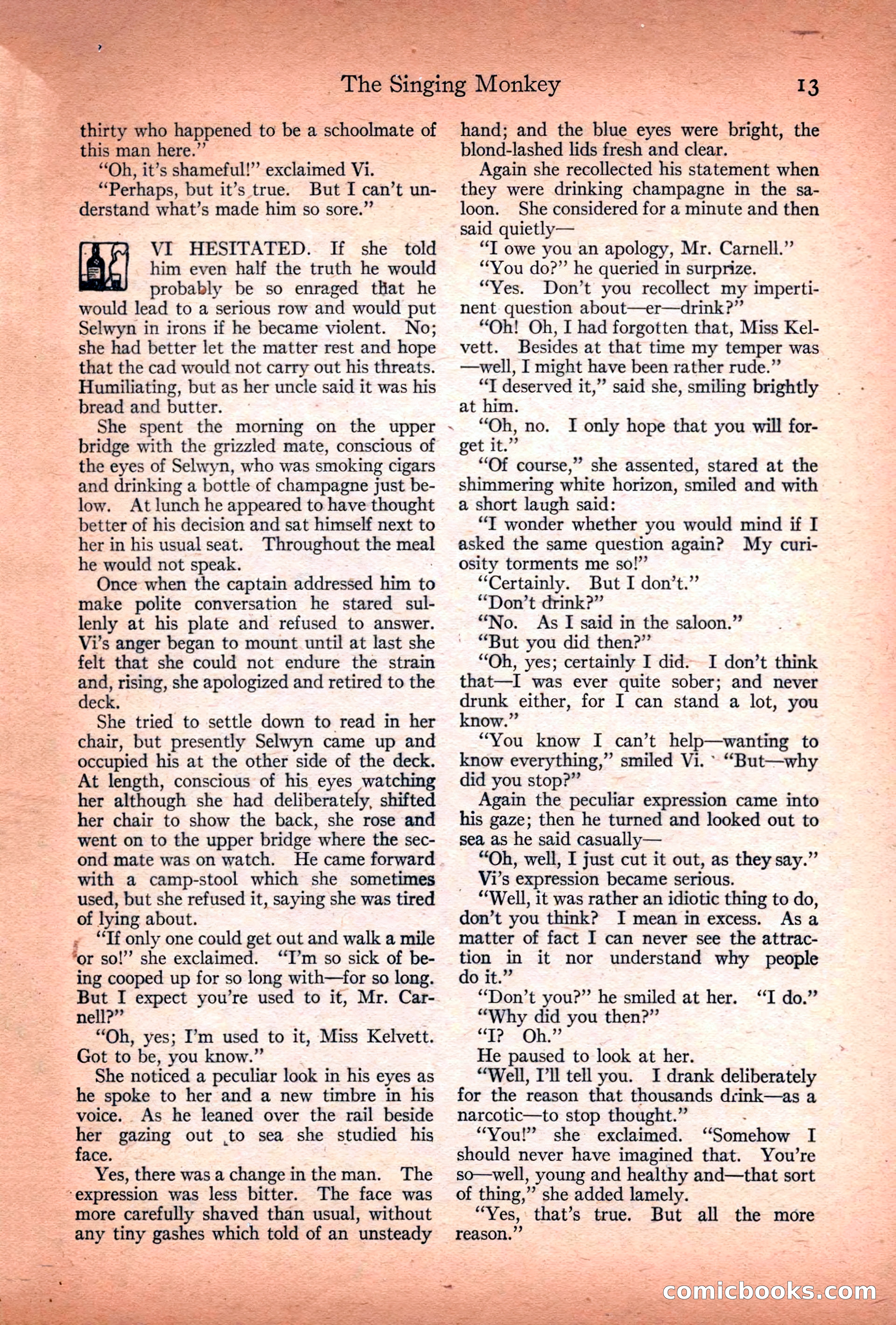
A restored page from Pulp Fiction, 1920. Page through the whole issue in the reader above.
📄 Transcribed text from this page (OCR, searchable)
Machine-transcribed from the original scan — historical spelling and the odd misread are preserved.
ae z thirty who happened to be a schoolmate of this man here.”’ | ~ “Oh, it’s shameful!” exclaimed Vi. “Perhaps, but it’s true. But I can’t un- derstand what’s made him so sore.” VI HESITATED. If she told him even half the truth he would = probably be so enraged that he would lead to a serious row and would put Selwyn in irons if he became violent. No; she had better let the matter rest and hope that the cad would not carry out his threats. Humiliating, but as her uncle said it was his bread and butter. She spent the morning on the upper - bridge with the grizzled mate, conscious of the eyes of Selwyn, who was smoking cigars and drinking a bottle of champagne just be- low. At lunch he appeared to have thought better of his decision and sat himself next to her in his usual seat. Throughout the meal he would not speak. . Once when the captain addressed him to make polite conversation he stared sul- lenly at his plate and refused to answer. Vi’s anger began to mount until at last she felt that she could not endure the strain and, rising, she apologized and retired to the deck. She tried to settle down to read in her chair, but presently Selwyn came up and occupied his at the other side of the deck. At length, conscious of his eyes watching her although she had deliberately, shifted her chair to show the back, she rose and went on to the upper bridge where the sec- ond mate was on watch. He came forward with a camp-stool which she sometimes used, but she refused it, saying she was tired of lying about. “Tf only one could get out and walk a mile r so!”’ she exclaimed. “I’m so sick of be- ing cooped up for so long with—for so long. But I expect you’re used to it, Mr. Car- nell?” “Oh, yes; I’m used to it, Miss Kelvett. Got to be, you know.” She noticed a peculiar look in his eyes as he spoke to her and a new timbre in his voice. As he leaned over the rail beside her gazing out to sea she studied his face. Yes, there wasa change inthe man. The expression was less bitter. The face was more carefully shaved than usual, without _ any tiny gashes which told of an unsteady ae = hand; and the blue eyes were bright, the blond-lashed lids fresh and clear. Again she recollected his statement when they were drinking champagne in the sa- loon. She considered for a minute and then said quietly— “T owe you an apology, Mr. Carnell.” “You do?” he queried in surprize. “Yes. Don’t you recollect my imperti- nent question about—er—drink?”’ “Oh! Oh, I had forgotten that, Miss Kel- vett. Besides at that time my temper was —well, I might have been rather rude.” | “T deserved it,” said she, smiling brightly at him. “Oh, no. get it.” “Of course,” she assented, stared at the shimmering white horizon, smiled and with a short laugh said: “TY wonder whether you would mind if I asked the same question again? My curi- osity torments me so!”’ “Certainly. But I don’t.” “Don’t drink?” “No. As I said in the saloon.” “But you did then?” “Oh, yes; certainly I did. I don’t think that—I was ever quite sober; and never drunk either, for I can stand a lot, you know.” “You know I can’t help—wanting to know everything,” smiled Vi. * “But—why did you stop?” Again the peculiar expression came into his gaze; then he turned and looked out to sea as he said casually— “Oh, well, I just cut it out, as they say.” Vi’s expression became serious. “Well, it was rather an idiotic thing to do, don’t you think? I mean in excess. Asa matter of fact I can never see the attrac- tion in it nor understand why people do it.” “Don’t you?” he smiled at her. “TI do.” “Why did you then?” he On,” He paused to look at her. “Well, Pll tell you. I drank deliberately for the reason that thousands drink—as a narcotic—to stop thought.” “You!” she exclaimed. “Somehow I should never have imagined that. You’re so—well, young and healthy and—that sort of thing,”’ she added lamely. “Yes, that’s true. But all the more I only hope that you will for-