
Pulp Fiction, 1920 · page 29 of 208
Adventure Magazine Cover — page 29: what you’re looking at
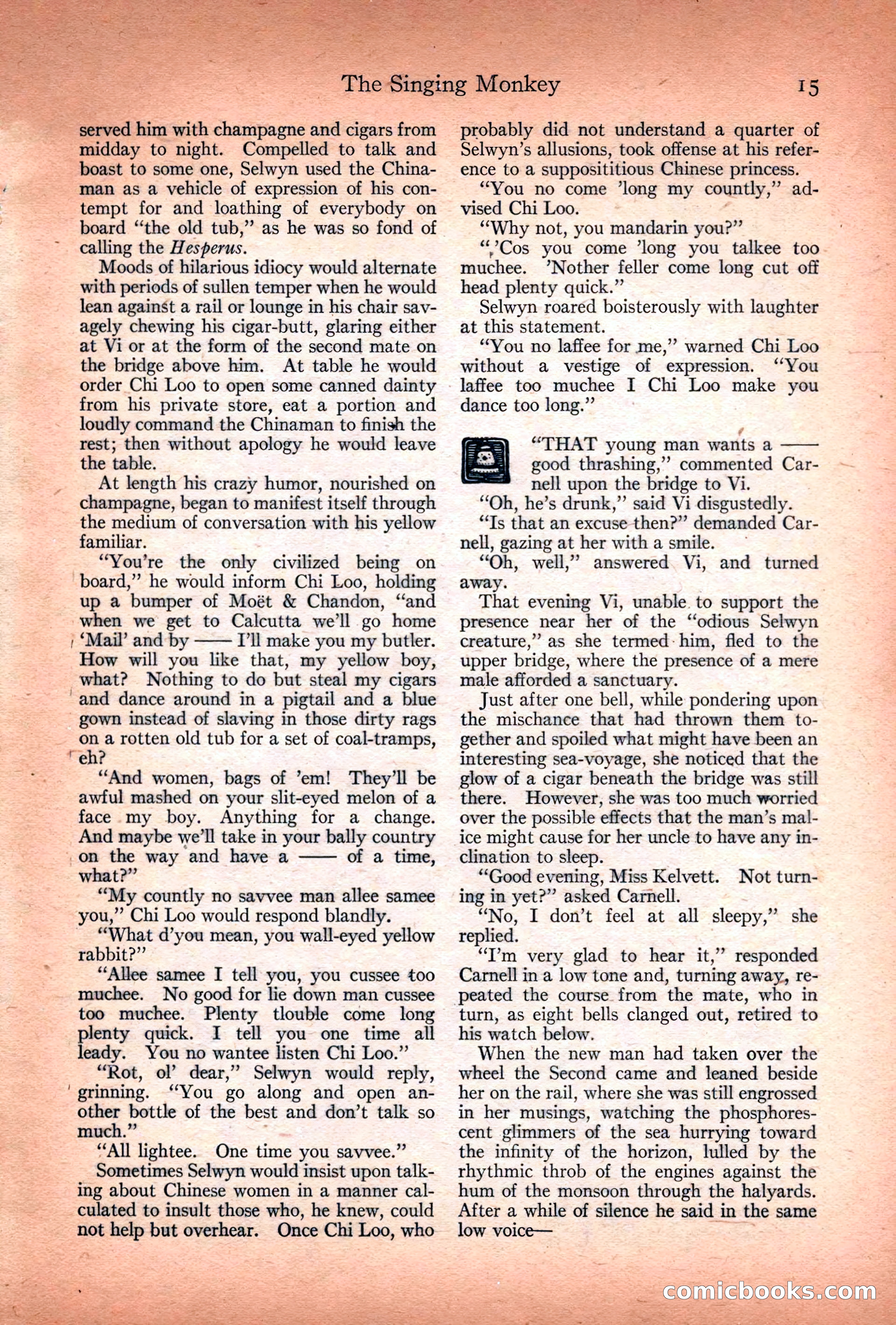
A restored page from Pulp Fiction, 1920. Page through the whole issue in the reader above.
📄 Transcribed text from this page (OCR, searchable)
Machine-transcribed from the original scan — historical spelling and the odd misread are preserved.
to night. Compelled to talk and th chateaus antic cigars ne vate - probably did 1 not uate a quarter « ’ Selwyn’s allusions, took offense at his refer- = boast to some one, Selwyn used the China- " + man as a vehicle of expression of his con- tempt for and loathing of everybody on board “the old tub,” as he was so fond of ~ calling the Hesperus. Moods of hilarious idiocy would alternate with periods of sullen temper when he would _ Jean against a rail or lounge in his chair sav- -agely chewing his cigar-butt, glaring either _ at Vi or at the form of the second mate on the bridge above him. At table he would order Chi Loo to open some canned dainty | _ from his private store, eat a portion and __~ loudly command the Chinaman to finish the ___- rest; then without apology he would leave “.. the table. = At length his crazy humor, nourished on = champagne, began to manifest itself through the medium of conversation with his yellow familiar. “You’re the only civilized being on = board,” he would inform Chi Loo, holding = 4 upa ‘bumper of Moét & Chandon, “and when we get to Calcutta we'll go home | ‘Mail’ and by —— I’ll make you my butler. How will you like that, my yellow boy, had _ what? Nothing to do but steal my cigars ~~ ‘and dance around in a pigtail and a blue gown instead of slaving in those dirty rags ona rotten old tub for a set of coal-tramps, = sues -t eh? *. “And women, bags of ’em! They'll be awful mashed on your slit-eyed melon of a . SS _ face my boy. Anything for a change. 3 _ And maybe we’ll take in your bally country = on the way and have a —— of a time, == what?” “My countly no savvee man allee samee __-you,”” Chi Loo would respond blandly. “What d’you mean, you wall-eyed yellow rabbit?” Be: “Allee samee I tell you, you cussee too _. muchee. No good for lie down man cussee 2s too muchee. Plenty tlouble come long plenty quick. I tell you one time all leady. You no wantee listen Chi Loo.” “Rot, ol’ dear,” Selwyn would reply, grinning. “You go along and open an- = ae bottle of the best and don’t talk so “All lightee. One time you savvee.’ Sometimes Selwyn would insist upon ‘it Ban ing about Chinese women in a manner cal- “ae Sa 0 to shawl Sie who, he ah could ence to a supposititious Chinese princess. _ ~ “You no come ‘long my countly,” ad- vised Chi Loo. “Why not, you mandarin you?” “’Cos you come ‘long you talkee too. muchee. ’Nother feller come long cut off head plenty quick.” Selwyn roared boisterously with laughter at this statement. “You no laffee for me,” warned Chi Loo without a vestige of expression. ‘You laffee too muchee I Chi Loo make you dance too long.” ¢ “THAT young man wants a peg) §=good thrashing,’ commented Car- —— nell upon the bridge to Vi. “Oh, he’s drunk,” said Vi disgustedly. “Ts that an excuse then?” demanded Car- nell, gazing at her with a smile. “Oh, well,” answered. Vi, away. and turned That evening Vi, unable. to support the presence near her ‘of the “odious Selwyn creature,” as she termed-him, fled to the upper bridge, where the presence of a mere male afforded a sanctuary. Just after one bell, while pondering upon the mischance that had thrown them to- gether and spoiled what might have been an interesting sea-voyage, she noticed that the glow of a cigar beneath the bridge was still there. However, she was too much worried over the possible effects that the man’s mal- ice might cause for her uncle to have any in- clination to sleep. “Good evening, Miss Kelvett. ing in yet?” asked Carnell. “No, I don’t feel at all sleepy,” she replied. “I’m very glad to hear it,” responded Carnell in a low tone and, turning away, re- Not turn- peated the course from the mate, who in turn, as eight bells clanged out, retired to his watch below. When the new man had taken over the wheel the Second came and leaned beside her on the rail, where she was still engrossed in her musings, watching the phosphores- cent glimmers of the sea hurrying toward the infinity of the horizon, lulled by the rhythmic throb of the engines against the hum of the monsoon through the halyards. After a while of silence he said in the same ws voice— az eT: c*%