
Pulp Fiction, 1917 · page 77 of 228
Adventure, February 1917 — page 77: what you’re looking at
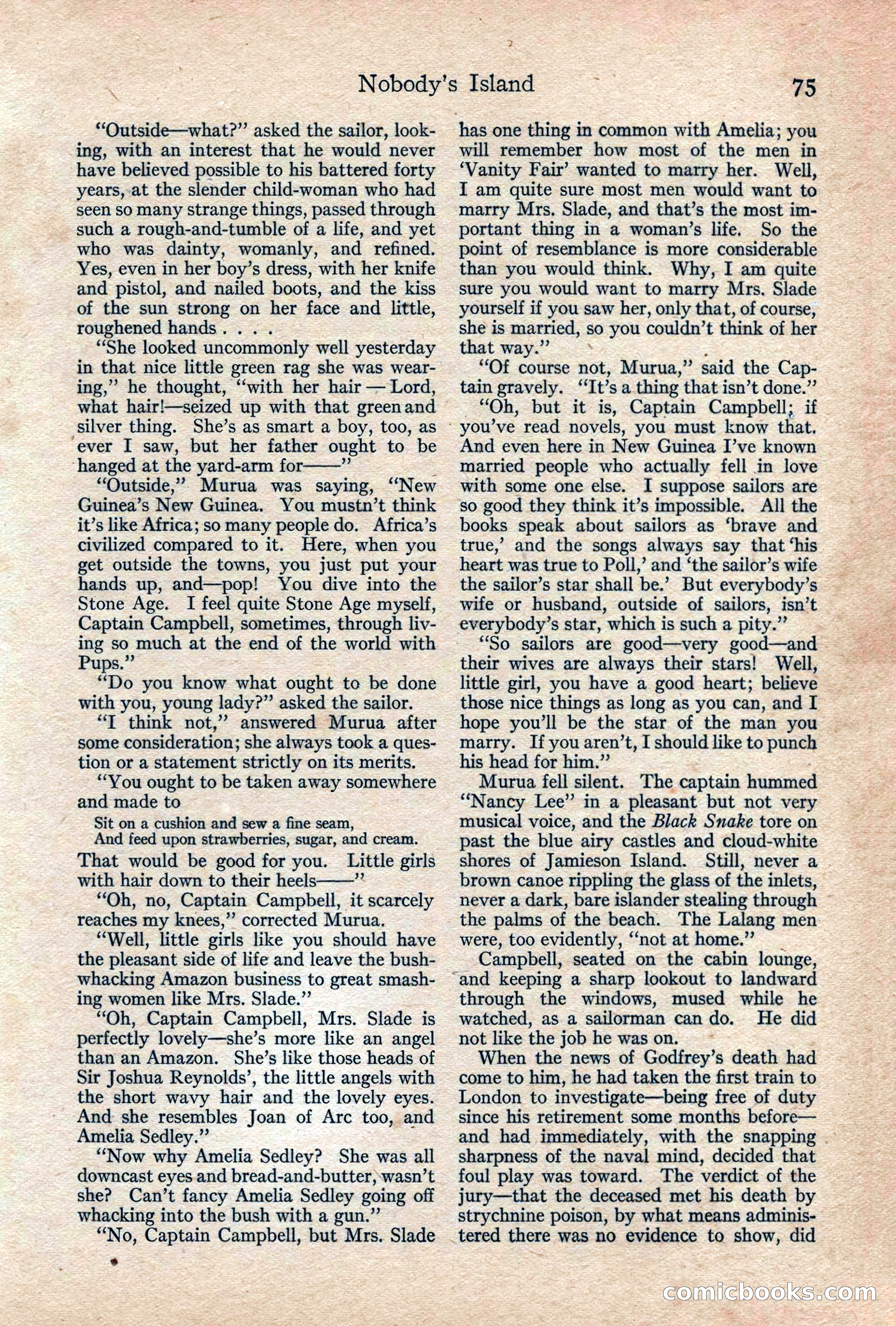
A restored page from Pulp Fiction, 1917. Page through the whole issue in the reader above.
📄 Transcribed text from this page (OCR, searchable)
Machine-transcribed from the original scan — historical spelling and the odd misread are preserved.
Nobody’s Island Ase *Outside—what?” asked the sailor, look- ing, with an interest that he would never have believed possible to his battered forty years, at the slender child-woman who had seen so many strange things, passed through such a rough-and-tumble of a life, and yet who was dainty, womanly, and refined. Yes, even in her boy’s dress, with her knife and pistol, and nailed boots, and the kiss of the sun strong on her face and little, roughened hands... . “She looked uncommonly well yesterday in that nice little green rag she was wear- ing,” he thought, “with her hair — Lord, what hair!—seized up with that greenand silver thing. She’s as smart a boy, too, as ‘ever I saw, but her father ought to be ‘hanged at the yard-arm for “Outside,” Murua was saying, “New Guinea’s New Guinea. You mustn’t think it’s like Africa; so many people do. Africa’s civilized compared to it. Here, when you get outside the towns, you just put your hands up, and—pop! You dive into the Stone Age. I feel quite Stone Age myself, Captain Campbell, sometimes, through liv- ing so much at the end of the world with Pups.” “Do you know what ought to be done with you, young lady?” asked the sailor. “T think not,” answered Murua after some consideration; she always took a ques- tion or a statement strictly on its merits. “You ought to be taken away somewhere and made to Sit on a cushion and sew a fine seam, And feed upon strawberries, sugar, and cream. That would be good for you. Little girls with hair down to their heels a “Oh, no, Captain Campbell, it scarcely reaches my knees,” corrected Murua. “Well, little girls like you should have the pleasant side of life and leave the bush- whacking Amazon business to great smash- ing women like Mrs. Slade.” “Oh, Captain Campbell, Mrs. Slade is perfectly lovely—she’s more like an angel than an Amazon. She’s like those heads of Sir Joshua Reynolds’, the little angels with the short wavy hair and the lovely eyes. And she resembles Joan of Arc too, and Amelia Sedley.” “Now why Amelia Sedley? She was all downcast eyes and bread-and-butter, wasn’t she? Can’t fancy Amelia Sedley going off whacking into the bush with a gun.” “No, Captain Campbell, but Mrs. Slade ° 2 75 has one thing in common with Amelia; you will remember how most of the men in ‘Vanity Fair’ wanted to marry her. Well, I am quite sure most men would want to marry Mrs. Slade, and that’s the most im- portant thing in a woman’s life, So the point of resemblance is more considerable than you would think. Why, I am quite sure you would want to marry Mrs. Slade yourself if you saw her, only that, of course, she is married, so you couldn’t think of her that way.” “Of course not, Murua,” said the Cap- tain gravely. “It’s a thing that isn’t done.” “Oh, but it is, Captain Campbell; if ‘ you’ve read novels, you must know that, And even here in New Guinea I’ve known married people who actually fell in love with some one else. I suppose sailors are so good they think it’s impossible. All the books speak about sailors as ‘brave and true,’ and the songs always say that ‘his heart was true to Poll,’ and ‘the sailor’s wife the sailor’s star shall be.’ But everybody’s wife or husband, outside of sailors, isn’t everybody’s star, which is such a pity.” “So sailors are good—very good—and their wives are always their stars! Well, little girl, you have a good heart; believe those nice things as long as you can, and I hope you'll be the star of the man you marry. Ifyou aren't, I should like to punch his head for him.” Murua fell silent. The captain hummed ‘Nancy Lee” in a pleasant but not very musical voice, and the Black Snake tore on past the blue airy castles and cloud-white shores of Jamieson Island. Still, never a . brown canoe rippling the glass of the inlets, never a dark, bare islander stealing through © the palms of the beach. The Lalang men were, too evidently, ‘‘not at home.” Campbell, seated on the cabin lounge, “and keeping a sharp lookout to landward through the windows, mused while he watched, as a sailorman cando. He did not like the job he wason. ~ When the news of Godfrey’s death had come to him, he had taken the first train to London to investigate—being free of duty since his retirement some months before— and had immediately, with the snapping . sharpness of the naval mind, decided that foul play was toward. The verdict of the jury—that the deceased met his death by a eechnile poison, by what means adminis- tered there was no evidence to show, did 0\(0\(6) S (EC) EGOMIG