
Pulp Fiction, 1917 · page 76 of 228
Adventure, February 1917 — page 76: what you’re looking at
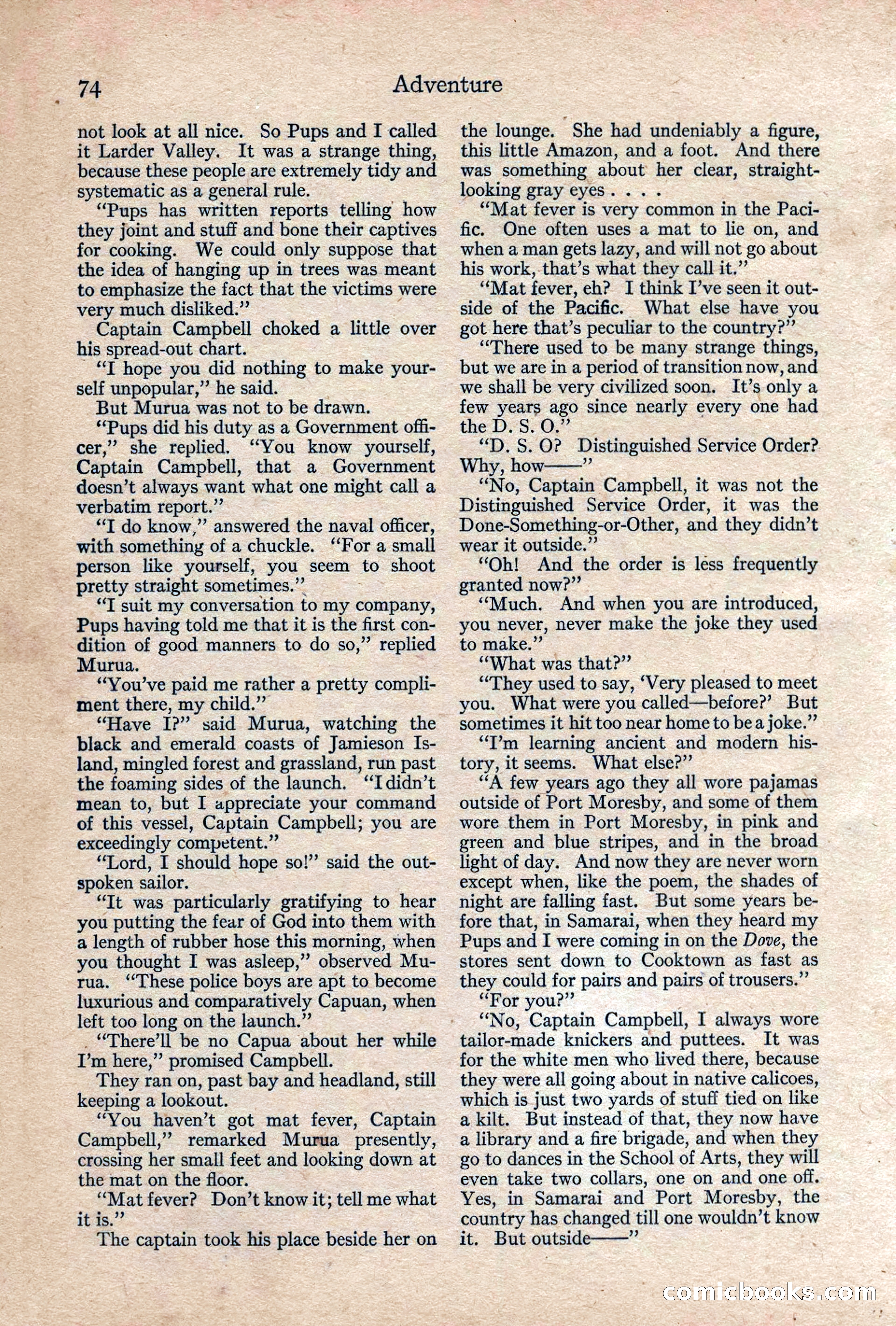
A restored page from Pulp Fiction, 1917. Page through the whole issue in the reader above.
📄 Transcribed text from this page (OCR, searchable)
Machine-transcribed from the original scan — historical spelling and the odd misread are preserved.
74 not look at all nice. So Pups and I called it Larder Valley. It was a strange thing, because these people are extremely tidy and systematic as a general rule. : “Pups has written reports telling how they joint and stuff and bone their captives for cooking. We could only suppose that the idea of hanging up in trees was meant to emphasize the fact that the victims were very much disliked.” Captain Campbell choked a little over his spread-out chart. “T hope you did nothing to make your- self unpopular,” he said. . But Murua was not to be drawn. ‘Pups did his duty as a Government offi- cer,” she replied. “You know yourself, Captain Campbell, that a Government doesn’t always want what one might call a verbatim report.”’ “T do know,”’ answered the naval officer, with something of a chuckle. ‘‘For a small person like yourself, you seem to shoot pretty straight sometimes.” “T suit my conversation to my company, Pups having told me that it is the first con- dition of good manners to do so,” replied Murua. ““You’ve paid me rather a pretty compli- ment there, my child.” “Have I?” said Murua, watching the black and emerald coasts of Jamieson Is- land, mingled forest and grassland, run past the foaming sides of the launch. ‘“Ididn’t mean to, but I appreciate your command of this vessel, Captain Campbell; you are exceedingly competent.”’ “Lord, I should hope so!’’ said the out- spoken sailor. “Tt was particularly gratifying to hear you putting the fear of God into them with -a length of rubber hose this morning, when you thought I was asleep,” observed Mu- rua. “These police boys are apt to become luxurious and comparatively Capuan, when left too long on the launch.” _ “There'll be no Capua about her while I’m here,”’ promised Campbell. They ran on, past bay and headland, still keeping a lookout. “You haven’t got mat fever, Captain Campbell,” remarked Murua presently, crossing her small feet and looking down at the mat on the floor. ““Mat fever? Don’t know it; tell me what it is.” The captain took his place beside her on Adventure the lounge. She had undeniably a figure, this little Amazon, and a foot. And there was something about her clear, straight- looking gray eyes... . “Mat fever is very common in the Paci- fic. One often uses a mat to lie on, and when a man gets lazy, and will not go about his work,-that’s what they call it.”’ “‘Mat fever, eh? I think I’ve seen it out- side of the Pacific. What else have you got here that’s peculiar to the country?” “There used to be many strange things, but we are in a period of transition now, and we shall be very civilized soon. It’s only a few years ago since nearly every one had the D<s7O “D.S.O? Distinguished Service Order?. Why, how——” “No, Captain Campbell, it was not the Distinguished Service Order, it was the Done-Something-or-Other, and they didn’t wear it outside.” “Oh! And the order is less frequently granted now?” 3 ‘‘Much. And when you are introduced, you never, never make the joke they used to make.” — “What was that?” “They used to say, ‘Very pleased to meet you. What were you called—before?’ But sometimes it hit too near home to bea joke.” “T’m learning ancient and modern his- tory, it seems. What else?’’ “A few years ago they all wore pajamas outside of Port Moresby, and some of them wore them in Port Moresby, in pink and green and blue stripes, and in the broad light of day. And now they are never worn except when, like the poem, the shades of night are falling fast. But some years be- fore that, in Samarai, when they heard my Pups and I were coming in on the Dove, the stores sent down to Cooktown as fast as they could for pairs and pairs of trousers.”’ “For you?” eae “No, Captain Campbell, I always wore tailor-made knickers and puttees. It was for the white men who lived there, because they were all going about in native calicoes, which is just two yards of stuff tied on like a kilt. But instead of that, they now have a library and a fire brigade, and when they go to dances in the School of Arts, they will even take two collars, one on and one off. Yes, in Samarai and Port Moresby, the country has changed till one wouldn’t know it. But outside——” | (E(0) IOOKk (CO) 3