
Pulp Fiction, 1917 · page 78 of 228
Adventure, February 1917 — page 78: what you’re looking at
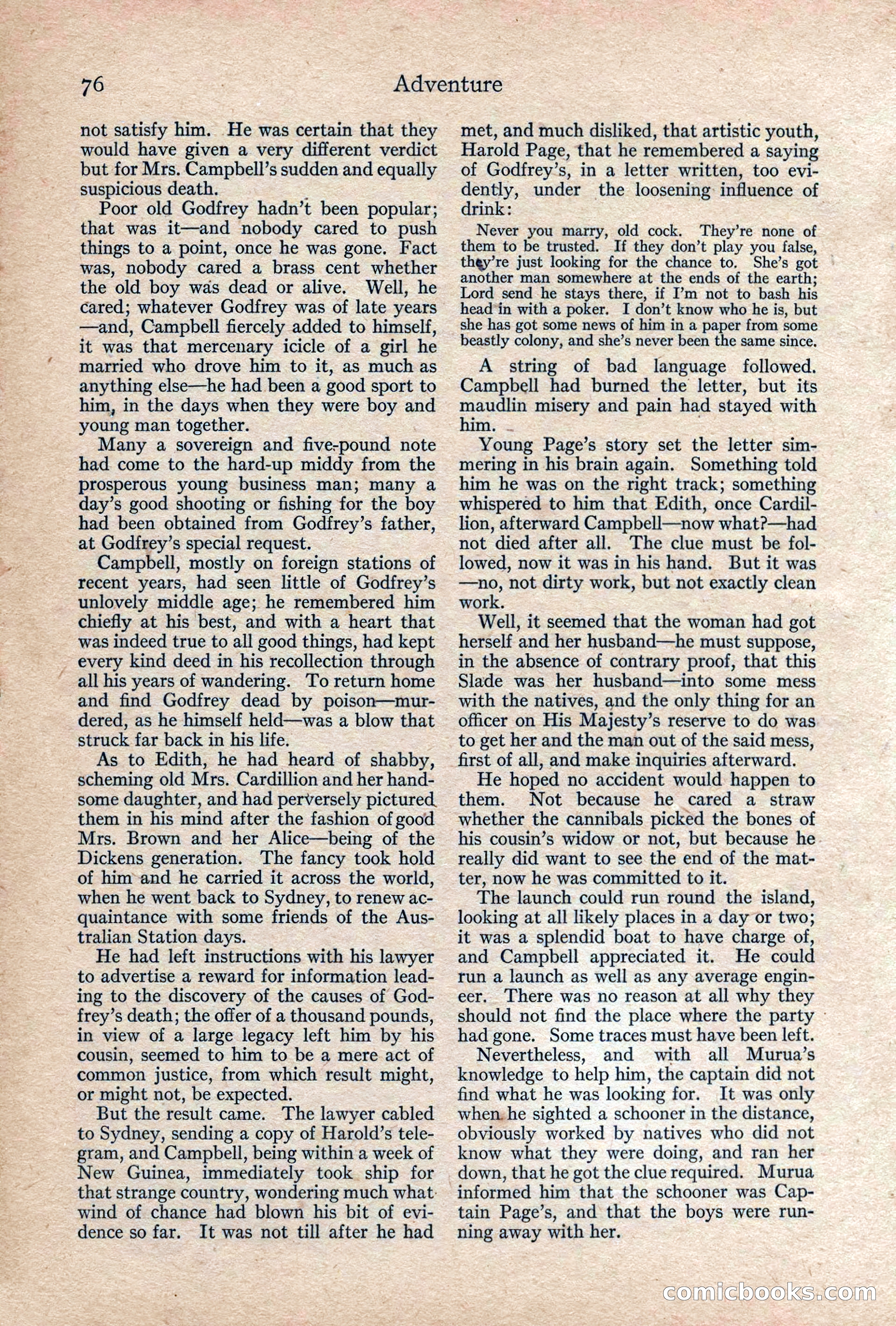
A restored page from Pulp Fiction, 1917. Page through the whole issue in the reader above.
📄 Transcribed text from this page (OCR, searchable)
Machine-transcribed from the original scan — historical spelling and the odd misread are preserved.
76 . | Adventure not satisfy him. He was certain that they would have given a very different verdict but for Mrs. Campbell’s sudden and equally suspicious death. Poor old Godfrey hadn’t been popular; that was it—and nobody cared to push things to a point, once he was gone. Fact was, nobody cared a brass cent whether the old boy was dead or alive. Well, he cared; whatever Godfrey was of late years —and, Campbell fiercely added to himself, it was that mercenary icicle of a girl he married who drove him to it, as much as anything else—he had been a good sport to him, in the days when they were boy and young man together. Many a sovereign and five-pound note had come to the hard-up middy from the prosperous young business man; many a day’s good shooting or fishing for the boy had been obtained from Godfrey’s father, at Godfrey’s special request. Campbell, mostly on foreign stations of recent years, had seen little of Godfrey’s unlovely middle age; he remembered him chiefly at his best, and with a heart that was indeed true to all good things, had kept every kind deed in his recollection through all his years of wandering. To return home and find Godfrey dead by poison—mur- dered, as he himself held—was a blow that struck far back in his life. As to Edith, he had heard of shabby, scheming old Mrs. Cardillion and her hand- some daughter, and had perversely pictured. them in his mind after the fashion of good Mrs. Brown and her Alice—being of the Dickens generation. The fancy took hold of him-and he carried it across the world, when he went back to Sydney, to renew ac- quaintance with some friends of the Aus- tralian Station days. He had left instructions with his lawyer to advertise a reward for information lead- ing to the discovery of the causes of God- frey’s death; the offer of a thousand pounds, in view of a large legacy left him by his cousin, seemed to him to be a mere act of common justice, from which result might, or might not, be expected. But the result came. The lawyer cabled to Sydney, sending a copy of Harold’s tele- gram, and Campbell, being within a week of New Guinea, immediately took ship for that strange country, wondering much what: - wind of chance had blown his bit of evi- dence so far. It was not till after he had met, and much disliked, that artistic youth, Harold Page, that he remembered a saying of Godfrey’s, in a letter written, too evi- dently, under the loosening influence of drink: Never you marry, old cock. They’re none of them to be trusted. If they don’t play you false, they’re just looking for the chance to, She’s got another man somewhere at the ends of the earth; Lord send he stays there, if I’m not to bash his headin with a poker. I don’t know who he is, but she has got some news of him in a paper from some beastly colony, and she’s never been the same since. A string of bad language followed. Campbell had burned the letter, but its maudlin misery and pain had stayed with him. - Young Page’s story set the letter sim- mering in his brain again. Something told him he was on the right track; something whispered to him that Edith, once Cardil- lion, afterward Campbell—now what?—had not died after all. The clue must be fol- lowed, now it was in his hand. But it was —no, not dirty work, but not exactly clean work. Well, it seemed that the woman had got herself and her husband—he must suppose, in the absence of contrary proof, that this Slade was her husband—into some mess with the natives, and the only thing for an officer on His Majesty’s reserve to do was to get her and the man out of the said mess, first of all, and make inquiries afterward. He hoped no accident would happen to them. Not because he cared a straw whether the cannibals picked the bones of his cousin’s widow or not, but because he really did want to see the end of the mat- ter, now he was committed to it. The launch could run round the island, looking at all likely places in a day or two; it was a splendid boat to have charge of, and Campbell appreciated it. He could run a launch as well as any average engin- eer. There was no reason at all why they should not find the place where the party ~ had gone. Some traces must have been left. Nevertheless, and with all Murua’s knowledge to help him, the captain did not find what he was looking for. It was only when. he sighted a schooner in the distance, obviously worked by natives who did not know what they were doing, and ran her down, that he got the clue required. Murua informed him that the schooner was Cap- tain Page’s, and that the boys were run- ning away with her. Ceonnicooolks